

The East India Company flew a distinctive flag that underwent several modifications during the company's existence from its incorporation by royal charter granted by Queen Elizabeth I on December 31, 1600, until the formal dissolution of the company on June 1, 1874. The company's flag is one of the oldest commercial flags in recorded history and its design influenced the development of several subsequent national flags. The earliest known version of the company's flag consisted of horizontal red and white stripes with the Saint George's Cross displayed on a canton in the upper left. The number of stripes varied across different periods and different productions, with versions bearing nine, eleven, thirteen, and fifteen stripes documented in contemporary illustrations and surviving flag records. The red and white stripes represented the company's English commercial identity, whilst the Saint George's Cross in the canton asserted the company's connection to the English Crown and its chartered authority. Following the Acts of Union of 1707 which united the kingdoms of England and Scotland into the Kingdom of Great Britain, the canton was modified to incorporate the Union Jack, replacing the Saint George's Cross. This reflected the company's transition from an English to a British chartered entity operating under the authority of the British Crown. The Union Jack canton was further updated following the Act of Union of 1801 which incorporated Ireland into the United Kingdom, with the addition of the Saint Patrick's Cross to the canton producing the version of the Union Jack that remains in use today. The company's flag therefore displayed the post-1801 Union Jack in the canton with the red and white horizontal stripes extending across the remainder of the field from 1801 until the company's dissolution. The company's flag was flown at the company's principal installations across its vast commercial and territorial empire. In India, the flag flew at the three presidency capitals of Fort William in Calcutta, Fort Saint George in Madras, and Bombay Castle. The flag was raised at Fort William on the establishment of the Calcutta settlement and flew continuously except during the period of Siraj ud-Daulah's capture of the fort on June 20, 1756, the event that produced the Black Hole of Calcutta, until the British recapture under Robert Clive on January 2, 1757. The flag flew at numerous other installations across the Indian subcontinent, at the company's factories and trading posts in China including the Canton factories, at Penang, Malacca, and Singapore in the Straits Settlements, at Aden, at Bencoolen and other posts in Sumatra, at Saint Helena in the South Atlantic, and at the company's headquarters at East India House on Leadenhall Street in the City of London. The company also maintained its own naval force, the Bombay Marine, subsequently renamed the Indian Navy, whose vessels flew the company's striped flag as their ensign. The company's merchant vessels, known as East Indiamen, flew the company's flag when operating in waters east of the Cape of Good Hope, where the company held its monopoly trading rights, and the standard British Red Ensign when operating in Atlantic waters west of the Cape. The resemblance between the East India Company flag and the flag of the United States of America, adopted on June 14, 1777, has generated sustained scholarly discussion. Both flags feature red and white horizontal stripes with a canton bearing a device in the upper left, and the visual similarity has led some historians to argue that the company's flag served as a direct inspiration for the American flag. Charles Fawcett advanced this thesis in a detailed study, noting that the company's flag was widely known in the American colonies, where the company's tea had been the subject of the Boston Tea Party on December 16, 1773. Other scholars have disputed a direct connection, arguing that the stripes on the American flag derived from other sources including the flag of the Sons of Liberty. The company's flag ceased to fly over Indian territory following the Government of India Act of 1858, which transferred the company's governmental functions to the British Crown in the aftermath of the Indian Rebellion of 1857. The Union Jack and subsequently the Blue Ensign bearing the Star of India badge replaced the company's striped flag at installations across India. The company continued to exist as a corporate entity until its formal dissolution on June 1, 1874, but its flag had effectively ceased to serve any practical function from 1858 onwards.

 1801-1857
 The East India Company flag changed over time. From the period of 1600 to 1707 (Act of Union between England and Scotland) the flag consisted of a St George's cross in the canton and a number of alternating Red and White stripes. After 1707 the canton contained the original Union Flag consisting of a combined St George's cross and a St Andrew's cross. After the Act of Union 1800, that joined Ireland into the United Kingdom, the canton of the East India Company's flag was altered accordingly to include the new Union Flag with the additional St Patrick's cross. There has been much debate and discussion regarding the number of stripes on the flag and the order of the stripes. Historical documents and paintings show many variations from 9 to 13 stripes, with some images showing the top stripe being red and others showing the top stripe being white.It has been suggested that the stripes were inspired by the flag of the Majapahit Empire, whose flags may still have flown across the Spice Islands in the Company's early days.
At the time of the American Revolution the East India Company flag would have been identical to the Grand Union Flag. The flag probably inspired the Stars and Stripes (as argued by Sir Charles Fawcett in 1937). Comparisons between the Stars and Stripes and the Company's flag from historical records present some convincing arguments. The John Company flag dates back to the 1600s whereas the United States adopted the Stars and Stripes in 1777.
The stripes and gridlike appearance of the flag gave rise to several pieces of imperial slang. Most notably is the phrase 'riding the gridiron'; this referred to travelling on a ship flying the company flag to/from India.

- Ensign of Indian Marine 1879 to 1891.
- Ensign of Royal Indian Marine 1891 to 11 November 1928.
- Jack of Royal Indian Marine 1 November 1928 to 1934.
- Jack of Royal Indian Navy 1934 to 1947.
The Star of India and is a combination of a sun and a star and a garter. The centre is a five-pointed star, one point at 12 o'clock, with lines from the centre to each point and from the centre to the indentation between each point, thus giving the star a three-dimensional appearance. Around the star is a circular band, tied at the bottom with a small tidy knot that projects only a little beyond the circumference of the band. The points of the star overlap the inner edge of the band by about one third of its width, and on the band is written in upper case letters with a dot at half height between each word, 'HEAVENS LIGHT OUR GUIDE', starting at the 7 o'clock point of the star and finishing at the 5 o'clock point. Projecting beyond the band are 16 slightly wavy sun's rays, alternating with 16 slightly smaller wavy rays. The proportions are:
centre to a point of the star 8.5 units
band 5 units
long ray 10 units
short ray 8 units.
total radius 22 units (the star overlaps the band)

Some versions have 26+26 rays with a greater difference between the length of the long and short rays so that the short rays have in total, a more circular outline with the long rays appearing to project out from the circumference of a circle. The rays and the star are yellow (gold?), and the band and background to the star is pale blue (silver?). On the star there's a certain amount of irregular shading which tends to be concentrated to the left of the lines running from the centre to the points and to the right of the lines running from the centre to the indentations. David Prothero


The ensign of the Royal Indian Marine made of wool bunting with a cotton hoist, machine sewn at the ends and the sides are the selvedges of the fabric. A cord is attached for hoisting. The design is entirely printed onto the surface of the fabric. The flag has a blue field with a Union Flag in the canton. In the fly is a badge with a star surrounded by a band inscribed 'HEAVENS LIGHT OUR GUIDE' within the sun's rays. The design was warranted by the Admiralty to the Indian Marine in 1877. It was used as an ensign until 1928. From 1928-47 it was used as a jack.
Merchant ensign


6 feet by 4 feet

35 1/2 inches wide and 23 inches high. The "Annin" manufacturer's label is on the side.


Vintage "Ever Wear" 3'x5' Cotton 15-Piece


3’x5’ Cotton

52" x 26"


 Personal flag made for me by Artelina of Brisbane
 The Union Flag defaced in the centre with the badge surmounted by a crown, no white disc, no garland:
- Viceroy and Governor General afloat in Indian Waters c1885 to 1947. Hoisted at main masthead.
- Hoisted at the foremasthead it indicated the presence of a subordinate Governor, Lieutenant- Governor, Chief Commissioner or Political Officer.
- Also hoisted at the fore by Political Resident Persian Gulf, or subordinate Political Officer within the limits of his jurisdiction, or on duty elsewhere.

British-Indian hockey players arrive in Holland for the 1928 Olympic games.


Left: Star of India from vintage red ensign


The ensign of local naval vessels is a usual defaced blue ensign. The badge is a golden lion rampant guardant holding in front paws a crown. Željko Heimer

In 1880 a Blue Ensign defaced with the badge of the Port Trust of Bombay was sanctioned by the Admiralty. It was followed in 1883 by one for the Port Trust of Calcutta. At the suggestion of Rear Admiral Sir John Hext, the Government of India requested that these ensigns should be withdrawn, and proposed that there should be a general maritime ensign for Indian port or harbour authorities. The Admiralty issued a warrant, dated 9th April 1884, authorising "the Blue Ensign of Her Majesty's Fleet with the Lion Rampant Guardant holding a Crown (the crest of the Honourable East India Company) in the fly thereof. To distinguish vessels of any particular department, a triangular flag or pennant will be flown in bows, with the name inscribed thereon of the department to which vessel belongs or duty on which employed."Royal Indian Army Service Corps
CUSTOMS in white letters on blue.
WATER POLICE in blue letters on white.
MEDICAL in black letters on yellow.
"Vessels of private bodies are to wear the Red Ensign with such distinguishing triangular flags as they decide upon."
These were:
PILOT in red letters on white.
PORT TRUST in white letters on red.
 |
| Željko Heimer |
Indian Princely States

... a mounted trooper and a scimitar and the word BARODA in white on a rectangular field of red ochre with a white margin ..The Princely State of Baroda, governed by the Gaekwad dynasty, possessed a small coastline on the Gulf of Khambhat and maintained a modest fleet for customs and ceremonial purposes. The state utilised a distinctive Red Ensign authorised by the British Admiralty on June 29, 1916. This flag consisted of the Red Ensign of the United Kingdom, possessing a red field with the Union Flag in the upper canton next to the staff, defaced in the centre of the fly with the badge of Baroda. The badge depicted a horseman charging with a sword on a white disc, symbolising the martial traditions of the Gaekwad cavalry. This Red Ensign served as the civil ensign for merchant vessels registered in the state ports such as Okha and Dwarka, distinguishing them from British India shipping.
Bhavnagar

...a crimson shield bearing an eagle in gold and in the first canton a crimson lion on a gold field supported by bulls with crest a galley: below the motto, [translates as], 'Man Proposes, God Disposes'...
The primary heraldic device for the Princely State of Bhavnagar was a red flag charged with a gold eagle with its wings displayed in the centre, which served as the personal standard of the Maharaja. Regarding the maritime domain, Bhavnagar possessed a coastline on the Gulf of Khambhat and maintained a significant port infrastructure. The British Admiralty authorised the usage of the Red Ensign of the United Kingdom defaced with the badge of Bhavnagar on July 24, 1928, for merchant vessels registered in the state. This flag consisted of a red field with the Union Flag in the upper canton next to the staff, defaced in the centre of the fly with the badge of the state. The badge depicted a crimson shield charged with a gold eagle displayed, placed upon a white disc to ensure visibility against the red field. This Red Ensign served as the civil ensign for the Bhavnagar State Railway steamers and local trading dhows, distinguishing them from British India shipping.
Cambay
The Princely State of Cambay, situated at the head of the Gulf of Khambhat in the Gujarat Agency, utilised a crimson flag charged with a gold Arabic inscription, which served as the personal standard of the Nawab. Regarding the maritime domain, Cambay possessed a significant historical trading port and maintained a fleet of local dhows. The British Admiralty authorised the usage of the Red Ensign of the United Kingdom defaced with the badge of Cambay on July 24, 1928, for merchant vessels registered in the state. This flag consisted of a red field with the Union Flag in the upper canton next to the staff, defaced in the centre of the fly with the badge of the state. The badge depicted a green shield charged with a gold tower, symbolising the fortified city of Khambhat, placed upon a white disc to ensure visibility against the red field.
Junagadh

... three bezants and three mountains in green and above the words JUNAGADH STATE BADGE in red in a white circle ...The Princely State of Junagadh's primary heraldic device was a badge featuring three gold bezants, or circular discs, arranged one above two, which symbolised the wealth and territories of the Babi dynasty. Regarding the maritime domain, Junagadh maintained a significant port at Veraval and possessed a merchant fleet. The Red Ensign was defaced with the badge of Junagadh. The badge depicted a red shield charged with the three gold bezants and three jagged mountains representing the Girnar range, placed upon a white disc to ensure visibility against the red field. On land, the Nawab utilised a state flag consisting of a red field charged with the three gold bezants in the centre, occasionally accompanied by a sword and Arabic inscription. The usage of these symbols became politically contentious following the partition of British India. On August 15, 1947, the Nawab Mahabat Khan III acceded to the Dominion of Pakistan, and the state flag flew alongside the flag of Pakistan for a brief period. However, Indian military forces occupied the state on November 9, 1947, assuming control of the administration.
Morvi

... a shield in gold bearing an oval badge charged with the sun, crescent moon and stars and the words MORVI STATE, with sword and lance on either side above supported by tigers and surmounted by a crown, below the motto, [translates as], 'Valour With Forgiveness' ...The Princely State of Morvi possessed the important port of Navlakhi on the Gulf of Kutch and maintained a fleet of small coastal vessels. It also used the Red Ensign defaced with the badge of Morvi on July 24, 1928, for merchant vessels registered in the state. This flag consisted of a red field with the Union Flag in the upper canton next to the staff, defaced in the centre of the fly with the badge of the state which ollowed the armorial bearings of the ruling Jadeon dynasty. It depicted a gold shield bearing a central oval badge charged with the sun, a crescent moon, and stars, surrounded by the English inscription MORVI STATE. This central device was flanked by a crossed sword and lance and supported by two tigers standing on a scroll. The entire composition was surmounted by a royal crown, and the scroll at the base bore the state motto in Sanskrit, which translates as Valour With Forgiveness. This complex heraldic badge was typically placed directly onto the red field of the ensign or upon a white disc to ensure visibility.
Nawanagar

... a shield bearing three fish above and a galley, supported by antelopes with crest a lion: below the motto, [translates as], 'Victory Be To Shrijam' ...The Princely State of Nawanagar, situated on the southern shore of the Gulf of Kutch in the Kathiawar Peninsula, possessed the important port of Bedi and maintained a significant merchant fleet. The British Admiralty authorised the usage of the Red Ensign of the United Kingdom defaced with the badge of Nawanagar on July 24, 1928, for merchant vessels registered in the state. The badge on its Red Ensign depicted a shield charged with three fish in the upper section and a galley, or sailing ship, in the lower section, representing the maritime nature of the state on the Gulf of Kutch. The shield was supported on either side by antelopes and surmounted by a crest consisting of a lion. Beneath the shield, a scroll bore the state motto in Sanskrit which translates as Victory Be To Shrijam.
Porbandar

... a figure of Hanuman flying and having in his hand a club and a mountain ...

... a right hand in green ...

... a conch shell in white surmounted by a crest in gold adorned by a cloth in blue ...
Aden
 The Colony of Aden utilised a distinctive system of vexillological symbols to denote its administrative status following its separation from the Bombay Presidency of British India on April 1, 1937. Prior to this date, the settlement utilised the maritime ensigns of the Government of India, specifically the Blue Ensign defaced with the Star of India. Upon assuming the status of a Crown Colony, the administration adopted a new heraldic badge to distinguish the territory. The British Admiralty authorised this badge on April 1, 1937. The design featured a traditional Arab dhow in natural colours, typically brown with white sails, proceeding under sail upon stylised blue and white wavy lines representing the Indian Ocean. The background of the badge consisted of a sky in a specific shade of turquoise blue. This maritime motif was selected to symbolise the historical and economic significance of Aden as a coaling station and a principal trading port on the route to India.
  A little curiosity for the philatelists; a flag derived from a postage stamp:
On 1st April 1937 the status of Aden was changed from a Settlement
within the Indian Empire to Crown Colony. The Chief Commissioner for
Aden had flown the "Viceroy's Union", but the Governor who replaced
him needed a new badge for his Union Jack and the Blue Ensign. He
wrote to the Colonial Office that it might feature, "a two-masted
dhow, of the type that had been built in Aden for 2000 years. Sails
white, hull white with green lines, brown hills in the background,
deep blue sea", and suggested that it might be similar to the postage
stamp just issued. The Admiralty authorised the usage of this dhow badge on the Blue Ensign for vessels owned or operated by the colonial government, such as those of the Aden Port Trust and the customs service.
A little curiosity for the philatelists; a flag derived from a postage stamp:
On 1st April 1937 the status of Aden was changed from a Settlement
within the Indian Empire to Crown Colony. The Chief Commissioner for
Aden had flown the "Viceroy's Union", but the Governor who replaced
him needed a new badge for his Union Jack and the Blue Ensign. He
wrote to the Colonial Office that it might feature, "a two-masted
dhow, of the type that had been built in Aden for 2000 years. Sails
white, hull white with green lines, brown hills in the background,
deep blue sea", and suggested that it might be similar to the postage
stamp just issued. The Admiralty authorised the usage of this dhow badge on the Blue Ensign for vessels owned or operated by the colonial government, such as those of the Aden Port Trust and the customs service.  This flag consisted of the Blue Ensign of the United Kingdom, possessing a blue field with the Union Flag in the upper canton next to the staff, defaced in the centre of the fly with the dhow badge. To ensure visibility against the dark blue field of the ensign, the badge was typically not placed on a white disc, as the turquoise background of the badge itself provided sufficient contrast, although manufacturing variations existed. The Governor of Aden utilised the Union Flag defaced with the same dhow badge in the centre, surrounded by a green garland of laurel leaves, as a personal standard to denote his rank as the representative of the Crown. Regarding the Red Ensign, the Colony of Aden did not receive a specific Admiralty warrant authorising a Red Ensign defaced with the dhow badge for civilian merchant vessels. Consequently, commercial shipping registered in the port of Aden was legally required to fly the undefaced Red Ensign of the United Kingdom in accordance with the Merchant Shipping Act 1894.
 Aden was both a Crown Colony, merely the port and its immediate hinterland, and a Protectorate, the rest of what became South Yemen. Aden was actually first a dependency and later a Chief Commissioner's Province of British India up until 1937. From 1937 Aden Colony used a badge very like Zanzibar's, an Arab dhow sailing on a sea. The principal differences were the lack of a crown, the dhow being a two-master (Zanzibar's was single) and the "sea" being stylised blue and white wavy lines, whereas Zanzibar's badge had a more natural seascape. Interestingly the Aden dhow is flying an old Omani flag, red with a white stripe at the hoist! Roy Stilling
 |
| Image of Governor's flag provided by Mr. Clay Moss |
 The Crown Colony of Ceylon utilised a specific vexillological symbol authorised by the British Admiralty to denote its administrative status within the British Empire. The primary heraldic device for the colony was the badge authorised by the Colonial Office and the Admiralty in 1875. This badge depicted a grey elephant standing on a green foreground, facing the fly, in front of a dagoba, or Buddhist stupa, which is a distinctive architectural structure of the island.
  A coconut palm tree was typically depicted in the background to symbolise the tropical vegetation and agricultural economy. The specific dagoba depicted is widely interpreted to be the Thuparama Dagoba in Anuradhapura, representing the ancient heritage of the region.
 The round shaped badge depicts a brown elephant facing hoist on green ground in front of a pinkish Buddhist temple on a dark blue background. The badge has a yellow-fimbriated red ring bearing 16 yellow four pointed stars and 16 yellow small balls. Nozomi Kariyasu
The British Admiralty officially approved this design for use on the Blue Ensign for vessels owned or operated by the colonial government, particularly those of the Colombo Port Commission and the customs service. This flag consisted of the Blue Ensign of the United Kingdom, possessing a blue field with the Union Flag in the upper canton next to the staff, defaced in the centre of the fly with the elephant and dagoba badge.
 |
| Ceylon Governor's Flag image by António Martins |
 |
| image by António Martins |
 The sequence of badges used on Mauritius's ensign passed through several distinct phases reflecting the colony's evolving heraldic representation.The earliest badge used on the ensign following the Admiralty circular of 1869 depicted a simple circular device containing a scene of the island's landscape and coastline. The initial design was relatively crude, consistent with the early period of colonial badge standardisation. This early badge was replaced by a more elaborate design depicting a quartered shield bearing four distinct devices. The first quarter depicted a ship, representing the maritime commerce upon which the island's economy depended and its strategic position on the sea route between the Cape of Good Hope and India.
 The second quarter depicted a palm tree, representing the island's tropical vegetation.
 The third quarter depicted a key, symbolising the island's strategic importance as the "key to the Indian Ocean," a designation that reflected Mauritius's function as a naval base commanding the central Indian Ocean shipping lanes. The fourth quarter depicted a star, representing the island's position as a guiding point for navigation in the Indian Ocean. The shield was surmounted by a royal crown. Above the shield was a sailing ship as the crest, and beneath the shield a motto scroll bore the Latin inscription translating as "Star and Key of the Indian Ocean," reinforcing the island's strategic identity within the British imperial system. The supporters flanking the shield consisted of a dodo on one side, referencing the extinct flightless bird that had been endemic to Mauritius before its extermination by Dutch settlers and introduced predators during the 17th century, and a deer on the other side, representing the Javan rusa deer introduced to the island during the Dutch colonial period which had become established in the island's forests and hunting reserves.
  The inclusion of the dodo as a heraldic supporter was a distinctive feature of the Mauritian arms, as the bird had been extinct since approximately 1681 and survived only in a handful of contemporary illustrations and skeletal remains. Its incorporation into the colonial arms transformed the dodo from a symbol of ecological destruction into an emblem of the island's unique natural history, and the bird subsequently became the most internationally recognised symbol of Mauritius. The revised arms were rendered within a circular frame and displayed on the Blue Ensign in the fly. The badge was displayed on the Blue Ensign for official governmental purposes, flown at the administrative headquarters at Government House in Port Louis, the island's capital and principal port on the north-western coast. The Red Ensign bearing the same badge on a white disc was used in civilian maritime contexts by vessels registered at Port Louis, which served as a significant Indian Ocean trading port and coaling station throughout the 19th and early 20th centuries.
The Governor's flag consisted of the Union Jack bearing the Mauritian badge on a white disc surrounded by a laurel garland in the centre.The colony's flag arrangements also encompassed the dependencies administered from Mauritius. The island of Rodrigues, situated approximately 650 kilometres to the east, was administered as a dependency of Mauritius and flew the Mauritian Blue Ensign rather than possessing its own separate badge. The Chagos Archipelago, including Diego Garcia, was similarly administered from Mauritius until its separation on November 8, 1965, to form the British Indian Ocean Territory, which received its own distinctive Blue Ensign bearing a separate badge. The Seychelles were administered as a dependency of Mauritius until their separation as a distinct Crown colony on August 31, 1903, after which they received their own colonial badge and ensign.The Blue Ensign bearing the Mauritian badge served until independence on March 12, 1968, when the colony became an independent state within the Commonwealth under Prime Minister Sir Seewoosagur Ramgoolam. The colonial ensign was lowered at Port Louis and replaced by the new national flag of Mauritius consisting of four horizontal stripes of red, blue, yellow, and green. The dodo from the colonial arms was retained in the coat of arms of independent Mauritius, maintaining the continuity of this distinctive heraldic element from the colonial into the post-colonial period.
Palestine and Transjordan
 The British administration of the Mandate for Palestine utilised a pictorial vexillological badge prior to the introduction of the text-based ensigns in 1927. Following the establishment of the civil administration on July 1, 1920, the first High Commissioner, Sir Herbert Samuel, adopted a specific badge to denote the authority of the Crown's representative. This badge consisted of a golden castle or fortress with two turrets, situated upon a rocky mount, placed within a white circular disc. The design was intended to represent the historical citadel of Jerusalem, often associated with the Tower of David. The British Admiralty authorised the usage of this badge on the Union Flag, where it was placed in the centre and surrounded by the standard green garland of laurel leaves.
  This defaced Union Flag served as the personal standard of the High Commissioner and was flown at the Government House in Jerusalem and on official vehicles. The British Resident in Transjordan, who reported to the High Commissioner, also utilised the Union Flag defaced with this castle badge to signify British authority in Amman. However, the castle design proved politically contentious as various communities interpreted the imagery as favouring specific religious narratives. Consequently, to maintain strict neutrality between the Arab and Jewish populations, the British government decided to retire the pictorial badge. The Admiralty revoked the warrant for the castle badge on December 2, 1927, and authorised its replacement with the text-based badge featuring the word PALESTINE in black block letters on a white disc. The revocation of the pictorial castle badge on December 2, 1927, marked the transition to a strictly textual vexillological system for the Palestine Mandate intended to maintain neutrality between the Arab and Jewish populations. This design was applied to three specific ensigns. The primary flag for the High Commissioner was the Union Flag defaced with the text badge in the centre, surrounded by the standard green garland of laurel leaves.
  |
| image by Željko Heimer and António Martins |
The Colonial Office agreed that the badge on the ensigns was, "repellent", and were considering the adoption of a badge that had a crown in the centre with 'PALESTINE' above and 'H.C.' below, when it was decided that the Foreign Office would probably not agree to a badge which featured a crown. The status of the administration of a mandated territory was not entirely clear, and some were of the opinion that in Palestine the Colonial Office were agents of the League of Nations, and that the use of a royal crown was not appropriate. It was proposed instead that a simplified version of the design that had been used for the Public Seal, should be used as a flag badge. (...) The badge based on the Seal was [strongly opposed by the Jewish Agency] and abandoned and on 17th July 1935 the High Commissioner selected a badge, similar to that of the Western Pacific High Commissioner, that had been considered in 1932. The design of the crown is unusual, but is perhaps a simplified version of the standard Imperial Crown with the normally domed arches flattened to make more space within the white circle for the lettering. The difficulty of fitting the crown and lettering into the available space may explain the version of the badge that appeared on the flag of the High Commissioner when his departure from Palestine was filmed in 1948. David Prothero
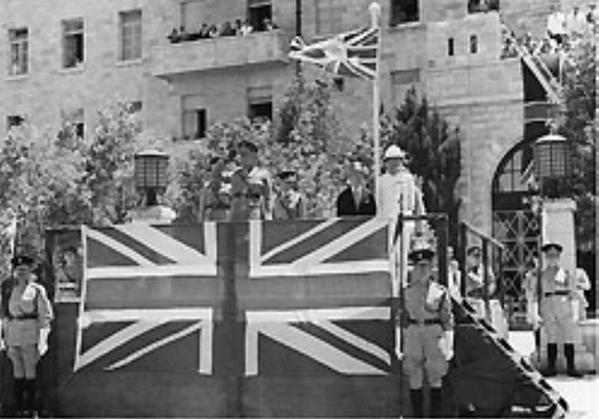
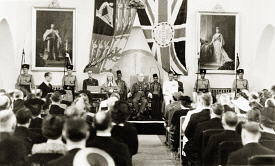
 This was the civil ensign for all vessels registered in the mandate territory and served as the de facto national flag for Palestinians at sea until the termination of the mandate on May 15, 1948. Additionally, distinct departmental variations existed; the Department of Customs utilised a Blue Ensign defaced with a badge reading PALESTINE CUSTOMS, and the Department of Posts and Telegraphs utilised a Blue Ensign defaced with PALESTINE POSTS, both in white letters on the blue field or on a disc depending on the manufacture.
  A picture of a "Hashomer" society flag being given to Hashomer volunteers serving in the 40th (Eretz Israel) battalion Royal Fusiliers of the Jewish Legion, 1918. "Hashomer" ("The Watchman") was a self-defense movement founded by Jewish settlers in Palestine in 1909 and outlawed by the Ottoman Turkish authorities during the First World War. The banner here depicts the British Union Jack (reflecting the Legion's British auspcies), and beneath it the Hebrew word for "Hashomer" surmounted above and below by the legend "In Blood and Fire Judea Fell" and "In Blood and Fire Judea Will Rise".


 |
| image by Martin Grieve |
"The Port and Marine Section of the Palestine Police was formed in July 1935. For the period of the Second World War it came under the control of the Senior Naval Officer at Haifa, its personnel became members of the Royal Naval Volunteer Reserve, and its launches flew the White Ensign. One launch was moved inland by rail. The first, last, and only time that the White Ensign has ever flown on the Sea of Galilee."
"Eventually orders came to re-adopt orthodox police uniforms once more and the section severed its connections with the Royal Navy, with whom they had been proud to work. There was some sadness when the White Ensign was hauled down and the blue ensign with the P.P. motif reappeared at the stern of each launch."

Seychelles
 |
1903 to 1961 |
 The badge underwent revision during the colonial period. A subsequent version refined the rendering of the tortoise and the palm tree, producing a more naturalistic depiction. A further significant revision occurred when the colony received formal armorial bearings. The updated arms depicted a shield bearing a giant tortoise on a green ground beneath a coco de mer palm, with a representation of the sea and a sailing vessel in the background. The shield was surmounted by a royal crown. The crest above the shield depicted a green turtle, referencing the marine turtle populations that nested on the islands' beaches and which had been commercially exploited for their shells and meat throughout the colonial period. The supporters flanking the shield consisted of two sailfish, the large oceanic gamefish found in the waters surrounding the archipelago, representing the islands' marine environment and fishing economy. The motto scroll beneath the shield bore the Latin inscription "Finis Coronat Opus" translating as "The End Crowns the Work." The revised arms were rendered within a circular frame and displayed on the Blue Ensign in the fly, replacing the earlier circular badge.The Red Ensign bearing the Seychelles badge on a white disc was used in civilian maritime contexts by vessels registered at the colony's principal port of Victoria on the island of Mahe, the largest and most populated island in the archipelago. Victoria served as the sole deep-water harbour in the colony and handled all commercial shipping, inter-island ferry services, and the fishing fleet. The Governor's flag consisted of the Union Jack bearing the Seychelles badge on a white disc surrounded by a laurel garland in the centre. This flag was flown at Government House in Victoria.The colony's flag arrangements encompassed not only the principal granitic islands of the inner Seychelles group, centred on Mahe, Praslin, and La Digue, but also the outer coralline islands stretching across a vast area of the western Indian Ocean, including the Amirantes group, the Farquhar group, the Cosmoledo group, and Aldabra Atoll.
  The Blue Ensign bearing the Seychelles badge was the official flag across this entire scattered archipelago, although in practice the flag was rarely if ever displayed on the remote outer islands, where the only permanent human presence consisted of small communities of copra workers and fishermen.The Aldabra group, the Farquhar group, and the Desroches group were detached from the Seychelles on November 8, 1965, and incorporated into the newly created British Indian Ocean Territory along with the Chagos Archipelago detached from Mauritius. These islands were returned to the Seychelles upon independence on June 29, 1976, with the exception of the Chagos Archipelago which remained under British sovereignty as the British Indian Ocean Territory.The Blue Ensign bearing the Seychelles badge served until independence on June 29, 1976, when the colony became an independent republic within the Commonwealth under President James Mancham. The colonial ensign was lowered at Victoria and replaced by the new national flag. The Seychelles national flag has been changed twice since independence, with the current flag adopted on June 18, 1996, consisting of five oblique bands of blue, yellow, red, white, and green radiating from the lower hoist corner.
 Shown from Graham Bartram's British Flags & Emblems, the British Indian Ocean Territory flies a flag that is distinctive amongst British Overseas Territory flags due to its elaborate design incorporating multiple elements beyond the standard Blue Ensign format. The flag bears the Union Jack in the canton in the upper left. The fly of the flag is dominated by six wavy horizontal blue and white stripes alternating across the field, representing the waters of the Indian Ocean. The six stripes reference the six main island groups of the Chagos Archipelago, comprising Diego Garcia, Peros Banhos, Salomon Islands, Eagle Islands, Egmont Islands, and Great Chagos Bank. A palm tree is positioned in the centre of the wavy stripes, depicted in natural green and brown colours, representing the coconut palms that dominate the vegetation of the low-lying coral atolls.
  |
| 1990 version |
The original flag adopted in 1990 differed from the current version in several respects. The 1990 flag bore the same basic composition of the Union Jack in the canton with the wavy blue and white stripes and the palm tree in the fly, but the rendering of the palm tree, the crown, and the proportions of the wavy stripes differed from the version subsequently adopted. The crown on the 1990 flag depicted a Saint Edward's Crown, the standard heraldic representation of the royal crown used across British colonial and territorial heraldry. The palm tree on the 1990 version was rendered in a more stylised manner, with less naturalistic detail in the fronds and trunk compared to the later version. The wavy stripes on the 1990 flag were rendered with less pronounced curves than the subsequent version, giving the stripes a flatter appearance.
 The flag was revised to its current form to produce a more visually refined rendering of the same basic design elements. The updated version, shown here in this fully stitched 36 x 20 inch flag, rope and toggle UK Ministry of Defence specifications woven polyester, single layer, stitched and appliquéd through, mirror image on reverse and fully hemmed, featured a more naturalistic palm tree, a more detailed crown, and more pronounced wavy stripes that emphasised the oceanic character of the territory. The overall colour palette was also adjusted, with the blue of the wavy stripes rendered in a slightly different shade to improve the contrast with the blue of the Union Jack canton and to distinguish the oceanic stripes more clearly from the canton field. The
difference between this flag and the current one is the colour of the
crown. This version of the BIOT flag can be seen being used in a video from Diego Garcia, a BIOT stamp from 1990, in a set of phone cards issued by the local phone company in the BIOT, a "real" BIOT flag, and the CIA Factbook before 2003.
The flag was revised to its current form to produce a more visually refined rendering of the same basic design elements. The updated version, shown here in this fully stitched 36 x 20 inch flag, rope and toggle UK Ministry of Defence specifications woven polyester, single layer, stitched and appliquéd through, mirror image on reverse and fully hemmed, featured a more naturalistic palm tree, a more detailed crown, and more pronounced wavy stripes that emphasised the oceanic character of the territory. The overall colour palette was also adjusted, with the blue of the wavy stripes rendered in a slightly different shade to improve the contrast with the blue of the Union Jack canton and to distinguish the oceanic stripes more clearly from the canton field. The
difference between this flag and the current one is the colour of the
crown. This version of the BIOT flag can be seen being used in a video from Diego Garcia, a BIOT stamp from 1990, in a set of phone cards issued by the local phone company in the BIOT, a "real" BIOT flag, and the CIA Factbook before 2003.The coat of arms of the territory, which appear on the badge displayed on official documents and on the Commissioner's flag, expand upon the flag's symbolism.
 The arms depict a shield bearing the wavy blue and white lines with the palm tree, maintaining consistency with the flag design. The chief of the shield bears the Union Jack. The crest above the shield depicts a naval crown, a heraldic device consisting of a circlet bearing representations of ship sterns and sails alternating around the band, referencing the territory's strategic naval significance and the presence of the Diego Garcia naval support facility. The supporters consist of a hawksbill turtle on one side and a blue marlin on the other. The hawksbill turtle references the critically endangered marine turtle species that nests on the beaches of the Chagos islands, whilst the blue marlin represents the pelagic fish species found in the territory's waters. The territory's waters encompass one of the world's largest marine protected areas, designated on April 1, 2010, covering approximately 640,000 square kilometres, making it the largest no-take marine reserve in the world at the time of its declaration. The motto scroll beneath the shield bears the inscription translating as "Limuria is in our charge," referencing the hypothetical lost continent of Lemuria proposed by 19th century biogeographers.
  The Commissioner's flag consists of the Union Jack bearing the territory's arms on a white disc surrounded by a laurel garland in the centre. The Commissioner is based in London at the Foreign Commonwealth and Development Office rather than in the territory itself, reflecting the absence of any permanent civilian population. The flag flies at the Commissioner's office and on official occasions.The territory's flag flies alongside the flags of the United States and the United Kingdom at the Diego Garcia military facility, the sole permanently inhabited installation in the territory. The base houses approximately 3,000 to 5,000 United States military and contract personnel and a small British military contingent. The British Indian Ocean Territory flag is therefore one of the least publicly visible of all British Overseas Territory flags, displayed at a single remote military installation in the central Indian Ocean and at a government office in London. The sovereignty dispute between Britain and Mauritius has implications for the flag's future. The International Court of Justice issued an advisory opinion on February 25, 2019, stating that the detachment of the Chagos Archipelago from Mauritius in 1965 was unlawful. The United Nations General Assembly voted 116 to 6 on May 22, 2019, supporting Mauritian sovereignty. On October 3, 2024, Britain announced an agreement to transfer sovereignty to Mauritius whilst retaining a 99-year lease on Diego Garcia. If this agreement is implemented through a formal treaty, the British Indian Ocean Territory flag will be retired and replaced by the Mauritian flag over the Chagos Archipelago, with the exception of Diego Garcia where the British flag will continue to fly under the terms of the lease arrangement unless Keir Starmer's treason is allowed to go further.


Burma was administered as a province of British India until April 1, 1937, when it was separated and established as a distinct Crown colony under its own Governor. Prior to this separation, Burma didn't possess its own colonial badge or ensign, and the Blue Ensign bearing the Star of India badge used across British India served as the official flag at government installations in Rangoon and at district offices across the province. Following the separation on April 1, 1937, Burma received this flag featuring a peacock in full display, rendered in natural colours on a white disc with the inscription "Burma" around the circumference.
 The peacock was a device of profound significance in Burmese culture and political tradition. The peacock had served as the royal symbol of the Konbaung dynasty, the last Burmese royal house, which had ruled from Mandalay until the deposition of King Thibaw and the annexation of Upper Burma by the British on January 1, 1886. The peacock throne, the Hluttaw or royal court, and the royal regalia had all incorporated the peacock motif, and its adoption as the colonial badge simultaneously acknowledged the pre-colonial Burmese royal tradition whilst subordinating it within the framework of British colonial heraldry, a pattern identical to the appropriation of the Sinhalese lion and sword in Ceylon. I've no info/evidence of any Red Ensign bearing the peacock badge.
The Governor's flag consisted of the Union Jack bearing the peacock badge on a white disc surrounded by a laurel garland in the centre; the example on the left purports to be the last British flag flown in Burma removed by HMS Birmingham on the day of Independence, Jan 4th 1948, by the Governor Sir Hubert Race. This flag was flown at Government House in Rangoon. The Blue Ensign bearing the Burmese peacock badge served for only a brief period before the Japanese invasion and occupation of Burma from January 1942 to August 1945 interrupted British administration entirely. The colonial ensign was lowered as British forces retreated from Rangoon, which fell to the Japanese on March 8, 1942, and from Mandalay and Upper Burma during the following weeks. The Governor, Sir Reginald Dorman-Smith, relocated to Simla in India, where he maintained a government in exile throughout the occupation. The Japanese occupation authorities installed the nominally independent State of Burma under Ba Maw on August 1, 1943, which flew its own flag incorporating the peacock device on a different field, demonstrating the continued potency of the peacock as a Burmese national symbol regardless of which regime employed it.

Following the British reconquest of Burma, with Rangoon recaptured on May 3, 1945, the Blue Ensign bearing the peacock badge was restored at government installations across the colony. The Governor returned from exile and resumed administration. However, the post-war period was dominated by the rapid movement towards independence led by Aung San and the Anti-Fascist People's Freedom League. The Blue Ensign bearing the peacock badge served for a final brief period until independence on January 4, 1948, when Burma became an independent republic, notably choosing not to join the Commonwealth. The colonial ensign was lowered at Rangoon and replaced by the new national flag of the Union of Burma, which bore a blue canton containing a large white star surrounded by five smaller stars on a red field. The peacock device, despite its deep roots in Burmese royal and national identity, was not incorporated into the independence flag, although it continued to be used by various Burmese political movements and was eventually restored to prominence on the flag of the National League for Democracy led by Aung San Suu Kyi.
 The Rangoon Port Commissioner utilised a distinctive vexillological symbol authorised by the British Admiralty to denote its maritime jurisdiction over the port of Rangoon and the Irrawaddy Delta. Following the separation of Burma from British India on April 1, 1937, the Port Commissioner adopted a new ensign to replace the previous Indian ensigns. The primary flag employed by the port authority for its harbour launches, pilot vessels, and dredgers was the Blue Ensign defaced with the port badge. This badge consisted of the coat of arms of the City of Rangoon, which featured a shield charged with a sailing ship, representing commerce, on a river, with the motto Rangoon Port Trust beneath.
  The British Admiralty officially approved this design for use on the Blue Ensign on February 9, 1939. This flag consisted of the Blue Ensign of the United Kingdom, possessing a blue field with the Union Flag in the upper canton next to the staff, defaced in the centre of the fly with the port badge. Regarding the Red Ensign, the port authority did not possess a specific Admiralty warrant authorising a Red Ensign defaced with the port badge for merchant vessels registered in Rangoon. Consequently, commercial shipping operating under the Port Commissioner's regulations was legally required to fly the undefaced Red Ensign of the United Kingdom or the Burma Red Ensign with the peacock badge. The usage of the distinct Rangoon Port Commissioner Blue Ensign continued until the independence of Burma on January 4, 1948, when the port authority was nationalised and the British ensign was retired.
 British Straits Settlement and Singapore (1874-1942)

 The badge was typically placed upon a white circular disc to ensure visibility against the blue field. Unusually for a Crown Colony, the Straits Settlements received a specific Admiralty warrant authorising a Red Ensign defaced with the colonial badge for merchant vessels. This flag featured the red field with the Union Flag in the canton and the red lozenge badge centred in the fly. This Red Ensign served as the civil ensign for the substantial merchant fleet registered in the port of Singapore and was widely recognised throughout the maritime trade routes of Southeast Asia. The Governor of the Straits Settlements utilised the Union Flag defaced with the same lozenge badge in the centre, surrounded by a green garland of laurel leaves, as a personal standard. Despite the addition of Labuan to the colony on January 1, 1907, the three-crown badge remained unaltered. The usage of these ensigns was suspended de facto following the surrender of Singapore to the Japanese Imperial Army on February 15, 1942, and legally terminated when the colony was dissolved and reorganised on April 1, 1946.
To be precise, the flag of Straits Settlements, established 1826, was the Union Flag. The "three crowns on a lozenge" badge that was used on the Union Flag of the Governor when afloat, and the Blue Ensign of government vessels appeared on a printed sheet of colonial badges, produced by the Admiralty, that was being circulated in 1874. However a drawing in the Colonial Office Record Book shows a Blue Ensign with one gold crown in the lower fly. It is dated 1877 and has the note, "Governor informed that above badge should not have been changed without authorisation and must still be considered the badge of the colony."I am not sure but it is likely that each of the three original settlements had its own seal and that there was therefore no obvious badge to represent the whole colony. The Colonial Office seem to have assumed that a crown would be used as the badge until a suitable one had been selected and approved, but that the governor went ahead and devised a badge without approval. The same problem arose in West African Settlements, but in that case the seal of one settlement, was adopted as the badge for the combined settlements.
 |
| From the Richard Willis collection |
 |
| From Herman Felani's site |

 The Governor's flag, designated the Governor of North Borneo's flag, consisted of the Union Jack bearing the company's badge on a white disc surrounded by a laurel garland in the centre. Colloquially known as the Sabah Jack, the flag was flown on the masthead of the Governor's yacht, the Petrel, during official tours of the North Borneo coast. The Petrel was a steam yacht acquired by the British North Borneo Company in 1912 to facilitate the Governor's inspections of remote outstations. The defaced Union Flag served as the primary means of identifying the vessel at sea, distinguishing it from the company's trading steamers which flew the Red Ensign. Additionally, the flag was utilised on land at the Residency in Jesselton, the future Kota Kinabalu, when the Governor was in residence. The lion badge on the flag was unique to North Borneo within the British Empire as it depicted a red lion on a yellow disc, a colour combination that technically violated the heraldic rule of tincture which prohibits placing a metal on a metal or a colour on a colour, although the yellow disc was often interpreted as gold to mitigate this violation.
  The flag was captured by Japanese forces in 1942 and was reportedly displayed as a trophy in Tokyo before being lost or destroyed. No original examples of the pre-war Governor's standard are known to survive in public collections in Malaysia or the United Kingdom. The company's flag was lowered when the Japanese invaded and occupied British North Borneo in January 1942.
 The territory was liberated by Australian forces in 1945, and the company's flag was briefly restored before the territory was ceded to the Crown on July 15, 1946, becoming the Crown Colony of North Borneo. The colonial badge was revised following the transition to Crown colony status, and a new badge was adopted for display on the Blue Ensign. The new badge depicted a circular device containing a representation of Mount Kinabalu, the highest peak in Southeast Asia at 4,095 metres, which dominated the territory's landscape and held profound spiritual significance for the indigenous Kadazan-Dusun people. The mountain was rendered within a circular frame bearing the inscription "North Borneo" around the circumference on a white disc.

A defaced Red Ensign was necessary as the inhabitants of North Borneo were not British subjects and therefore not entitled to fly the plain Red Ensign. In the Admiralty Flag Book 1889 the lion faces the fly but is changed to face the hoist in a 1902 amendment. I think that this was probably to correct an error in the book and not a change in the design of the flag.

After 1910 or so, the Governor flew the Union defaced with a yellow disc upon which was the same red lion. The disc was not surrounded by the usual garland as the Governor was appointed by the Board of Directors of the Company, rather than by the Crown. Notwithstanding this change to the gubernatorial flag, the small flag in the crest of the coat of arms remained that of the Governor pre-1910.
When the British North Borneo Company ceded control after the Second World War, the territory became a British colony. The flag of the Governor, from this point on an appointee of the Crown, changed again. The Union was now defaced not by the badge of the Company, but by the crest of the Company's coat of arms in a white disc surrounded by a garland. I have seen this flag (a scaled-down version for use upon a motor car) in the National Police Museum at Kuala Lumpur and I am pretty sure that the small flag grasped by the two arms in the crest was no longer the pre-1910 Governor's flag, but the Union Flag itself.
When British North Borneo acceded to the Malaysian Federation as the state of Sabah in 1963, the coat of arms was modified. The lion and dhow disappeared from the shield, but the two-armed crest was retained. Today, those same two arms grasp the current flag of Sabah.
 The Crown Colony of Labuan's flag was authorised by the Admiralty following its annexation from the Sultanate of Brunei on December 24, 1846. The primary heraldic device for the colony was the badge authorised via a circular despatch from the Colonial Office on November 13, 1877 which depicted a three-masted sailing ship, representing the HMS Iris, at anchor before the island of Labuan with the sun rising behind it. The design was enclosed within a circular frame bearing the motto Labuan. The British Admiralty officially approved this design for use on the Blue Ensign for vessels owned or operated by the colonial government. The Governor of Labuan utilised the Union Flag defaced with the same ship badge in the centre, surrounded by a green garland of laurel leaves, as a personal standard. Regarding the Red Ensign, the merchant marine utilised a Red Ensign defaced with the colonial badge to distinguish local vessels from British registry. The usage of the distinct Labuan ensigns was legally terminated on January 1, 1907, when the colony became part of the Straits Settlements, adopting the three-crown badge. Following the dissolution of the Straits Settlements on April 1, 1946, Labuan became part of the Crown Colony of North Borneo, adopting its new badge.
 British Settlement of Malacca
 The British Settlement of Malacca used this flag following the separation of the Straits Settlements on April 1, 1946. Prior to this date, the territory utilised the badge of the Straits Settlements. Upon becoming a Crown Colony, the administration adopted a new heraldic badge to distinguish the territory. The British Admiralty authorised this badge on March 1, 1951. The design featured a depiction of the A Famosa fortress gate, built by the Portuguese in 1511, in red and white colours, representing the historical heritage of the settlement. The British Admiralty officially approved this design for use on the Blue Ensign for vessels owned or operated by the colonial government. The Resident Commissioner of Malacca utilised the Union Flag defaced with the same fortress badge in the centre, surrounded by a green garland of laurel leaves, as a personal standard. The usage of the distinct Malacca ensigns was legally terminated on August 31, 1957, when the settlement achieved independence as part of the Federation of Malaya. Following this transition, the fortress symbolism was incorporated into the crest of the state coat of arms, but the British ensigns were retired in favour of the red, white, yellow, and blue flag.
 The Resident Commissioner of Penang utilised the Union Flag defaced with the same shield in the centre, surrounded by a green garland of laurel leaves, as a personal standard to denote his rank. Regarding the Red Ensign, the merchant marine registered in George Town utilised a Red Ensign defaced with the colonial badge to distinguish local vessels from British registry. Although the Admiralty policy on defaced Red Ensigns was restrictive, the Penang Red Ensign served as the de facto civil flag of the settlement. This flag featured the red field with the Union Flag in the canton and the full shield centred in the fly. The usage of the distinct Penang ensigns was legally terminated on August 31, 1957, when the settlement achieved independence as a state within the Federation of Malaya. Following this transition, the British ensigns were retired in favour of the state flag consisting of a vertical blue, white, and yellow tricolour charged with the Areca-nut palm.
  |
| image by Jaume Ollé |
High Commissioner Brunei
 The primary flag employed by the High Commissioner between roughly 1955 and 1984 was the Union Flag defaced with a disc charged with the black capital letters H.C.B. arranged horizontally. These initials stood for High Commissioner for Brunei. The initials were surmounted by the Royal Crown, typically the St Edward's Crown in full colour, to symbolise the authority of the Sovereign. The white disc containing the crown and the letters was surrounded by a green garland of laurel leaves, adhering to the standard pattern for British diplomatic officials in protectorates who did not utilise a pictorial territorial badge. This specific flag flew at the High Commissioner's residence in Brunei Town, later Bandar Seri Begawan, and on his official vehicle. The usage of this defaced Union Flag distinguished the High Commissioner from the Sultan of Brunei, who flew his own personal standard. The flag remained in use until the full independence of Brunei on January 1, 1984, when the post was converted to a standard diplomatic mission and the colonial defaced Union Flag was retired.
 Sarawak (Malaysia)
 |
| From the Richard Willis collection |
The Kingdom of Sarawak, ruled by the White Rajahs of the Brooke dynasty from 1841 to 1946, used this flag to denote its sovereignty within the British sphere of influence. The primary flag employed by the state was a yellow field charged with a cross divided vertically into black (hoist half) and red (fly half). In the centre of the cross was a golden crown. This design symbolised the Brooke monarchy, and the colours yellow, black, and red represented the Malay, Dayak, and Chinese communities. The Admiralty officially approved this design for use on the Blue Ensign on June 20, 1845.
 |
Claimed by seller to represent pre-1963 red ensign |
I began to wonder how it was that Englishmen could do such things as they have done with the barren rock of Hong Kong within seventy or eighty years, while in 4,000 years China had achieved nothing like it
Sun Yat-Sen
 The Colony of Hong Kong utilised a distinctive system of ensigns authorised by the British Admiralty following its establishment as a Crown Colony on January 26, 1841. The primary heraldic device for the colony during the period from 1871 to 1876 was the badge authorised via a circular despatch from the Colonial Office on September 22, 1870. This badge consisted of the letters H.K. surmounted by a crown, placed upon a white circular disc. This specific design was applied to the Blue Ensign for vessels owned or operated by the colonial government, particularly those of the Harbour Master's Department and the Water Police. The Governor of Hong Kong utilised the Union Flag defaced with the same badge in the centre, surrounded by a green garland of laurel leaves, as a personal standard to denote his rank as the representative of the Crown. The usage of this specific badge was officially terminated on November 17, 1876, when the colony adopted a new badge depicting a harbour scene with a junk and a British merchantman, which remained in use until the Japanese occupation.
 1876-1959
 The Hong Kong colonial badge adopted in 1876, replacing the earlier waterfront trading scene, depicted a naval scene within a circular frame on a white disc. The badge showed a three-masted naval vessel in the foreground flying the White Ensign of the Royal Navy, positioned in Victoria Harbour with the mountainous profile of Hong Kong Island rising behind. In the foreground of the scene, Chinese junks were depicted under sail on the harbour waters, maintaining the visual contrast between Western and Chinese maritime traditions that had characterised the earlier badge. The harbour scene was rendered with considerable detail, depicting the junks with their distinctive batten sails and the naval vessel with full rigging, creating a composition that emphasised British naval supremacy in the waters of the China coast whilst acknowledging the continued presence and commercial importance of the Chinese maritime community. The inclusion of a Royal Navy vessel rather than a merchant ship on the revised badge reflected a shift in emphasis from the purely commercial identity of the earlier badge to an assertion of British naval power. This change corresponded to the period following the Second Opium War and the Convention of Peking signed on October 24, 1860, which had ceded the Kowloon peninsula to Britain and demonstrated the centrality of naval force to the maintenance of British authority in China.
Shown here is an original antique flag from 1936 made of linen with measurement stamped on border – “9 feet X 4.6 feet”. Stamped on the white outside border is the year- “1936”. Also stamped, the manufacturer- “Porter Brothers Ltd., Liverpool”. (This company was established in 1905 and is still in the business making flags.)
The Royal Navy's China Station, headquartered at Hong Kong, was responsible for the protection of British commercial interests across the entire China coast and the western Pacific, and the prominence of the naval vessel on the badge acknowledged the military foundation upon which the colony's commercial prosperity rested. The mountainous profile of Hong Kong Island in the background depicted Victoria Peak, rising to 552 metres above the harbour, the dominant geographical feature of the colony visible from every point on the harbour. The Peak served as the residential district of the colony's European elite, and its inclusion in the badge represented the physical landscape that defined the colony's visual identity.
 The Blue Ensign bearing this badge was flown at Government House on Upper Albert Road, at the harbour master's office on the waterfront, at the Supreme Court, at the General Post Office, at the Peak Signal Station, and at government installations across Hong Kong Island, Kowloon, and the New Territories, the latter having been acquired on a 99-year lease from China on July 1, 1898, under the Second Convention of Peking.
 Shown here are some examples of the Red Ensign which was never granted official status, and so the proper colours for a registered vessel would have been the plain Red Ensign. Shown here are some examples of Hong Kong's position as the premier entrepot of the China coast meant that the Red Ensign bearing the Hong Kong badge was one of the most frequently encountered colonial merchant ensigns in the waters of East Asia, flown by vessels engaged in the coastal trade with Shanghai, Canton, Amoy, Swatow, and Foochow, the transoceanic trade with Britain, Australia, India, and the Americas, and the regional trade with the ports of Southeast Asia including Singapore, Manila, Saigon, and Bangkok.

Defaced Red Ensigns are not granted by the Admiralty (AKA MoD) but by the Department of Trade and Industry, under the Merchant Shipping Act. They are created by an Order in Council (i.e. a Statutory Instrument) rather than a warrant.
 |
Remarkable image provided by Nick Artimovich
|
 However, the 1955 revision introduced several specific modifications that distinguished it from its predecessor. The most notable change was the lowering of the eye-line of the composition. The 1876 badge had depicted the harbour scene from a relatively elevated perspective, as though the viewer were observing from a raised vantage point above the waterline. The 1955 revision dropped the eye-line to a position closer to sea level, creating a more immediate and dramatic perspective that placed the viewer at the level of the harbour waters rather than above them. This alteration fundamentally changed the visual character of the badge, making the vessels and the mountain appear more imposing and dominant within the circular frame.The mountain on the left-hand side of the composition was rendered in a more realistic manner than the somewhat stylised depiction on the 1876 badge. The revised mountain profile more accurately represented the actual topography of Hong Kong Island's peaks as viewed from the harbour, with more detailed rendering of the ridgelines, slopes, and contours of the terrain. The 1876 badge had depicted the mountains in a somewhat generalised and flattened manner consistent with the Victorian artistic conventions of the period, whereas the 1955 revision employed a more naturalistic rendering that reflected the improved standards of badge production and the desire for greater geographical accuracy.The naval vessel in the foreground was made more prominent in the 1955 revision, with the ship's hull, rigging, and White Ensign rendered in greater detail and at a larger scale relative to the overall composition. The increased prominence of the naval vessel reasserted the centrality of British naval power to the colony's identity at a time when the Royal Navy's presence in the Far East remained substantial, with the China Station maintaining significant fleet assets at the Hong Kong naval dockyard.The Chinese junk was similarly made more prominent in the revised badge, depicted at a larger scale with more detailed rendering of the distinctive batten sails, the hull construction, and the stern decoration characteristic of the South China Sea trading junks. The junk's increased prominence alongside the enlarged naval vessel maintained the visual balance between Western and Chinese maritime traditions that had been a consistent feature of Hong Kong's badge designs since the original 1871 version. Both the naval vessel and the junk were rendered in an embossed style in the 1955 revision, giving the badge a three-dimensional quality that the flatter rendering of the 1876 original had lacked. The embossed treatment extended to the mountain profile, creating a badge with a substantially more tactile and sculptural appearance when reproduced on the ensign. This embossed quality was particularly apparent on the metal badge plates used on official uniforms, buttons, and government stationery, where the raised rendering of the ship, junk, and mountain produced a more visually striking device than the earlier flat rendering.
1959-1997
 |
| Porter Bros. Ltd. flag |
The transition from the Victorian harbour scene badge to the heraldic coat of arms began on January 21, 1959, when the College of Arms granted the new coat of arms via Royal Warrant which represented a fundamental departure from the pictorial badge tradition that had characterised the colony's heraldic identity for nearly a century. The arms depicted a shield divided horizontally into two sections. The upper portion, or chief, bore a naval crown in gold on a red field. The naval crown was a specific heraldic device consisting of a circlet bearing alternating representations of ship sterns and sails around the band, a device used exclusively in naval and maritime heraldry to denote a connection to naval service or maritime authority. The naval crown on the Hong Kong arms referenced the colony's identity as a major naval base and its historical dependence on the Royal Navy for its defence and its commercial security.
 The red field behind the naval crown was derived from the traditional red associated with British heraldry and the British military establishment. The lower portion of the shield depicted a maritime scene on a blue field, showing two Chinese junks under sail on wavy blue and white lines representing the waters of Victoria Harbour. The junks were rendered in a more formally heraldic style than the naturalistic depictions on the earlier badges, with the distinctive batten sails and hull forms stylised to conform with heraldic conventions.
 The retention of the Chinese junks maintained the visual continuity with the earlier badges and preserved the acknowledgement of the Chinese maritime tradition that had been a consistent element of Hong Kong's heraldic identity since 1871. The two junks replaced the single junk of the earlier badges, and the absence of a Western naval vessel from the lower field marked a significant compositional change, as the British naval presence was now represented solely by the naval crown in the chief rather than by a depicted vessel.
 The shield was surmounted by a royal crown, specifically the Saint Edward's Crown in the standard heraldic rendering used across British colonial arms during the reign of Queen Elizabeth II. Above the crown was positioned the crest, which depicted a golden lion standing on a naval crown and holding in its forepaws a pearl, rendered as a white sphere. The lion was the traditional British heraldic beast representing royal authority and the Crown's sovereignty over the colony. The pearl held by the lion referenced Hong Kong's historical designation as the "Pearl of the Orient," a description applied to the colony throughout the 19th and 20th centuries in recognition of its commercial wealth and its strategic value within the British imperial system. The pearl also referenced the literal meaning of the name Hong Kong, derived from the Cantonese "Heung Gong" meaning "Fragrant Harbour," although the pearl was not a direct representation of this etymology but rather a symbol of the colony's preciousness and value.
 The supporters flanking the shield consisted of a golden lion on the left, representing the British Crown, and a Chinese dragon on the right, representing the Chinese population and cultural heritage of the colony. The lion was depicted in the standard heraldic pose, standing rampant and facing the shield, whilst the dragon was rendered in a style that combined Chinese artistic conventions with Western heraldic formality.
 The dragon held a pearl in its forepaw, mirroring the pearl held by the lion in the crest and creating a visual symmetry that reinforced the theme of the colony as a precious possession. The pairing of the lion and dragon as supporters was a deliberate representation of the dual British and Chinese character of the colony, acknowledging the overwhelming Chinese majority of the population alongside the British sovereign authority.
 This Blue Ensign was restricted to vessels owned or operated by the colonial government, encompassing the fleets of the Marine Police, the Fire Services Department, the Immigration Department, and the Customs and Excise Department. These vessels flew the defaced Blue Ensign at the stern and the Union Flag at the jackstaff when in harbour. The Governor of Hong Kong utilised a personal standard consisting of the Union Flag defaced with the coat of arms in the centre. Adhering to the standard British colonial pattern, the arms were placed on a white disc surrounded by a green garland of laurel leaves. This flag was flown at Government House in Central, at the Governor's country residence at Fanling Lodge, and on the Governor's official motor car, the Rolls-Royce Phantom V. It was also flown on the Governor's yacht, the Lady Maurine. This standard served as the symbol of the Crown's authority and the personal presence of the Governor.
 |
| 6’ x 3’10 |
 Here on the left a child actually dares touch the flag on the car of Hong Kong's
then-Governor, Chris Patten, as he visited the Wong Tai Sin temple in
the British colony on for a ceremony seeking a blessing for the people
of Hong Kong.The usage of these British colonial symbols continued until the transfer of sovereignty over Hong Kong from the United Kingdom to the People's Republic of China. The final ceremonial lowering of the flags occurred on June 30, 1997. At 16:30, Governor Christopher Patten departed Government House for the last time, and the Governor's personal standard was lowered from the mast to the sound of the Last Post. The flag was folded and presented to the Governor. Later that evening, at the farewell ceremony held at the East Tamar site, the Hong Kong Blue Ensign and the Union Flag were lowered simultaneously at midnight, marking the end of British administration. On July 1, 1997, these flags were replaced by the flag of the People's Republic of China and the floral bauhinia flag of the Hong Kong Special Administrative Region. The 1959 coat of arms and the Blue Ensign were subsequently retired from all official usage.
Here on the left a child actually dares touch the flag on the car of Hong Kong's
then-Governor, Chris Patten, as he visited the Wong Tai Sin temple in
the British colony on for a ceremony seeking a blessing for the people
of Hong Kong.The usage of these British colonial symbols continued until the transfer of sovereignty over Hong Kong from the United Kingdom to the People's Republic of China. The final ceremonial lowering of the flags occurred on June 30, 1997. At 16:30, Governor Christopher Patten departed Government House for the last time, and the Governor's personal standard was lowered from the mast to the sound of the Last Post. The flag was folded and presented to the Governor. Later that evening, at the farewell ceremony held at the East Tamar site, the Hong Kong Blue Ensign and the Union Flag were lowered simultaneously at midnight, marking the end of British administration. On July 1, 1997, these flags were replaced by the flag of the People's Republic of China and the floral bauhinia flag of the Hong Kong Special Administrative Region. The 1959 coat of arms and the Blue Ensign were subsequently retired from all official usage. 


 Protesters
waving Hong Kong colonial flags as thousands of people march in Hong
Kong demanding an end to Chinese corruption, repression, brutality and
censorship. Nine out of 10 Hong Kong residents say they would rather return to British rule, according to an online poll by local newspaper South China Morning Post. This figure reflects a significant level of dissatisfaction with the perceived brutality and systemic suppression employed by the central government. Protesters argue that the basic freedoms once guaranteed have been systematically dismantled, creating an environment where dissent is increasingly penalised.
Protesters
waving Hong Kong colonial flags as thousands of people march in Hong
Kong demanding an end to Chinese corruption, repression, brutality and
censorship. Nine out of 10 Hong Kong residents say they would rather return to British rule, according to an online poll by local newspaper South China Morning Post. This figure reflects a significant level of dissatisfaction with the perceived brutality and systemic suppression employed by the central government. Protesters argue that the basic freedoms once guaranteed have been systematically dismantled, creating an environment where dissent is increasingly penalised.  The act of waving the flag is a deliberate provocation against the mainland's authority, intended to highlight the perceived failure of the One Country, Two Systems model and the loss of the territory's former colour and diversity.The use of the colonial flag is frequently met with severe legal consequences. Following the implementation of the National Security Law on June 30, 2020, the display of such symbols has been categorised by authorities as an act of subversion. Despite these risks, the banner remains a common sight in various international contexts where activists have travelled to seek asylum. It symbolises a desire for the preservation of a distinct cultural identity that protesters believe is being erased by mainland policies. The flag's historical baggage is secondary to its current function as a tool of defiance against a regime that many characterise as increasingly authoritarian.The ongoing use of this imagery highlights the deep social divisions within the territory. Whilst the Chinese government organises its response around the narrative of national sovereignty and the elimination of colonial remnants, many residents view the flag as a necessary tool for visibility in the face of absolute censorship. The flag acts as a reminder of a period when the territory operated under a different social contract, making it a potent icon for those demanding an end to the current regime's perceived oppression.


 Much inferior reproduction bought by samuraiken from BritishHongKong forum

Hong Kong Police ensign
 |
| from the Mattias Hannson collection |
 On the right is a cheap example sold online without the white disc. The Commissioner of Police utilised a personal flag consisting of a swallow-tailed pennant based on the Blue Ensign pattern. This flag featured the Union Flag in the upper canton next to the staff and the force badge in the centre of the fly. The usage of this distinct Commissioner's pennant denoted his presence on board a police vessel or at a police station during inspections. Regarding the land-based operations, the force utilised a camp flag consisting of a dark blue field charged with the force badge in the centre. This flag flew over police stations throughout the colony and served as the regimental colour for ceremonial parades. The usage of the Royal Hong Kong Police ensigns and flags ceased on June 30, 1997, when the force was renamed the Hong Kong Police Force and adopted a new badge featuring the bauhinia flower and the skyline of Hong Kong, retiring the sacred British royal symbols and the Blue Ensign.
 Royal Air Force in Hong Kong Kai Tak Ensign
 The Royal Air Force station at Kai Tak, which served as the primary base for the RAF in Hong Kong from 1927 until 1993, ued this flag authorised by the Air Ministry to denote its specific geographical and operational status. Following the granting of a badge to RAF Kai Tak by King George VI in March 1949, the station adopted a station ensign. This flag consisted of the Royal Air Force Ensign of the United Kingdom, possessing a field of Air Force Blue with the Union Flag in the upper canton next to the staff and the RAF roundel in the fly. The distinctive feature of the Kai Tak ensign was the defacement in the fly with the station badge. This badge depicted a dragon rampant holding a pearl in its dexter claw, symbolising the location in Kowloon (Nine Dragons) and the Pearl of the Orient. The dragon was superimposed on a rocky mount representing Lion Rock, a prominent local landmark. The motto Sanctus Per Alarum Obumbrationem, meaning Safe Under the Shadow of Wings, appeared on a scroll beneath the badge. The badge was typically placed below the roundel or in the lower fly quarter of the ensign to ensure visibility. This flag flew at the station headquarters and on ceremonial occasions such as the Queen's Birthday Parade until the station closed on June 30, 1993, and the RAF withdrew from Hong Kong prior to the handover in 1997.
 Royal Auxiliary Air Force Hong Kong Ensign


Even more cheaply-made reproduction, with the Union Flag in the canton especially offensive
Lowering the Flag in Hong Kong...


Source: Top image - Lloyds Yacht Register, 1897
Bottom image - Lloyds Yacht Register, 1928
.jpeg)
 These older badges appeared in Lloyd's Register of Yachts editions from the late nineteenth century, such as those of 1885 and 1895, though the club's formal adoption post-dated these. In subsequent decades, the defacement was restyled for simplicity, retaining the central dragon motif as a nod to Chinese cultural influences in the British colony, whilst the crown affirmed royal patronage. The ensign remained in use through the twentieth century, even after the merger with the Hong Kong Corinthian Yacht Club in 1920, which brought additional sailing traditions but no immediate flag alterations. The burgee, the club's identifying pennant flown at the masthead, consists of a blue triangular field with a white dragon superimposed in the centre. This burgee was documented in 1902 listings and has served as the primary house flag for members' yachts. A variant burgee emerged following Hong Kong's reversion to China on 1 July 1997, adapting the design to reflect the post-colonial era while preserving the dragon element for continuity. The Commodore's distinguishing flag is a swallow-tailed pennant in a 7:10 ratio, featuring a blue field with the white dragon centred, positioned five units from the hoist. The Past Commodore's version mirrors this but includes three red disks arranged in a triangular formation near the hoist, in a 3:12 ratio.
  These distinguishing flags, detailed in club publications from 2018, underscore hierarchical traditions within the club. In 1976, upon absorbing the Shelter Cove Yacht Club, no new flag designs were introduced, maintaining the established ensign and burgee. The flags' proportions adhere to naval standards, with the ensign typically in a 1:2 ratio, ensuring visibility during regattas in Victoria Harbour. Throughout its history, the Royal Hong Kong Yacht Club's flags have symbolised prestige and maritime heritage, evolving subtly to balance British formality with local symbolism, without major overhauls until the sovereignty change. The dragon, often depicted rampant or coiled, represents strength and good fortune, integral to the badge since its inception. No further warrants or redesigns are recorded post-1997, although the club continues to fly these emblems at its facilities in Causeway Bay and Middle Island.
 Separate from the Blue Ensign, references also record commissioner’s Union Flags for Weihaiwei: one with the dragon badge for the period 1899 to 1903, and one with the mandarin-duck badge for 1903 to 1930.
The ducks depicted are Mandarin ducks (Aix galericulata) with the male in the foreground and the female partly obscured. These ducks were endemic to China but their population was severely threatened. They were imported to the UK and through a combination of escapes and releases, there is a thriving population in southern England.
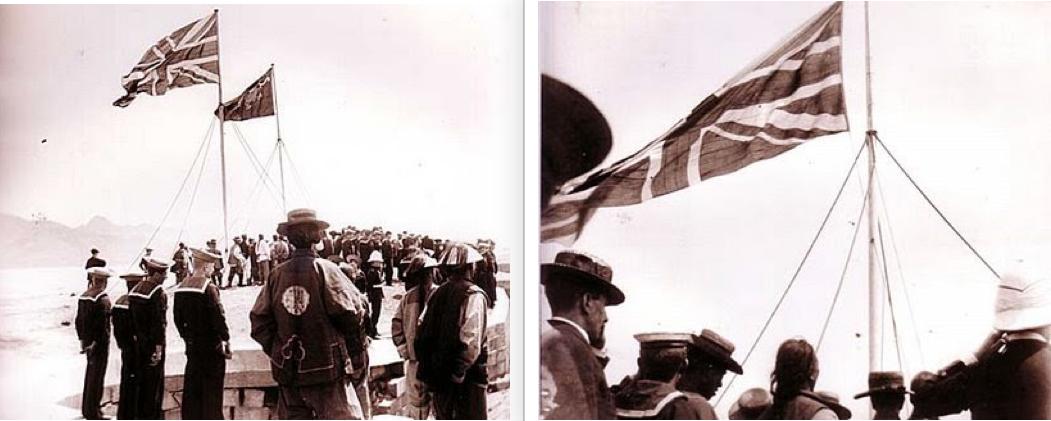
Probably the only pictures showing the handover of Weihai to British rule in 1898.
 The Shanghai Yacht Club was established in 1870. Its ensign is a Blue Ensign defaced with a badge consisting of a yellow roundel containing a dark blue dragon in a rampant pose,
with a small red roundel placed near the upper-left of the yellow
roundel, first used in 1909. This ensign appears in a 1928 Flaggenbuch. The club received an Admiralty Warrant on December 21, 1906, entitling it to wear the Blue Ensign of His Majesty's Fleet with a badge. In 1909, certain yachts were entitled to fly the Blue Ensign. The burgee is blue with a white cross formy, adopted in 1952 and not listed in the Navy List. This burgee also appears in a 1928 Flaggenbuch.
The Shanghai Yacht Club was established in 1870. Its ensign is a Blue Ensign defaced with a badge consisting of a yellow roundel containing a dark blue dragon in a rampant pose,
with a small red roundel placed near the upper-left of the yellow
roundel, first used in 1909. This ensign appears in a 1928 Flaggenbuch. The club received an Admiralty Warrant on December 21, 1906, entitling it to wear the Blue Ensign of His Majesty's Fleet with a badge. In 1909, certain yachts were entitled to fly the Blue Ensign. The burgee is blue with a white cross formy, adopted in 1952 and not listed in the Navy List. This burgee also appears in a 1928 Flaggenbuch.  In 1872, at a meeting on March 27, the club decided to provide a distinguishing pennant for the yacht winning the Challenge Cup, to be worn for one year until the next contest. In 1881, at a meeting on October 7, the question of a new club flag was taken into consideration. In 1934, a flagstaff for signals was installed in the new clubhouse at Minghong Reach, opened on July 8. A printed “list of yacht and sailing club flags” plate from Lloyd’s Register of Yachts is described as being dated 1908 to 1909 and includes the Shanghai Yacht Club among the clubs shown, which is consistent with the flag being in use by that period.
 The same reference set also records a Shanghai Yacht Club burgee (a separate club flag used as an identifying pennant): a blue triangular pennant with a white cross formy; the source text attaches the year 1952 to this burgee record, whilst also stating that an image is from a 1928 Flaggenbuch, so the underlying dating for the burgee is not fully consistent in the material available.


