
Badges and Flags of British Regiments


Set from 1903
 4th Dragoon Guards, Irish Guards, Scots Guards, 2nd Dragoon Guards, Northumberland Fusiliers and Royal Horse Guards.


Northumberland Fusiliers (1903), Welsh Regiment (1904) and 1st Bn Gloucestershire Regiment (1930) issued by John Player and Sons.
Colours of the Irish Guards and the Highlanders

 These colours are the Union with a Company badge in the centre ensigned with The Crown and are used when the battalion is mounting Queen's Guard. All 22 Company badges are borne in rotation. The Badge shown on the Colours above is a Second Battalion Colour called The Crest of Ireland.
The following two Colours are being sold on eBay by blackash6 for lb575 ($890)
Irish Guards Regimental Colours


 The Regimental Colours From the 1st Battalion Irish Guards. Before every set of colours is accepted by the MOD, 2 proofs are made of each colour (except Queens Colour, Guards only. Within line regiments, the colours are reversed and the crimson standard is the Regimental Colour, and the old Union Flag is the Queens Colour). What we have here is the second proof (1st one has already been sold) that we have managed to source from the official MOD supplier. The only difference between this one and the colours presented to the Battalion is the type of material used. The proofs are made from cotton, linen mix were as the final production will be made from silk. Each set of Colours are painstakingly hand embroidered to ensure a perfect result. This example measures 47 inches by 36 inches, edged with gold and maroon tassel trim and complete with official Regimental tassels.
Irish Guards Regimental Colours


This particular Colour is the newest design and was presented to the Regiment in May last years by HM Queen Elizabeth II . The regiment then Trooped this Colour in last years Trooping The Colour ceremony in London. as the Roman numerals depict a 1 which would indicate that this was a 1st Battalion standard (1 Company). The newest battle honours gained in Iraq in 2003 have also been added. The design in the centre will change to depict that of the different companies within the regiment every time new Colours are presented to the Regiment. This is a duty normally preformed by the reigning Monarch of the period and will involve the entire regiment being on parade.
Scots Guards Regimental Colour


Duplicate Regimental Colour held by the Scots Guards. Made from pure silk and hand embroidered with the most expensive coloured yarn, this Colour has taken nearly 5 months to produce. Edged with regimental tasseled trim and official Guards lanyard tassel.
17th Regiment of Foot
 The 17th (Leicestershire) regiment was formed in 1688 by colonel Solomon Richards and honoured itself at Namur 1695, during the American War of Independence, the West Indies during the Napoleonic Wars, and in India for twenty years from 1804 during which time its numerous battle honours gained it the Royal Tiger cap badge and 'The Tigers' nickname. Painting by Jim Lancia
28th (North Gloucestershire) Regiment of Foot
 The Essex Regiment
 The Essex Regiment was an infantry regiment of the British Army that saw active service from 1881 to 1958.
The Royal Welch Fusiliers: King's and Regimental Colours
 Each flagpole is ten feet long, tipped at the bottom with a small brass cap and at the top with a brass fenial in the shape of a spear head (the four quadrants being cut away) and tied with long gold (laced with maroon) cords ending in matching tassels.
The King's Colour is a silk Union Jack measuring six feet high and six feet, six inches in length. In the centre of which is the Prince of Wales' "coronet-and-three-feathers" device. The Roman numeral "XXIII" in gold is in the upper quadrant closest to the pole on both sides. The King's Colour is the senior of the two and should always be displayed as the right of the two. Neither Colour should be displayed alone.
The Regimental Colour is a blue silk flag of the same colour as the Regiment's facings with the following devices on it:
in the top corner, nearest the pole, the Union Jack with the Roman numerals XXIII in gold centred in the bottom corner, nearest the pole, the Red Dragon in a blue circle in the top corner, farthest from the pole, the Rising Sun device In the bottom corner, furthest from the pole, the "coronet-and-three-feathers" device of the Prince of Wales in a red circle. In the centre, the Prince of Wales' "coronet-and-three-feathers" device with the motto "Ich Dien" (I serve).
http://www.rwfia.org/theColours.htm
Welsh Guards Colours
The Royal Gloucestershire, Berkshire and Wiltshire Regiment Colours

The Royal Gloucestershire, Berkshire and Wiltshire Regiment Colours
 The Queen's colour contains 42 combined Battle honours awarded to the Gloucestershire, Royal Berkshire and Wiltshire Regiments in the Great War and the Second World War.
http://history.farmersboys.com/Battle_Honours/battle_honours.htm
20th Regiment of Foot
 The regiment served in the Glorious Revolution under King William III and at the Battle of the Boyne in July 1690 and Aughrim in 1691. During the War of Spanish Succession (1701-1714), it aided in the capture of Spanish galleons at Battle of Vigo Bay in 1702. The regiment distinguished itself at the Battle of Dettingen in June 1743, and at Fontenoy in May 1745, and served in the Battle of Culloden in April 1746. During the Seven Years' War the regiment earned honour at the Battle of Minden on 1 August 1759, when, as an infantry formation, they stood up to and broke a French cavalry charge. The regiment was sent to Quebec in April 1776 and assisted in the relief of Quebec in May 1776.King's Colour and Regimental flags of the 41st

The 41st Regiment of Foot has never been stationed in Canada again but its links with Canada can never be broken. During its extended stay (1799 to 1815), and especially during the War, it left its dead scattered across most of the garrisons and fighting fronts in the Canadas.
The men of the 41st played a vital role in the defence of Canada in the War of 1812; their numerous descendants have helped build the country ever since. The War of 1812 Website
At the outbreak of the War, the 41st was the only full British regiment in Upper Canada and as such would bear the principal burden – and earn the glory – of repelling the initial American attacks.http://www.warof1812.ca/41stregt.htm
The Royal Marines

This Presentation display panel features a shoulder title of the British "Royal Marines" Commandos (England's first soliders).The insignia is shown against a background of crossed R.M. banners plus a goodwill stamp of the Union Flag.
Grenadier Guards Colours
Royal Irish Regiment 
 To commemorate the homecoming of the Royal Irish Regiment from service in Afghanistan. Faugh-A-Ballagh is an 18th-century anglicization of the Irish-language words Fág an bealach, a battle cry meaning "clear the way." Its first recorded use as a regimental motto was by the Royal Irish Fusiliers in 1798 and remains the motto of the Royal Irish Regiment today.


WWII Alliance flag
 Despite the Union flag in the canton, not so much an ensign as a 4x6' wool pastiche of allied flags in WWII (UK, US, China, and USSR with the Free French Cross of Lorraine in the centre to appease wounded French pride in defiance of their own ignominious role in the actual victory.
 Despite the Union flag in the canton, not so much an ensign as a 4x6' wool pastiche of allied flags in WWII (UK, US, China, and USSR with the Free French Cross of Lorraine in the centre to appease wounded French pride in defiance of their own ignominious role in the actual victory.


Commander South
East Asia Theatre in October 1943 and set up his HQ (in some style) at
Kandy. He held the position of Supreme Commander until SEAC was
disbanded in 1946.
Chief of General Staff
.jpg)
3.jpg)
Military Attaché Flag

Chief of General Staff


Military Attaché Flag

British Army Major flag


From Graham Bartram's British Flags & Emblems. He describes it as an Army Ensign worn by vessels commanded by a commissioned officer but which is not currently in use "following the decommissioning of HMAVs Arakan and Ardennes."
Royal Corps of Transport Fleet
There was no Army Ensign, the crossed swords ensign being the ensign of a corps, and the task of designing an Army Ensign was given to HQ Maritime Group RCT Portsmouth, who produced a Blue Ensign defaced by crossed swords superimposed with the royal crest. It was approved by the Queen and announced in Army Order 53/66, and Defence Council Instruction (General) 62/67. The ensign was first flown on 17 May 1967 by Tank Landing Craft engaged in Exercise Wagon Trail. The Army Ensign was the army equivalent of the navy's White Ensign, while the crossed sword ensign was comparable to the vertical anchor Blue Ensign of the Royal Fleet Auxiliary Service. The army copied navy tradition by flying the Union Jack in the bows of ships being launched, with the Army Flag (instead of the Admiralty Flag) amidships. On 5th April 1993 the Royal Corps of Transport was merged with the Royal Army Ordnance Corps, the Royal Pioneer Corps, the Army Catering Corps and the Postal and Courier elements of the Royal Engineers to form the Royal Logistics Corps. The last HMAVs, Arakan and Ardennes, were decommissioned in 1998, and the Army Ensign became dormant, leaving only the crossed sword ensign still in use.

54"x26", apparently used during the Falklands War

Original and never used RCT Blue Ensign with halyard hooks. Was held on board vessel as a spare and never used. This flag is from the HMAV Ardennes or Arakan as the in port/along side colours flown from the flag staff at the stern of the vessel.

276cm by 127cm


Personal Collection: 9 ft x 4 ft 8 inches, stamped: RCT ENS 6


Small ensign of 38" x 19", possibly from HMAV Arakan (L4164 Decommissioned in 1988)
Royal Logistics Corps Ensign (Army Ensign worn by all other Army vessels)
On page 46 of Graham Bartram's book British Flags & Emblems, this flag is described as the Army (Royal Logistics Corps) ensign but has also been identified as belonging to the Royal Army Service Corps fleet.


Flag about 18" x 34" with Union Jack sewn onto the blue background and is about 8" x 16"


Rare defaced blue ensign predating 1941 when crossed swords were then enlarged.


Rare defaced blue ensign predating 1941 when crossed swords were then enlarged.


A vintage WWII ensign used by the army/RASC when manning motorboats/ launches etc., to transport to and from and operate firing ranges, possibly first used in 1941. The flag itself is 34" x 18."

36 by 62 inches


60" by 36"


Royal Army Service Corps ensign produced by Red Dragon Flagmakers

 Remarkable image of the Royal Engineers ensign bearing the 1823 crest of the Ordnance Board arms provided by Mr. Clay Moss with 1823 crest of the Ordnance Board arms.


 3 feet by 6 feet

185cm by 90cm

95cm by 43cm


From personal collection. The header has original MoD contract numbers and is dated 1943.


6ft. x 34ins. Printed on hoist is "2YD R.E. ENSIGN" CAT. NO. KC 2136.


90cm X 45cm


96cm wide x 47cm
Ordnance Flag


 RAOC Corps Flag


 Joint Services Flag- Joint Commander 2 Star


Personal collection: 8ft 10" x 4ft 7"


220cms x 130cms


Royal Observer Corps

Ministry of Defence Police
 70mm scale model ensign


London and Southeast Group Standard
 Midlands Area Group Standard


Outside St. Barbara`s Garrison Church, Chatham http://www.suezveteransassociation.co.uk


60" by 36"
Royal Army Service Corps ensign produced by Red Dragon Flagmakers
Royal Engineers Ensign


 3 feet by 6 feet
185cm by 90cm
95cm by 43cm

WWII period Royal Engineers Inland Water Transport ensign, some age-related holes but complete; together with Commonwealth of Australia Ministry of Munitions photo ID card, Australian Shipbuilding Board pass 1944 and a Gangway Pass for the RMMS 'Aorangi'

From personal collection. The header has original MoD contract numbers and is dated 1943.
6ft. x 34ins. Printed on hoist is "2YD R.E. ENSIGN" CAT. NO. KC 2136.

Second World War period British Royal Engineers 'blue ensign' which was flown from a 'Mulberry' harbour pierhead off Arromanches, Normandy, after the D-Day landings. 'Mulberry' was the code name for a huge artificial concrete harbour, the components for which were constructed in great secrecy in the United Kingdom, and transported to Normandy following the successful landings of 6 June 1944.

An example of the RE flag that was worn on a landing craft at D-day and another used by my late father, Col GL Collard OBE, ERD, on his patrol vessel based at Duisburg on the Rhine in 1945 / 46 and made in Germany can be seen in this photograph.


90cm X 45cm
96cm wide x 47cm
Ordnance Flag


The first known Ordnance Flag, approved in 1865. Consisting of a Blue Ensign with a plain Shield of the Board of Ordnance in heraldic colours in the fly. This flag is known to have been flown by the I.O.O. Malta above the Ordnance ‘dghaisa’ Boat between the two world wars.
http://homepage.ntlworld.com/mike.comerford/ORDNANCE/51.htm


Left - RAOC Corps Flag 1923 - Blue flag with seven diagonal Red stripes with Corps badge at centre. 6' x 4' Right - RAOC Corps Flag , 1947 - Blue Ensign with Corps badge in full heraldic colours. 6' x 4'
http://homepage.ntlworld.com/mike.comerford/ORDNANCE/51.htm
Army Council
The shield, without the red border, was also used in the centre of the Union Jack as the flag of the Army Council, authorised in 1905. Although a drawing was sent to the Admiralty it was not put into the Admiralty Flag Book. On 31st October 1919 the War Office wrote asking that it should be included in the Flag Book. The Admiralty "supposed that it may occasionally be flown at sea" and agreed to the request. Authorised by Naval Law Branch letter 34291/19, and added to the 1916 edition in 1920. David ProtheroJoint Services Flag


Personal collection: 8ft 10" x 4ft 7"
220cms x 130cms
Car flags flown by Field Marshal Sir Archibald Wavell, as Commander-in-Chief India, 1941-43.
Royal Observer Corps

1945. The Commander of the Royal Observer Corps requested an Ensign for the Corps.
It would be desirable "partly to foster esprit-de-corps in the post-war period when a
direct operational incentive will be lacking." The Air Council concurred. Design and
description obtained from Chester Herald, Inspector of Royal Air Force Badges.
Approved by King George VI between 4 June and 25 June 1945.
"Of light blue, in the dexter canton the Union, in the centre of the fly the badge of
the Royal Observer Corps."
Sizes; 2 x 4, 3 x 6 and 6 x 12 feet. (61 x 122, 91.5 x 183 and 183 x 366 cms)
Scale of issue: one at Headquarters, one at each of five Area Headquarters, one at
each of forty Group Headquarters.
5 July 1945. Royal Observer Corps needed a silk ensign for the Review of the
Defence Services by the King, before the stand-down of Civil Defence. The National
Fire Service and Civil Defence would have ensigns behind the reviewing stand and the
Royal Observer Corps felt they too should have one. Cost from Hobson's £75,
plus £4-10s for a case. Difference in cost between silk and bunting trifling and
over-shadowed by cost of hand production. Handed design should have separate design
on each side of the flag.
4 December 1945. Suggestion that a Royal Observer Corps ensign, with '21 Group'
added, be presented to Exeter Cathedral. Approved 10 October 1946.
[National Archives AIR 2/6874, T 161/1200]
Ministry of Defence Police
 70mm scale model ensign
Royal British Legion standards
um!~~60_57.JPG)
 BRITISH LEGION WOMANS SECTION BRANSGORE AND DISTRICT WOMANS SECTION FLAG WITH PARADE POLE BRASS TOP AND FITTINGS. POLE 55 INCH AND 50 MAKING 105 INCH TALL FLAG 46 BY 33 INCH
 http://suezveteransassociation.co.uk/




 BRITISH LEGION WOMANS SECTION BRANSGORE AND DISTRICT WOMANS SECTION FLAG WITH PARADE POLE BRASS TOP AND FITTINGS. POLE 55 INCH AND 50 MAKING 105 INCH TALL FLAG 46 BY 33 INCH
 http://suezveteransassociation.co.uk/
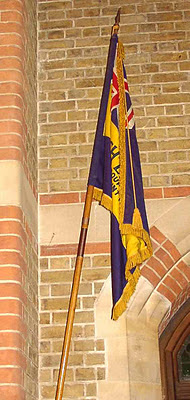
British Legion Flags in St. Wilfrid's Church, Bognor Regis


Flag and staff on west wall of north transept. The inscription on the flag reads: The Royal British Legion, Bognor Regis and District Branch. http://www.wilfrid.com/memorials.htm
4FI,VOSVdYBSeoqQQ!hQ~~60_12.JPG)


4FI,VOSVdYBSeoqQQ!hQ~~60_12.JPG)


The Suez Veterans Association


Parade of over forty standards at the National Memorial Alrewas 30th May 2006, commemorating 50 years since the Suez Crisis.

London and Southeast Group Standard
 Midlands Area Group Standard

Outside St. Barbara`s Garrison Church, Chatham http://www.suezveteransassociation.co.uk
Suez Canal Middle East Veterans

Purported Special Air Services Flags
 SAS Special Air Services Banner Flag. Featuring the Special Air Services badge of the SAS printed on white Ensign.
 3' x 2'
Standards at ceremony for the Sidon
3' x 2'
Standards at ceremony for the Sidon
 Arrival of the Standard Bearers before the ceremony at Portland for the unveiling of the Memorial Stone for those men lost in Her Majesty's Submarine SIDON in June 1955 commenced. Apart from the Submarine Standards, there were Standards from the Ganges Association and from a Merchant Navy Organisation .

 http://aussie_news_views.typepad.com/aussie_news_views/australias_best/index.html
 http://www.novinite.com/view_news.php?id=102388


British soldiers folded away the flag after six years in Basra

Sold at http://www.unitedflags.co.uk/suezcanalvets.htm
 SAS Special Air Services Banner Flag. Featuring the Special Air Services badge of the SAS printed on white Ensign.
 3' x 2'
 Arrival of the Standard Bearers before the ceremony at Portland for the unveiling of the Memorial Stone for those men lost in Her Majesty's Submarine SIDON in June 1955 commenced. Apart from the Submarine Standards, there were Standards from the Ganges Association and from a Merchant Navy Organisation .
http://www.godfreydykes.info/HM%20SUBMARINE%20SIDON%20MEMORIAL%20SERVICE.htm
The Union Jack in Iraq Christmas Eve, 2008
 Men continue to fight and die under the Union flag, here draping a casket carried out of St. George's Church in Telford after the funeral service for 27 year old Damian Davies who died alongside two of his fellow Royal Marines, Sgt. John Manuel and Cpl. Marc Birch, on Dec. 12. They had been killed in Afghanistan after having been approached by a 13 year old boy pushing a wheelbarrow in which a bomb was hidden.
RN and RAN Ensigns in Iraq The Iraqi ensign along with those of the training teams that have been working with the Iraq Coalition Defence Force: US Navy, Royal Australian Navy, Royal Netherlands Navy and the Royal Navy. Shame the latter flag is the only one that appears to be a cheap printed version.National flag-draped coffin of late Warrant Officer David Nary on repatriation to Australia 10 November 2005.
 Christmas Eve, 2008
 Men continue to fight and die under the Union flag, here draping a casket carried out of St. George's Church in Telford after the funeral service for 27 year old Damian Davies who died alongside two of his fellow Royal Marines, Sgt. John Manuel and Cpl. Marc Birch, on Dec. 12. They had been killed in Afghanistan after having been approached by a 13 year old boy pushing a wheelbarrow in which a bomb was hidden.
RN and RAN Ensigns in Iraq
 The Iraqi ensign along with those of the training teams that have been working with the Iraq Coalition Defence Force: US Navy, Royal Australian Navy, Royal Netherlands Navy and the Royal Navy. Shame the latter flag is the only one that appears to be a cheap printed version.National flag-draped coffin of late Warrant Officer David Nary on repatriation to Australia 10 November 2005.
 http://aussie_news_views.typepad.com/aussie_news_views/australias_best/index.html
Royal Marines' flag lowered for last time in Basra
 http://www.novinite.com/view_news.php?id=102388

British soldiers folded away the flag after six years in Basra
Colours of the Taranaki Rifle Volunteers
 The
Taranaki Militia and Rifle Volunteers' efforts in 1860 were rewarded
by the presentation of an impressive flag in 1861, designed and sewn
by the women of the area. Note that the banner with the words "South
Africa" in the top right-hand of the flag was added to the corps'
colours following their participation in the South African War.
The
Taranaki Militia and Rifle Volunteers' efforts in 1860 were rewarded
by the presentation of an impressive flag in 1861, designed and sewn
by the women of the area. Note that the banner with the words "South
Africa" in the top right-hand of the flag was added to the corps'
colours following their participation in the South African War.

Cradock Mounted Volunteers (1860-1866)
 The standard of the Cradock Mounted Volunteers. The website
has noted the incorrect spelling of three of the Battle Honours as
well as the fact that the Drum Major's Mace appears to be upside-down. The
physical flag, which served as the regimental colour for the unit
during the Eighth Frontier War of 1850 to 1853 and subsequent campaigns,
consisted of a silk Union Flag measuring approximately four feet by six
feet. The centre of the St George's Cross was defaced with a painted
device rather than a sewn badge. This central device featured a Union
Wreath composed of roses, thistles, and shamrocks to symbolise the
connection to the United Kingdom, surrounding the unit's designation.
The initials C M V were prominent within the wreath, often accompanied
by the full title Cradock Mounted Volunteers painted in gold letters.
The standard utilised the 1801 Union Flag pattern with the combined
saltires of St Andrew and St Patrick. This flag was carried by the unit
during engagements against the Xhosa in the Amatola Mountains. The
standard differed from regulation British Army colours which were
strictly codified by the War Office, reflecting the improvisational
nature of colonial volunteer forces in the 19th century. The flag is
historically significant as one of the oldest surviving military colours
in South Africa and is preserved in the Cradock Museum.
The standard of the Cradock Mounted Volunteers. The website
has noted the incorrect spelling of three of the Battle Honours as
well as the fact that the Drum Major's Mace appears to be upside-down. The
physical flag, which served as the regimental colour for the unit
during the Eighth Frontier War of 1850 to 1853 and subsequent campaigns,
consisted of a silk Union Flag measuring approximately four feet by six
feet. The centre of the St George's Cross was defaced with a painted
device rather than a sewn badge. This central device featured a Union
Wreath composed of roses, thistles, and shamrocks to symbolise the
connection to the United Kingdom, surrounding the unit's designation.
The initials C M V were prominent within the wreath, often accompanied
by the full title Cradock Mounted Volunteers painted in gold letters.
The standard utilised the 1801 Union Flag pattern with the combined
saltires of St Andrew and St Patrick. This flag was carried by the unit
during engagements against the Xhosa in the Amatola Mountains. The
standard differed from regulation British Army colours which were
strictly codified by the War Office, reflecting the improvisational
nature of colonial volunteer forces in the 19th century. The flag is
historically significant as one of the oldest surviving military colours
in South Africa and is preserved in the Cradock Museum.
Colour of the Kaffrarian Rifles

British South Africa Police Banner
 Photograph of the British South Africa Police Banner from the Officers Mess, Morris Depot, Salisbury by Cliff Rogers. The
British South Africa Police, which served as the primary law
enforcement and paramilitary force in Rhodesia from 1890 to 1980,
utilised a specific vexillological symbol authorised by the British
government to denote its status as a colonial constabulary. The primary
flag employed by the BSAP for ceremonial and operational purposes was
the Union Flag defaced with the badge of the corps. This badge consisted
of the crest from the coat of arms of the British South Africa Company,
which the College of Arms granted on June 11, 1890. The design featured
a golden lion guardant passant, supporting an ivory tusk with its right
paw, to symbolise the British imperial presence and the trade in ivory.
The badge was placed upon a white disc in the centre of the Union Flag
and surrounded by a garland of laurel leaves. This specific flag flew
over all police stations, forts, and administrative offices throughout
Southern Rhodesia and Northern Rhodesia until the termination of company
rule. regarding the usage of maritime ensigns, the British South Africa
Company didn't possess a warrant from the British Admiralty to fly a
Red Ensign or a Blue Ensign defaced with the company badge on the high
seas. Consequently, the company's river steamers operating on the
Zambezi River and its vessels on Lake Tanganyika and Lake Nyasa were
legally required to fly the undefaced Red Ensign of the United Kingdom
for civil identification. The absence of a specific company ensign for
merchant vessels distinguished the British South Africa Company from the
Imperial British East Africa Company, which had secured such a warrant.
The usage of the defaced Union Flag as the state symbol ceased in
Southern Rhodesia on September 12, 1923, and in Northern Rhodesia on
April 1, 1924, when the British government assumed direct control and
the territories adopted new colonial Blue Ensigns based on their
respective shields of arms.
Photograph of the British South Africa Police Banner from the Officers Mess, Morris Depot, Salisbury by Cliff Rogers. The
British South Africa Police, which served as the primary law
enforcement and paramilitary force in Rhodesia from 1890 to 1980,
utilised a specific vexillological symbol authorised by the British
government to denote its status as a colonial constabulary. The primary
flag employed by the BSAP for ceremonial and operational purposes was
the Union Flag defaced with the badge of the corps. This badge consisted
of the crest from the coat of arms of the British South Africa Company,
which the College of Arms granted on June 11, 1890. The design featured
a golden lion guardant passant, supporting an ivory tusk with its right
paw, to symbolise the British imperial presence and the trade in ivory.
The badge was placed upon a white disc in the centre of the Union Flag
and surrounded by a garland of laurel leaves. This specific flag flew
over all police stations, forts, and administrative offices throughout
Southern Rhodesia and Northern Rhodesia until the termination of company
rule. regarding the usage of maritime ensigns, the British South Africa
Company didn't possess a warrant from the British Admiralty to fly a
Red Ensign or a Blue Ensign defaced with the company badge on the high
seas. Consequently, the company's river steamers operating on the
Zambezi River and its vessels on Lake Tanganyika and Lake Nyasa were
legally required to fly the undefaced Red Ensign of the United Kingdom
for civil identification. The absence of a specific company ensign for
merchant vessels distinguished the British South Africa Company from the
Imperial British East Africa Company, which had secured such a warrant.
The usage of the defaced Union Flag as the state symbol ceased in
Southern Rhodesia on September 12, 1923, and in Northern Rhodesia on
April 1, 1924, when the British government assumed direct control and
the territories adopted new colonial Blue Ensigns based on their
respective shields of arms.
.jpg)
 The
Singapore Volunteer Rifle Corps, established as a colonial militia unit
on July 8, 1854, utilised a distinctive vexillological symbol
authorised by the British War Office following its formation to denote
its status as a volunteer force. The primary flag employed by the corps
was the Union Flag defaced with the regimental badge. This badge
consisted of a gold lion rampant holding a rifle in its dexter paw,
superimposed on a red disc, and surrounded by a garter bearing the
inscription SINGAPORE VOLUNTEER RIFLE CORPS. The British Army
regulations officially approved this design for use on the Union Flag to
distinguish the unit from regular British regiments stationed in the
Straits Settlements. This flag served as the regimental colour and was
carried on parades and during field exercises. The usage of this defaced
Union Flag ceased when the corps was disbanded on December 16, 1887,
and reorganised into the Singapore Volunteer Artillery, which adopted
new colours based on the Royal Artillery pattern.
The
Singapore Volunteer Rifle Corps, established as a colonial militia unit
on July 8, 1854, utilised a distinctive vexillological symbol
authorised by the British War Office following its formation to denote
its status as a volunteer force. The primary flag employed by the corps
was the Union Flag defaced with the regimental badge. This badge
consisted of a gold lion rampant holding a rifle in its dexter paw,
superimposed on a red disc, and surrounded by a garter bearing the
inscription SINGAPORE VOLUNTEER RIFLE CORPS. The British Army
regulations officially approved this design for use on the Union Flag to
distinguish the unit from regular British regiments stationed in the
Straits Settlements. This flag served as the regimental colour and was
carried on parades and during field exercises. The usage of this defaced
Union Flag ceased when the corps was disbanded on December 16, 1887,
and reorganised into the Singapore Volunteer Artillery, which adopted
new colours based on the Royal Artillery pattern.
THE STRAITS SETTLEMENTS VOLUNTEER FORCE


 Labuan Volunteer Defence Detachment

 The standard of the Cradock Mounted Volunteers. The website
has noted the incorrect spelling of three of the Battle Honours as
well as the fact that the Drum Major's Mace appears to be upside-down. The
physical flag, which served as the regimental colour for the unit
during the Eighth Frontier War of 1850 to 1853 and subsequent campaigns,
consisted of a silk Union Flag measuring approximately four feet by six
feet. The centre of the St George's Cross was defaced with a painted
device rather than a sewn badge. This central device featured a Union
Wreath composed of roses, thistles, and shamrocks to symbolise the
connection to the United Kingdom, surrounding the unit's designation.
The initials C M V were prominent within the wreath, often accompanied
by the full title Cradock Mounted Volunteers painted in gold letters.
The standard utilised the 1801 Union Flag pattern with the combined
saltires of St Andrew and St Patrick. This flag was carried by the unit
during engagements against the Xhosa in the Amatola Mountains. The
standard differed from regulation British Army colours which were
strictly codified by the War Office, reflecting the improvisational
nature of colonial volunteer forces in the 19th century. The flag is
historically significant as one of the oldest surviving military colours
in South Africa and is preserved in the Cradock Museum.
The standard of the Cradock Mounted Volunteers. The website
has noted the incorrect spelling of three of the Battle Honours as
well as the fact that the Drum Major's Mace appears to be upside-down. The
physical flag, which served as the regimental colour for the unit
during the Eighth Frontier War of 1850 to 1853 and subsequent campaigns,
consisted of a silk Union Flag measuring approximately four feet by six
feet. The centre of the St George's Cross was defaced with a painted
device rather than a sewn badge. This central device featured a Union
Wreath composed of roses, thistles, and shamrocks to symbolise the
connection to the United Kingdom, surrounding the unit's designation.
The initials C M V were prominent within the wreath, often accompanied
by the full title Cradock Mounted Volunteers painted in gold letters.
The standard utilised the 1801 Union Flag pattern with the combined
saltires of St Andrew and St Patrick. This flag was carried by the unit
during engagements against the Xhosa in the Amatola Mountains. The
standard differed from regulation British Army colours which were
strictly codified by the War Office, reflecting the improvisational
nature of colonial volunteer forces in the 19th century. The flag is
historically significant as one of the oldest surviving military colours
in South Africa and is preserved in the Cradock Museum. 
The Kaffrarian Rifles, a regiment which was stationed in East London, utilised
a distinctive flag during the period surrounding the formation of the
Union of South Africa on May 31, 1910, which featured a specific faunal
badge rather than the allegorical figure of Hope found on earlier
colonial colours. This flag, which served as the official Regimental
Colour, featured a field of Rifle Green, in adherence to the British
tradition that Rifle regiments should carry green colours to reflect
their light infantry role. The centre of the fly was defaced with the
head of a Cape Buffalo in natural colours, depicted facing towards the
hoist. This animal head badge served as the primary emblem of the unit,
symbolising the formidable wildlife of the Eastern Cape frontier.
Standard British Army regulations typically prescribed green camp flags
for Rifle units and prohibited the carrying of Colours. The buffalo head
design on the red field replaced previous colonial symbols and aligned
the regimental identity with the local environment rather than imperial
heraldry. This flag was flown at the drill hall and during field
encampments as a symbol of unit cohesion within the newly established
Union Defence Force structure. The buffalo motif subsequently became the
permanent cap badge of the regiment, accompanied by the Latin motto
Nunc Animis, meaning Now With Courage.
British South Africa Police Banner
 Photograph of the British South Africa Police Banner from the Officers Mess, Morris Depot, Salisbury by Cliff Rogers. The
British South Africa Police, which served as the primary law
enforcement and paramilitary force in Rhodesia from 1890 to 1980,
utilised a specific vexillological symbol authorised by the British
government to denote its status as a colonial constabulary. The primary
flag employed by the BSAP for ceremonial and operational purposes was
the Union Flag defaced with the badge of the corps. This badge consisted
of the crest from the coat of arms of the British South Africa Company,
which the College of Arms granted on June 11, 1890. The design featured
a golden lion guardant passant, supporting an ivory tusk with its right
paw, to symbolise the British imperial presence and the trade in ivory.
The badge was placed upon a white disc in the centre of the Union Flag
and surrounded by a garland of laurel leaves. This specific flag flew
over all police stations, forts, and administrative offices throughout
Southern Rhodesia and Northern Rhodesia until the termination of company
rule. regarding the usage of maritime ensigns, the British South Africa
Company didn't possess a warrant from the British Admiralty to fly a
Red Ensign or a Blue Ensign defaced with the company badge on the high
seas. Consequently, the company's river steamers operating on the
Zambezi River and its vessels on Lake Tanganyika and Lake Nyasa were
legally required to fly the undefaced Red Ensign of the United Kingdom
for civil identification. The absence of a specific company ensign for
merchant vessels distinguished the British South Africa Company from the
Imperial British East Africa Company, which had secured such a warrant.
The usage of the defaced Union Flag as the state symbol ceased in
Southern Rhodesia on September 12, 1923, and in Northern Rhodesia on
April 1, 1924, when the British government assumed direct control and
the territories adopted new colonial Blue Ensigns based on their
respective shields of arms.
Photograph of the British South Africa Police Banner from the Officers Mess, Morris Depot, Salisbury by Cliff Rogers. The
British South Africa Police, which served as the primary law
enforcement and paramilitary force in Rhodesia from 1890 to 1980,
utilised a specific vexillological symbol authorised by the British
government to denote its status as a colonial constabulary. The primary
flag employed by the BSAP for ceremonial and operational purposes was
the Union Flag defaced with the badge of the corps. This badge consisted
of the crest from the coat of arms of the British South Africa Company,
which the College of Arms granted on June 11, 1890. The design featured
a golden lion guardant passant, supporting an ivory tusk with its right
paw, to symbolise the British imperial presence and the trade in ivory.
The badge was placed upon a white disc in the centre of the Union Flag
and surrounded by a garland of laurel leaves. This specific flag flew
over all police stations, forts, and administrative offices throughout
Southern Rhodesia and Northern Rhodesia until the termination of company
rule. regarding the usage of maritime ensigns, the British South Africa
Company didn't possess a warrant from the British Admiralty to fly a
Red Ensign or a Blue Ensign defaced with the company badge on the high
seas. Consequently, the company's river steamers operating on the
Zambezi River and its vessels on Lake Tanganyika and Lake Nyasa were
legally required to fly the undefaced Red Ensign of the United Kingdom
for civil identification. The absence of a specific company ensign for
merchant vessels distinguished the British South Africa Company from the
Imperial British East Africa Company, which had secured such a warrant.
The usage of the defaced Union Flag as the state symbol ceased in
Southern Rhodesia on September 12, 1923, and in Northern Rhodesia on
April 1, 1924, when the British government assumed direct control and
the territories adopted new colonial Blue Ensigns based on their
respective shields of arms. .jpg)
John Vaughan sent me this photo of an interesting flag ... that of the South African Soldiers Association in Australia. This flag is on display near the National Boer War Memorial on ANZAC Parade in Canberra. Bruce BerryThe flag of the South African Soldiers Association of Australia consists of a Union Flag defaced in the centre with the specific badge of the veteran organisation. This banner served as the ceremonial standard for Australian volunteers who served in the Second Boer War between October 11, 1899, and May 31, 1902. In the centre of the St George's Cross, a shield is superimposed. This shield is surmounted by a Royal Crown. The shield itself is charged with the capital letters S.A.S.A., which function as the acronym for the South African Soldiers Association. This specific vexillological arrangement distinguished the Australian veterans of the South African campaign from other ex-service organisations during Anzac Day parades and commemorative services. The flag represents the lineage of the colonial forces from New South Wales, Victoria, Queensland, South Australia, Western Australia, and Tasmania who fought in the conflict, rather than the armed forces of the Union of South Africa. The National Boer War Memorial, dedicated on May 31, 2017, preserves this symbol to honour the 23,000 Australian men who served in the war.
Singapore Volunteer Rifle Corps
 The
Singapore Volunteer Rifle Corps, established as a colonial militia unit
on July 8, 1854, utilised a distinctive vexillological symbol
authorised by the British War Office following its formation to denote
its status as a volunteer force. The primary flag employed by the corps
was the Union Flag defaced with the regimental badge. This badge
consisted of a gold lion rampant holding a rifle in its dexter paw,
superimposed on a red disc, and surrounded by a garter bearing the
inscription SINGAPORE VOLUNTEER RIFLE CORPS. The British Army
regulations officially approved this design for use on the Union Flag to
distinguish the unit from regular British regiments stationed in the
Straits Settlements. This flag served as the regimental colour and was
carried on parades and during field exercises. The usage of this defaced
Union Flag ceased when the corps was disbanded on December 16, 1887,
and reorganised into the Singapore Volunteer Artillery, which adopted
new colours based on the Royal Artillery pattern.
The
Singapore Volunteer Rifle Corps, established as a colonial militia unit
on July 8, 1854, utilised a distinctive vexillological symbol
authorised by the British War Office following its formation to denote
its status as a volunteer force. The primary flag employed by the corps
was the Union Flag defaced with the regimental badge. This badge
consisted of a gold lion rampant holding a rifle in its dexter paw,
superimposed on a red disc, and surrounded by a garter bearing the
inscription SINGAPORE VOLUNTEER RIFLE CORPS. The British Army
regulations officially approved this design for use on the Union Flag to
distinguish the unit from regular British regiments stationed in the
Straits Settlements. This flag served as the regimental colour and was
carried on parades and during field exercises. The usage of this defaced
Union Flag ceased when the corps was disbanded on December 16, 1887,
and reorganised into the Singapore Volunteer Artillery, which adopted
new colours based on the Royal Artillery pattern. THE STRAITS SETTLEMENTS VOLUNTEER FORCE
Left: Penang & Province Wellesley Volunteer Corps (P&PWVC)
Centre: Singapore Volunteer Corps (SVC)
Right: Malacca Volunteer Corps (MVC)
Centre: Singapore Volunteer Corps (SVC)
Right: Malacca Volunteer Corps (MVC)
THE SINGAPORE VOLUNTEER CORPS (After 1954)
 Labuan Volunteer Defence Detachment
THE 1st SINGAPORE INFANTRY REGIMENT

On
27th July of 1961, the Yang di-Pertuan Negara of Singapore, Encik
Yusof Bin Ishak presented the Queen's Colour and the Regimental Colour
to 1SIR. The Regimental Colour was retained after Singapore's
independence in 1965 and was replaced officially 21 years later on 7th
November 1982, with one of a similar design.
http://www.geocities.com/inescutcheon/FlagsMilitary2.HTML


