
Alberta

The province of Alberta has employed variations of both the British Red Ensign and the Blue Ensign throughout its history as a political and administrative entity within Canada. When Alberta was created as a province on September 1, 1905, through the Alberta Act passed by the Parliament of Canada, it did not possess a distinctive provincial flag. The convention across Canadian provinces during this period was the unofficial use of ensigns bearing provincial arms or badges in the fly, a practice derived from British colonial flag traditions. Alberta received its coat of arms by royal warrant on May 30, 1907, granted by King Edward VII. The arms depicted a red Saint George's Cross on a white field in the upper portion of the shield, with a representation of the Alberta prairie landscape in the lower portion, featuring wheat fields in the foreground, green foothills in the middle ground, and the Rocky Mountains under a blue sky with a setting sun in the background. This armorial design was subsequently placed on both Red Ensign and Blue Ensign formats for use in different contexts.
 The Red Ensign variant, consisting of the standard British Red Ensign
with the Alberta arms displayed in the fly, served as the de facto
provincial flag for public and civilian purposes from 1907 onwards. It
was flown at provincial government buildings, schools, courthouses, and
public events across Alberta for over half a century. The Blue Ensign
variant, following British convention, was associated with governmental
and official usage, although the distinction between Red and Blue Ensign
usage in the Canadian provincial context was never as rigorously
enforced as it was in British maritime practice. In practical terms, the
Red Ensign was far more commonly displayed across the province, and
most Albertans who encountered a provincial flag during the period from
1907 to 1968 would have seen the Red Ensign version.
The Red Ensign variant, consisting of the standard British Red Ensign
with the Alberta arms displayed in the fly, served as the de facto
provincial flag for public and civilian purposes from 1907 onwards. It
was flown at provincial government buildings, schools, courthouses, and
public events across Alberta for over half a century. The Blue Ensign
variant, following British convention, was associated with governmental
and official usage, although the distinction between Red and Blue Ensign
usage in the Canadian provincial context was never as rigorously
enforced as it was in British maritime practice. In practical terms, the
Red Ensign was far more commonly displayed across the province, and
most Albertans who encountered a provincial flag during the period from
1907 to 1968 would have seen the Red Ensign version. 

British Columbia
 British Columbia employed variations of the British ensign format for its provincial flag throughout the late 19th and early 20th centuries, reflecting both its colonial origins and its status within the Canadian Confederation. British Columbia entered Confederation on July 20, 1871, as the sixth province of Canada, having previously existed as the Crown Colony of British Columbia from 1858 and the merged Colony of British Columbia from 1866. The colonial period established the precedent for ensign-based flag usage, with the Blue Ensign bearing a colonial badge serving as the official flag of the colony under British imperial regulations governing the use of ensigns by Crown colonies. The province received its coat of arms by royal warrant on March 31, 1906, granted by King Edward VII. The armorial design was distinctive and explicitly referenced the province's geographical and political identity. The upper portion of the shield depicted the Union Jack with a gold antique crown at the centre, symbolising the province's British colonial heritage and its origin as a Crown colony. The lower portion displayed a golden half-sun setting over blue and white wavy bars representing the Pacific Ocean, signifying British Columbia's position as Canada's westernmost province and its relationship to the sea. The full achievement included a crest of a royal lion standing upon a crown, supporters consisting of a wapiti stag on the left and a bighorn ram on the right, and the provincial motto, a Latin phrase translating to "Splendour without diminishment."
  (purported 15 July 1870 - 10 May 1905)
 (9 Oct 1870 - 31 Mar 1906)
 ( 31 Mar 1906 - c.1950)
 (c.1950 - 27 June 1960)
 Following
the grant of arms, the provincial shield was placed on both Red Ensign
and Blue Ensign formats for use in varying contexts. The Red Ensign
variant, bearing the provincial arms in the fly on the standard red
field with the Union Jack in the canton, served as the de facto
provincial flag for general public use. It was displayed at government
buildings, schools, and civic events across the province. The Blue
Ensign variant was employed in more strictly governmental and official
capacities, although as with other Canadian provinces, the distinction
between the two formats was inconsistently observed. The Red Ensign was
the more commonly encountered version in everyday use across the
province. British Columbia's adoption of a distinctive provincial flag
predated the Canadian national flag debate of the 1960s by several
years. The provincial legislature passed the Provincial Flag Act on June
20, 1960, under the government of Premier W.A.C. Bennett, making
British Columbia one of the first Canadian provinces to adopt a formally
legislated flag.
Following
the grant of arms, the provincial shield was placed on both Red Ensign
and Blue Ensign formats for use in varying contexts. The Red Ensign
variant, bearing the provincial arms in the fly on the standard red
field with the Union Jack in the canton, served as the de facto
provincial flag for general public use. It was displayed at government
buildings, schools, and civic events across the province. The Blue
Ensign variant was employed in more strictly governmental and official
capacities, although as with other Canadian provinces, the distinction
between the two formats was inconsistently observed. The Red Ensign was
the more commonly encountered version in everyday use across the
province. British Columbia's adoption of a distinctive provincial flag
predated the Canadian national flag debate of the 1960s by several
years. The provincial legislature passed the Provincial Flag Act on June
20, 1960, under the government of Premier W.A.C. Bennett, making
British Columbia one of the first Canadian provinces to adopt a formally
legislated flag. 

Manitoba
 The primary symbol for the province was the shield of arms, featuring a buffalo standing on a rock, which King Edward VII granted via Royal Warrant on May 10, 1905. Following this grant, the provincial government utilised the Blue Ensign for vessels owned by the province, consisting of a blue field with the Union Flag in the canton and the provincial shield centred in the fly. This flag served administrative and maritime functions but was not the general flag of the populace. For land use, the province relied on the Canadian Red Ensign, which served as the de facto national flag. However, the political landscape regarding flag usage shifted dramatically during the 1960s. When the federal government of Canada replaced the Canadian Red Ensign with the Maple Leaf flag on February 15, 1965, the Progressive Conservative government of Manitoba, led by Premier Dufferin Roblin, sought to preserve the traditional British symbolism. Consequently, the provincial legislature introduced Bill 52 to establish a distinctive provincial flag that incorporated the Red Ensign design. The legislature passed this bill, and Queen Elizabeth II granted personal approval for the use of the Royal Union Flag in the design in October 1965. The official flag of Manitoba, defined as a Red Ensign defaced with the provincial shield of arms, received Royal Assent on May 11, 1965, and was proclaimed on May 12, 1966. This legislative act made Manitoba one of only two provinces, the other being Ontario, to officially adopt a Red Ensign as its provincial flag, thereby maintaining the visual link to the British Red Ensign that the federal government had abandoned.


The primary symbol for the province was the shield of arms, featuring a buffalo standing on a rock, which King Edward VII granted via Royal Warrant on May 10, 1905. Following this grant, the provincial government utilised the Blue Ensign for vessels owned by the province, consisting of a blue field with the Union Flag in the canton and the provincial shield centred in the fly. This flag served administrative and maritime functions but was not the general flag of the populace. For land use, the province relied on the Canadian Red Ensign, which served as the de facto national flag. However, the political landscape regarding flag usage shifted dramatically during the 1960s. When the federal government of Canada replaced the Canadian Red Ensign with the Maple Leaf flag on February 15, 1965, the Progressive Conservative government of Manitoba, led by Premier Dufferin Roblin, sought to preserve the traditional British symbolism. Consequently, the provincial legislature introduced Bill 52 to establish a distinctive provincial flag that incorporated the Red Ensign design. The legislature passed this bill, and Queen Elizabeth II granted personal approval for the use of the Royal Union Flag in the design in October 1965. The official flag of Manitoba, defined as a Red Ensign defaced with the provincial shield of arms, received Royal Assent on May 11, 1965, and was proclaimed on May 12, 1966. This legislative act made Manitoba one of only two provinces, the other being Ontario, to officially adopt a Red Ensign as its provincial flag, thereby maintaining the visual link to the British Red Ensign that the federal government had abandoned. 
Manitoban flag made for me by Artelina

Sewn version from Flying Colours


Lieutenant Governor's Flag (1905-1984)
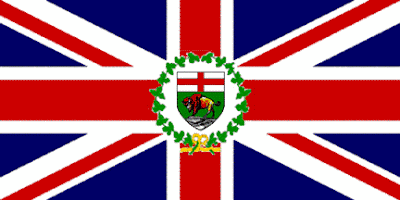 image by Martin Grieve
The 1880 badge was replaced by the arms, shield only, granted by royal warrant 10 May 1905. The Union Jack defaced with this badge was used as a car flag after 1956, and on Government House after 1965, until replaced by the present flag 11 May 1984. The addition of supporters, crest, motto etc., were granted by warrant of the Governor-General 23 October 1992.
David Prothero
image by Martin Grieve
The 1880 badge was replaced by the arms, shield only, granted by royal warrant 10 May 1905. The Union Jack defaced with this badge was used as a car flag after 1956, and on Government House after 1965, until replaced by the present flag 11 May 1984. The addition of supporters, crest, motto etc., were granted by warrant of the Governor-General 23 October 1992.
David Prothero
 A photo of the old flag flying from the Residence of the Lieutenant-Governor, scanned from Le Guide du Palais Legislatif du Manitoba.
 A current postcard showing the former Lt.Gov's flag
 Apparently during the most recent floods, a specially-designed blue ensign featuring a water buffalo was used on boats; I would love to find out more about this if true.

 Replica flag of the 5th Earl of Selkirk in parade size, flown for the first time at the Selkirk Highland Gathering on June 16th, 2012. The replica’s coat of arms was designed by Gary Styrchak and Claire Starling made five parade sized replicas, one of which was presented to Lord Selkirk in Scotland in August by the Lord Selkirk Boys’ Pipe Band.

Sewn version from Flying Colours
Glorious vintage sewn wool flag - 8 ft x 4 ft
Another vintage 1965 70.5 X 31.5. SCYCO
Lieutenant Governor's Flag (1905-1984)
 image by Martin Grieve
 A photo of the old flag flying from the Residence of the Lieutenant-Governor, scanned from Le Guide du Palais Legislatif du Manitoba.
 A current postcard showing the former Lt.Gov's flag
Purported blue ensign (10 May 1905 - 12 May 1966)


New Brunswick
 The province of New Brunswick employed ensign-based flags from its earliest period within the Canadian Confederation, having joined as one of the four original provinces on July 1, 1867, through the British North America Act. New Brunswick's entry into Confederation was itself a contentious political event, as significant portions of the population, particularly in the northern francophone communities and amongst the commercial interests of Saint John, had opposed the union during the debates of the mid 1860s. The colony had previously used a Blue Ensign bearing a colonial badge under the standard British imperial regulations governing Crown colonies, and this practice carried forward into the provincial period. New Brunswick received its coat of arms by royal warrant on May 26, 1868, making it one of the earliest Canadian provinces to receive a formal armorial grant. The design was straightforward, consisting of a gold lion passant guardant on a red field in the upper portion of the shield, with an ancient galley under sail on blue waves in the lower portion. The lion referenced the province's connection to the British Crown and its historical links to the Duchy of Brunswick in Germany, from which the province derived its name, having been named in honour of King George III, who was simultaneously the Duke of Brunswick-Lüneburg through the Hanoverian succession. The galley represented the shipbuilding industry that had dominated the province's economy throughout the 19th century, when New Brunswick was one of the world's leading producers of wooden sailing vessels. The Saint John shipyards alone produced hundreds of vessels during the golden age of wooden shipbuilding between 1820 and 1880, and the industry's prominence in the provincial identity justified its central position in the armorial design. This shield was placed on both Red Ensign and Blue Ensign formats for provincial use following the 1868 grant. The Red Ensign variant, bearing the provincial arms in the fly on the standard red field with the Union Jack in the canton, served as the primary provincial flag for public and civilian display. It flew at the Legislative Assembly building in Fredericton, at courthouses, schools, and public buildings across the province. The Blue Ensign variant was used in more narrowly official contexts, although the distinction was loosely observed in practice. For nearly a century, the Red Ensign format served as the de facto provincial flag without formal legislative authority, functioning through custom and administrative convention rather than statute.


 |
| (28 Sep 1870 - 18 May 1904) |
 Above the figures is the inscription Terra Nova, and below is the Latin motto Haec Tibi Dona Fero, translating to "I bring these gifts to thee." The Newfoundland Legislature officially recognised this Red Ensign as the national colours in the Civil Ensign Act of 1904, although the National Flag Act of 1931 later designated the Union Flag as the official national flag on land, relegating the Red Ensign to maritime and commercial usage.The Newfoundland Blue Ensign functioned as the official flag for vessels in the public service of the government, specifically those operating under the Department of Marine and Fisheries for customs enforcement and patrol duties. In accordance with the Colonial Naval Defence Act of 1865, this flag featured the Blue Ensign of the United Kingdom, possessing a blue field with the Union Flag in the upper canton, defaced with the same Mercury and Britannia badge centred in the fly.

The Red and Blue Ensigns with the great seal in the fly were Newfoundland's unofficial flags from 1904 until 1931. The Red Ensign was to be flown by commercial shipping whilst the blue was to be flown by governmental ships. Neither ensign was ever formally adopted by the national parliament, but the red ensign gained wide enough use, both at sea and on land, to be considered the unofficial national flag. The badge in the flag consists of Mercury, the God of Commerce and Merchandise, presenting to Britannia a fisherman who, in a kneeling attitude, is offering the harvest of all the sea. Above the device in a scroll are the words ' Terra Nova ', and below the motto Haec Tibi Dona Fero or "These gifts I bring thee."


Heavy canvas multi-piece stitched ensign with reinforced edging with the maker's stamp LANE & NEEVE LTD MILLWALL LONDON measuring approximately 51" x 102" or 4.25' x 8.5'; possibly made for military use or for flying outside a government building. The edging adjacent the Union Jack is marked 3 YRDS and "NEWFOUNDLAND NAGLE" handwritten in black ink. The Britannia Works of Messrs Lane & Neeve, sailcloth and sacking manufacturers, operated between 1893 and 1922 at which time they went into liquidation.
 Red ensign inside Newfoundland's Government House


10 feet by 5


Glorious 108" (275cm) X 51" (130cm) 9ft x 4ft vintage flag
 Newfoundland's National War Memorial being unveiled by Earl Haig on July 1, 1924.
http://www.heritage.nf.ca/greatwar/gallery/commem/national/haig/page3.html


The glorious red ensign of Newfoundland flies over Fort Amherst, at the entrance to St. John’s harbour.
 The Newfoundland Blue Ensign bearing the dominion arms served as the official governmental flag throughout the period of responsible government and continued in use during the Commission of Government period from February 16, 1934, when the dominion voluntarily suspended self-government due to the financial crisis caused by the collapse of fish prices and the crushing burden of war debt accumulated during the First World War. The Commission, consisting of six appointed commissioners under a British-appointed governor, administered Newfoundland as a direct dependency of the Crown from 1934 until Confederation with Canada in 1949. During this period, the Blue Ensign bearing the dominion arms continued to fly at government buildings in Saint John's, including the Colonial Building on Military Road which served as the seat of administration.
 The Newfoundland Blue Ensign bearing the dominion arms served as the official governmental flag throughout the period of responsible government and continued in use during the Commission of Government period from February 16, 1934, when the dominion voluntarily suspended self-government due to the financial crisis caused by the collapse of fish prices and the crushing burden of war debt accumulated during the First World War. The Commission, consisting of six appointed commissioners under a British-appointed governor, administered Newfoundland as a direct dependency of the Crown from 1934 until Confederation with Canada in 1949. During this period, the Blue Ensign bearing the dominion arms continued to fly at government buildings in Saint John's, including the Colonial Building on Military Road which served as the seat of administration.
 Lieutenant-Governor

The British derived flags of Newfoundland differ from those of other Canadian provinces because Newfoundland did not join the Canadian confederation until 1949. Thus the garland on the flag of the governor was laurel not maple, the badges also appeared on Blue Ensigns, and the Red Ensign was a merchant ensign, and not a provincial land flag like those of Ontario and Manitoba.
From the Lieutenant-Governor's Residence


 Besides the Union flag featured on the British Columbian flag and Manitoban and Ontario red ensigns, at the time it represented the province of Newfoundland, first adopted in 1931 and used until the suspension of responsible government in 1934. It was readopted as the official provincial flag in 1952, and used until 1980 when replaced by a particularly unfortunate design. According to Wikipedia the Newfoundland and Labrador branch of the Royal Canadian Legion still doesn't recognise the new Newfoundland flag, contending that during both world wars Newfoundland soldiers fought under the Union Flag of the dominion, and it displays the Union Flag at all official functions.
Although its international relations were still handled by Britain, Newfoundland had Dominion status and a National Flag Act was passed that became effective on 15 May 1931. It was originally intended that there should be three national flags, but this was amended to just one, the Union Jack. The circular badge on the governor's flag and ensigns was retained and not replaced by the shield of the arms. There was no section on penalties for misuse of flags, as the Statute of Westminster, a British Act that gave legal form to the Balfour definition of Dominion status, had not been enacted, and the British Commonwealth Merchant Shipping Agreement (1931) had not been signed. Any instances that arose would have been dealt with under the 1894 Merchant Shipping Act. [Public Record Office DO 35/130/8]. In 1933, owing to world depression and inability to meet interest charges on Public Debt, the Legislature asked the King to suspend the constitution and appoint Commissioners. They took office in 1934 thus ending Dominion status.After the 1939-1945 war, in a referendum held to decide Newfoundland's constitutional future, just over 52 percent of those voting favoured union with Canada, and this took effect 31 March 1949. It had no immediate effect on the flags in use, and the Revised Statutes of 1952, Chapter 272 retained the Red and Blue Ensigns, and reaffirmed the Union Jack as the 'national flag'. The ensigns were discontinued in 1965, when Canada adopted its current flag, but the Union Jack continued to be the provincial flag. While this was satisfactory in Newfoundland, it caused problems when flown on the Canadian mainland. It was not generally recognised as the flag of Newfoundland, but taken to be either the flag of the United Kingdom, or the Royal Union Flag. This was also a Union Jack, that had been adopted as an official Canadian flag on 18 December 1964. The present provincial flag was chosen by the House of Assembly on 28 May 1980, given royal assent on 6 June, and first raised on 24 June, the anniversary of the discovery of Newfoundland by John Cabot in 1497. David Prothero
Fictional Royal Newfoundland Air Force Ensign
 The individual selling this foolishly got duped by a spoof website. The Dominion of Newfoundland did not possess an independent air force and therefore never authorised a unique "Royal Newfoundland Air Force Ensign" analogous to the flags of the Royal Canadian Air Force or the Royal Australian Air Force. Instead, the Dominion contributed manpower to the Royal Air Force, most notably the No. 125 (Newfoundland) Squadron. Consequently, the air force ensign flown at the strategic airbases of Gander, Torbay, and Botwood during the Second World War was the standard Royal Air Force Ensign. For civil aviation purposes, the Dominion utilised the British Civil Air Ensign, which displays a light blue field divided by a dark blue cross fimbriated with white, with the Union Flag in the first quarter. This Civil Air Ensign was the standard flag flown by flying boats at the Botwood seaplane base and by civil carriers operating through Newfoundland airspace prior to 1949.

 The town of Cupids, Newfoundland, adopted a municipal flag that consists of a blue field with the Union Jack positioned in the canton in the upper left. The seal incorporates a representation of the original colonial plantation and the harbour at Cuper's Cove, surrounded by text reading "First English Colony in Canada" in reference to the settlement's status as the oldest continuously inhabited English settlement in the country. The blue field of the flag references the Atlantic Ocean and Conception Bay, upon whose western shore the town is situated. The retention of the Union Jack in the canton follows the Blue Ensign format that was standard across British colonial territories and was maintained in various Canadian municipal and provincial flags throughout the 19th and 20th centuries. The flag's design reflects the town's deliberate cultivation of its colonial founding heritage as a central element of its civic identity, particularly following the commencement of archaeological excavations at the plantation site in 1995 under the direction of William Gilbert and the subsequent designation of the site as a National Historic Site of Canada on November 19, 2001. The inclusion of the specific text "First English Colony in Canada" on the seal is a claim that has generated occasional dispute, as the English settlement at Saint John's, Newfoundland, whilst not formally chartered as a colony until a later date, had functioned as a seasonal and semi-permanent English fishing station from as early as the 1520s. The Cupids flag asserts the distinction between informal seasonal occupation and formally chartered colonial settlement, positioning Guy's 1610 plantation as the earliest deliberate attempt at permanent English colonisation in what is now Canadian territory. The flag is displayed at the Cupids Legacy Centre, at the town hall, and at civic events commemorating the founding of the settlement.
Northwest Territories
 |
| (c.1950 - 24 Feb 1956) |
 |
| (24 Feb 1956 - 31 Jan 1969) |
Nova Scotia
 |
| 1868-1929 |
 |
| image by Jaume Ollé |
Following the 1929 restoration, the province didn't update the Red Ensign with the new arms. Instead, the province adopted a banner of arms as its official flag. This design extends the 1625 shield—a silver field with a blue saltire charged with an inescutcheon of the Royal Arms of Scotland—across a rectangular shape. While the 1929 warrant authorised this banner, the actual physical transition was slow, and the Red Ensign with the obsolete 1868 salmon shield continued to appear in unofficial capacities for several years. However, legally, the era of the Nova Scotia Red Ensign concluded with the restoration of the ancient arms, making Nova Scotia the only province to transition from a de facto usage of the British ensign system to a banner of arms prior to the national flag debates of the 1960s.
 from http://www.clockworksky.net/cliveless_world/ah_cliveless_world_northam.html
Lieutenant Governor's Flag


images by Martin Grieve and Graham Bartram,
 http://www.flags.net/CANA02.htm
Unlike most other provincial vice-regals in Canada, the Lieutenant Governor of Nova Scotia bears a personal flag which consists of a Union Flag defaced with the shield of the Nova Scotia Coat of Arms surrounded by a circle of 18 green maple leaves. This is the last of the Canadian governors' flags to retain the original design set out by Queen Victoria in 1869.

.jpg)
Flying gloriously outside Province House in Halifax
Ontario
 Ontario's use of the Red Ensign bearing provincial arms commenced following the grant of the Ontario coat of arms by royal warrant on May 26, 1868. The shield, consisting of a red Saint George's Cross on a white field in the upper portion and three gold maple leaves conjoined on a single stem on a green field in the lower portion, was placed in the fly of the standard British Red Ensign. This arrangement was never formally legislated but functioned through administrative convention for ninety-seven years. The Red Ensign variant was the predominant version displayed at the Ontario Legislative Building at Queen's Park in Toronto, and was reproduced in miniature for desks in government offices, courtrooms, and school classrooms across the province. The Blue Ensign variant bearing the same arms was employed in more narrowly official and governmental contexts, particularly at federal-provincial meetings and at installations where protocol demanded the governmental rather than civilian ensign, although the distinction between the two was inconsistently maintained and the Red Ensign overwhelmingly dominated public display.
  |
|
1959-1965 |
 The crisis point arrived with the national flag debate of 1963 to 1965. Prime Minister Lester Pearson announced his intention to adopt a distinctive Canadian flag on May 27, 1964, proposing a design featuring three red maple leaves between two blue borders. The reaction in Ontario was fierce. Premier John Robarts publicly opposed the removal of the Red Ensign as the national flag, and the Ontario legislature debated the matter extensively. The Conservative caucus at Queen's Park was overwhelmingly hostile to Pearson's proposal, viewing the elimination of the Union Jack from the national flag as a betrayal of the Loyalist heritage upon which Ontario had been founded. When Parliament adopted the Maple Leaf flag on December 15, 1964, with the flag officially raised for the first time on February 15, 1965, the Ontario government moved immediately to preserve the ensign tradition at the provincial level. The Ontario Flag Act received first reading on April 14, 1965, and royal assent on May 21, 1965, formally adopting the Red Ensign bearing the Ontario shield of arms as the official provincial flag.
 Flag of the Lieutenant Governor of Ontario


Flying in Hamilton – January 7, 1939
 The Regional Municipality of
Niagara, established on January 1, 1970, through the amalgamation of the
former Lincoln and Welland counties, adopted a flag that incorporated
ensign-derived elements reflecting the region's Loyalist heritage. The
Niagara region had been one of the primary destinations for Loyalist
refugees following the American Revolutionary War, with thousands of
displaced families crossing the Niagara River from New York State into
the territory that became Upper Canada during the 1780s. The town of
Niagara-on-the-Lake, originally known as Newark, served as the first
capital of Upper Canada from 1792 to 1797 under Lieutenant Governor John
Graves Simcoe. The Niagara regional flag incorporated the red and white
colour scheme associated with the ensign tradition and included
heraldic elements referencing both the British connection and the
region's geographical identity centred on the Niagara River and the
Falls. The flag was displayed at the regional government headquarters in
Thorold and at municipal buildings throughout the constituent
communities of Saint Catharines, Niagara Falls, Welland, Fort Erie, Port
Colborne, Grimsby, Lincoln, Pelham, Wainfleet, West Lincoln, and
Thorold. The existence of the Niagara Blue Ensign alongside the Ontario Red Ensign demonstrates the profound and enduring influence of the 1865 Colonial Naval Defence Act standards on the identity of the province, preserving a system of flag identification that distinguishes between civil, governmental, and municipal authority through the colour of the ensign's field.
The Regional Municipality of
Niagara, established on January 1, 1970, through the amalgamation of the
former Lincoln and Welland counties, adopted a flag that incorporated
ensign-derived elements reflecting the region's Loyalist heritage. The
Niagara region had been one of the primary destinations for Loyalist
refugees following the American Revolutionary War, with thousands of
displaced families crossing the Niagara River from New York State into
the territory that became Upper Canada during the 1780s. The town of
Niagara-on-the-Lake, originally known as Newark, served as the first
capital of Upper Canada from 1792 to 1797 under Lieutenant Governor John
Graves Simcoe. The Niagara regional flag incorporated the red and white
colour scheme associated with the ensign tradition and included
heraldic elements referencing both the British connection and the
region's geographical identity centred on the Niagara River and the
Falls. The flag was displayed at the regional government headquarters in
Thorold and at municipal buildings throughout the constituent
communities of Saint Catharines, Niagara Falls, Welland, Fort Erie, Port
Colborne, Grimsby, Lincoln, Pelham, Wainfleet, West Lincoln, and
Thorold. The existence of the Niagara Blue Ensign alongside the Ontario Red Ensign demonstrates the profound and enduring influence of the 1865 Colonial Naval Defence Act standards on the identity of the province, preserving a system of flag identification that distinguishes between civil, governmental, and municipal authority through the colour of the ensign's field.
Prince Edward Island
 |
| (23 Sep 1905 - 24 Mar 1964) |
The original shield featured a gold lion passant guardant on a red background in the chief and a large oak tree protecting three oak saplings on a white background in the base, representing the relationship between the colony and the United Kingdom. Under the provisions of the Colonial Naval Defence Act of 1865, the provincial government was authorised to fly the Blue Ensign on vessels owned or operated by the Crown in the right of Prince Edward Island. This flag consisted of the Blue Ensign of the United Kingdom, possessing a blue field with the Union Flag in the upper canton, defaced with the provincial shield centred in the fly. Regarding the Red Ensign, the provincial legislature never passed a statute adopting a Red Ensign defaced with the Prince Edward Island shield for official use on land. Despite the lack of official status, commercial flag manufacturers produced unauthorised Red Ensigns bearing the provincial shield in the fly, which private citizens and municipal institutions purchased to display a distinct provincial identity alongside the Canadian Red Ensign.


Quebec

 Under the provisions of the Colonial Naval Defence Act of 1865, the provincial government of Quebec was authorised to utilise a Blue Ensign defaced with this shield for vessels owned or operated by the Crown in the right of Quebec. This flag consisted of the Blue Ensign of the United Kingdom, possessing a blue field with the Union Flag in the upper canton, defaced with the provincial shield centered in the fly. Regarding the Red Ensign, the provincial legislature never passed a statute adopting a Red Ensign defaced with the Quebec shield for official use on land. Despite the lack of official status, commercial flag manufacturers produced unauthorised Red Ensigns bearing the Quebec shield in the fly, which private citizens and businesses occasionally purchased to display a distinct provincial identity alongside the Canadian Red Ensign. However, the use of the British ensign system in Quebec was significantly less popular than in the anglophone provinces due to the cultural distinctiveness of the francophone majority. The reliance on the Union Flag and the defaced ensigns was effectively terminated on January 21, 1948, when the provincial government under Premier Maurice Duplessis adopted the Fleurdelisé as the official flag of Quebec via an Order in Council. This new design, featuring a white cross on a blue field with four white fleurs-de-lis, replaced the Union Flag on the the Parliament Building in Quebec City on the same day.
 Montreal's arms consists of a white cross that divides the field into four quarters. In each quarter is placed a symbol representing one of the four founding peoples of the city as recognised at the time of adoption. The upper left quarter contains a gold fleur-de-lis representing the French, the upper right contains a red rose representing the English, the lower left contains a green shamrock representing the Irish, and the lower right contains a thistle representing the Scots. A white pine was added to the centre of the flag on September 9, 2017, to represent Indigenous peoples, a modification approved by the city council under Mayor Denis Coderre in response to calls for greater recognition of the Indigenous presence on the island of Montreal, which had been the site of the Haudenosaunee settlement of Hochelaga recorded by Jacques Cartier during his visit in October 1535. The original city without the pine had been designed to reflect the ethnic composition of Montreal's population as understood in the 1930s, when the four European founding groups dominated the city's civic, commercial, and religious institutions.
Saskatchewan
 Upon the establishment of the Province of Saskatchewan on September 1, 1905, the government adhered to the vexillological traditions of the British Empire regarding the use of ensigns to signify administrative authority. The primary heraldic symbol for the province was the shield of arms, which King Edward VII granted via Royal Warrant on August 25, 1906. This shield featured three gold sheaves of wheat on a green background in the base and a red lion passant guardant on a gold background in the chief. Under the provisions of the Colonial Naval Defence Act of 1865, the provincial government was authorised to utilise a Blue Ensign defaced with this shield for vessels owned by the Crown in the right of Saskatchewan. However, due to the landlocked geography of the province, the practical application of this maritime flag was negligible compared to coastal jurisdictions.
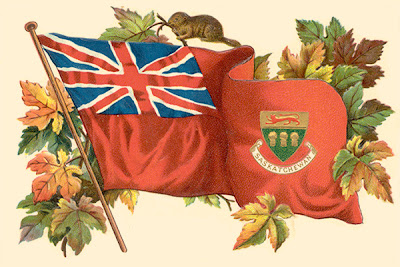 Regarding
the Red Ensign, the provincial legislature never passed a statute
adopting a Red Ensign defaced with the Saskatchewan shield for official
use on land. The authorised flag for public buildings remained the Royal
Union Flag and the Canadian Red Ensign. Despite the lack of official
status, commercial flag manufacturers produced unauthorised Red Ensigns
bearing the Saskatchewan shield in the fly, which private citizens and
municipal institutions purchased to display a distinct provincial
identity. This unofficial usage of the defaced Red Ensign persisted
until the provincial government sought a unique design to commemorate
the 60th anniversary of the province.
Regarding
the Red Ensign, the provincial legislature never passed a statute
adopting a Red Ensign defaced with the Saskatchewan shield for official
use on land. The authorised flag for public buildings remained the Royal
Union Flag and the Canadian Red Ensign. Despite the lack of official
status, commercial flag manufacturers produced unauthorised Red Ensigns
bearing the Saskatchewan shield in the fly, which private citizens and
municipal institutions purchased to display a distinct provincial
identity. This unofficial usage of the defaced Red Ensign persisted
until the provincial government sought a unique design to commemorate
the 60th anniversary of the province.
According to Mr. Tim Novak, archivist at the Saskatchewan Archives Board,

 Under the provisions of the Colonial Naval Defence Act of 1865, the provincial government of Quebec was authorised to utilise a Blue Ensign defaced with this shield for vessels owned or operated by the Crown in the right of Quebec. This flag consisted of the Blue Ensign of the United Kingdom, possessing a blue field with the Union Flag in the upper canton, defaced with the provincial shield centered in the fly. Regarding the Red Ensign, the provincial legislature never passed a statute adopting a Red Ensign defaced with the Quebec shield for official use on land. Despite the lack of official status, commercial flag manufacturers produced unauthorised Red Ensigns bearing the Quebec shield in the fly, which private citizens and businesses occasionally purchased to display a distinct provincial identity alongside the Canadian Red Ensign. However, the use of the British ensign system in Quebec was significantly less popular than in the anglophone provinces due to the cultural distinctiveness of the francophone majority. The reliance on the Union Flag and the defaced ensigns was effectively terminated on January 21, 1948, when the provincial government under Premier Maurice Duplessis adopted the Fleurdelisé as the official flag of Quebec via an Order in Council. This new design, featuring a white cross on a blue field with four white fleurs-de-lis, replaced the Union Flag on the the Parliament Building in Quebec City on the same day.


Saskatchewan
 Upon the establishment of the Province of Saskatchewan on September 1, 1905, the government adhered to the vexillological traditions of the British Empire regarding the use of ensigns to signify administrative authority. The primary heraldic symbol for the province was the shield of arms, which King Edward VII granted via Royal Warrant on August 25, 1906. This shield featured three gold sheaves of wheat on a green background in the base and a red lion passant guardant on a gold background in the chief. Under the provisions of the Colonial Naval Defence Act of 1865, the provincial government was authorised to utilise a Blue Ensign defaced with this shield for vessels owned by the Crown in the right of Saskatchewan. However, due to the landlocked geography of the province, the practical application of this maritime flag was negligible compared to coastal jurisdictions.
  Regarding
the Red Ensign, the provincial legislature never passed a statute
adopting a Red Ensign defaced with the Saskatchewan shield for official
use on land. The authorised flag for public buildings remained the Royal
Union Flag and the Canadian Red Ensign. Despite the lack of official
status, commercial flag manufacturers produced unauthorised Red Ensigns
bearing the Saskatchewan shield in the fly, which private citizens and
municipal institutions purchased to display a distinct provincial
identity. This unofficial usage of the defaced Red Ensign persisted
until the provincial government sought a unique design to commemorate
the 60th anniversary of the province.
Regarding
the Red Ensign, the provincial legislature never passed a statute
adopting a Red Ensign defaced with the Saskatchewan shield for official
use on land. The authorised flag for public buildings remained the Royal
Union Flag and the Canadian Red Ensign. Despite the lack of official
status, commercial flag manufacturers produced unauthorised Red Ensigns
bearing the Saskatchewan shield in the fly, which private citizens and
municipal institutions purchased to display a distinct provincial
identity. This unofficial usage of the defaced Red Ensign persisted
until the provincial government sought a unique design to commemorate
the 60th anniversary of the province. According to Mr. Tim Novak, archivist at the Saskatchewan Archives Board,
It is my opinion that no such flag has ever existed for Saskatchewan, officially or unofficially. The use of the Red Ensign with the Saskatchewan arms in the fly was likely created from the imagination of the postcard artist or publisher. Postcard collectors may know of similar cards from this series for other provinces. The postcard probably dates from the early 1900s to 1910s.
Vancouver Island
 Vancouver Island (officially known as the Island of Vancouver and its Dependencies), was a crown colony of British North America from 1849 to 1866, after which it was united with British Columbia. The united colony joined the Canadian Confederation in 1871. The colony comprised Vancouver Island and the Gulf Islands of the Strait of Georgia.The British colonial flag of Vancouver Island today used as a local representative flag. The Colony of Vancouver Island, established as a Crown colony in 1849, utilised the vexillological standards of the British Empire to denote its distinct administrative status prior to its amalgamation with the mainland. The primary symbol employed for flag identification was derived from the Great Seal of the Island of Vancouver and its Dependencies, which Queen Victoria formally approved on December 13, 1849. This seal featured a complex allegorical design depicting a trident, a caduceus, and a cornucopia to symbolise the maritime, commercial, and agricultural potential of the territory, surmounted by a beaver resting on a pine cone.
  Following the enactment of the Colonial Naval Defence Act of 1865, the colonial government was authorised to fly the Blue Ensign on vessels owned or operated by the public service. This flag consisted of the Blue Ensign of the United Kingdom, possessing a blue field with the Union Flag in the upper canton, defaced with the colonial badge centred in the fly. The badge utilised on the flag typically placed the elements of the seal within a white roundel to ensure visibility against the dark blue background. Regarding the Red Ensign, merchant vessels registered in the capital city of Victoria flew the Red Ensign of the United Kingdom as their maritime colours. While the British Admiralty regulations of the period generally prohibited the defacement of the Red Ensign by colonies without a specific Royal Warrant, unauthorised versions featuring the Vancouver Island badge in the fly were manufactured and utilised by local merchant captains to distinguish their ships from those of the mother country. The official usage of these separate colonial ensigns was terminated on November 19, 1866, when the British Parliament enforced the union of the Colony of Vancouver Island with the Colony of British Columbia. Upon this political consolidation, the independent jurisdiction of the island ceased, rendering its specific Blue Ensign obsolete and requiring the adoption of the symbols of the united Colony of British Columbia for all subsequent maritime and administrative purposes.

Yukon
The Yukon Territory didn't possess a distinct Blue Ensign or Red Ensign authorised by Royal Warrant during its early history. Unlike the Canadian provinces which held specific maritime privileges under the Colonial Naval Defence Act of 1865, the Yukon was a territory administered directly by the federal government and therefore utilised the standard flags of the Dominion of Canada. The primary flag flown on land for administrative and civil purposes was the Royal Union Flag and subsequently the un-defaced Canadian Red Ensign. The territory lacked a coat of arms until Queen Elizabeth II granted the shield via Royal Warrant on February 24, 1956. Following this grant, commercial flag manufacturers produced unofficial versions of the Canadian Red Ensign defaced with the territorial shield in the fly for sale to private citizens, but the Territorial Council never ratified this design for official government use. The Commissioner of the Yukon utilised a personal standard consisting of the Union Flag defaced with the coat of arms surrounded by a garland of maple leaves following the 1956 grant.
 (1934 - 5 Nov 1956)
(5 Nov 1956 - 1 Dec 1967)
Royal Canadian Mounted Police

Various Canadian Companies and Organisations
Hudson's Bay Company

Various Canadian Companies and Organisations
Hudson's Bay Company

 |
| Flying above Nanaimo Bastion, Nanaimo, British Columbia |
 The Hudson's Bay Company functioned not merely as a commercial enterprise but as the de facto government of Rupert's Land, exercising judicial, military, and administrative authority over the territory in the absence of any other British governmental presence. The ensign therefore served a dual function, identifying company vessels and installations commercially whilst simultaneously asserting British sovereignty over the territory against competing French claims. The French, operating from their base in New France, contested British control of the Hudson Bay region throughout the late 17th and early 18th centuries, and the company's posts were attacked and captured on multiple occasions during the Anglo-French wars. York Factory itself changed hands between British and French forces several times between 1694 and 1714, and the company ensign was hauled down and replaced by the French fleur-de-lis on each occasion before being restored following the Treaty of Utrecht on April 11, 1713, which confirmed British sovereignty over the Hudson Bay drainage basin.
  The ensign was carried inland as the company expanded its operations westward during the late 18th and early 19th centuries in response to competition from the North West Company, a Montreal-based rival that had established a network of trading posts across the interior of the continent. The Hudson's Bay Company ensign flew at posts established along the Saskatchewan, Athabasca, Peace, and Columbia river systems as the company's traders pushed into the prairies, the boreal forest, and eventually the Pacific slope. Following the forced merger of the Hudson's Bay Company and the North West Company on March 26, 1821, which eliminated the competitive threat and consolidated the entire fur trade under a single corporate structure, the company ensign became the sole commercial flag displayed across the vast network of trading posts stretching from Hudson Bay to the Pacific Ocean and from the Great Lakes to the Arctic.
 The company ensign flew at Fort Vancouver on the Columbia River, the headquarters of the Columbia District, which encompassed the present-day states of Washington, Oregon, and Idaho as well as the mainland of British Columbia. It flew at Fort Victoria, established on the southern tip of Vancouver Island in 1843 by James Douglas as the new Pacific headquarters in anticipation of the loss of the Columbia District to the United States. When the Oregon Treaty of June 15, 1846, established the 49th parallel as the international boundary, the company ensign was lowered at Fort Vancouver and the American flag raised in its place, whilst the company ensign continued to fly at Fort Victoria and the posts north of the border.The ensign underwent modifications during the 19th century as the company's status evolved. The original armorial badge was simplified for practical use on flags, and variations appeared across different posts and vessels. Some versions displayed only the initials HBC on the fly of the Red Ensign rather than the full coat of arms, a simplified rendering that was easier to produce and identify at a distance. The letters HBC were popularly interpreted by the company's critics and by Indigenous peoples as standing for "Here Before Christ," a reference to the company's antiquity and its pervasive presence across the northern half of the continent. The transfer of Rupert's Land from the Hudson's Bay Company to the Dominion of Canada on July 15, 1870, for a payment of 300,000 pounds and the retention of one twentieth of the fertile belt of the prairies, terminated the company's sovereign authority over the territory and consequently its right to fly the ensign as a symbol of governmental jurisdiction.
  The company ensign thereafter served a purely commercial function, identifying company trading posts, retail stores, and vessels. The company continued to operate its northern trading post network well into the 20th century, and the ensign remained in use at remote posts across the Arctic and subarctic where the Hudson's Bay Company store constituted the sole commercial establishment. The ensign flew at posts in Baffin Island, the Mackenzie Delta, the Keewatin District, and northern Quebec throughout the early and mid 20th century.The modern Hudson's Bay Company, which transformed from a fur trading enterprise into a Canadian retail corporation during the 20th century, has retained the historical coat of arms and the ensign as corporate heritage symbols. The ensign is displayed at the company's flagship department stores and at corporate events, serving as a link to the 1670 charter and the company's claim to being the oldest incorporated joint-stock merchandising company in the English-speaking world.


Glorious rare 1920-30's HUGE Canada Hudson's Bay Company sewn ensign by Leckie Toronto


Dates to the 1920s and flown at various premises belonging to the Hudson’s Bay Company including outside Hudson Bay House in Lime Street in London from 1924. It was also flown in Fenchurch Street , Great Trinity Lane ( on Garlick Hill ) and Bishopgate Street, also in the City of London as the premises moved over the years. It measures 12 feet 70 inches by 5 feet 10 inches and bears the label of John Edgington and Co Ltd of 108 Old Kent Road, London.


Flag appears to be made of a satin type fabric with "HBC" sewn on but Union Jack printed. Dates before 1969) but looks the same (& same fabric) as the one the UK National Maritime Museum has on its website:
 The flag is made of nylon fabric and it is machine sewn with the design printed. A rope and toggle is attached.


The flag on the left is at the Prince of Wales Northern Heritage Centre


Left: Hanging in Christ Church Cathedral in Victoria, B. C., Canada. It is the flag that flew from many of the Hudson Bay trading ships that arrived in Victoria Harbour, and was the flag that flew over Fort Victoria.


Hudson's Bay Company, Fort Vancouver, Washington. Image taken August 27, 2006.
http://www.iinet.com/~englishriver/LewisClarkColumbiaRiver/Regions/Places/fort_vancouver.html
 Flag held at the Glenbow Museum (Alberta) used at the Hudson's Bay Company's 250th anniversary pageant, Lower Fort Garry, 1920 and featured in the online exhibition Mavericks: An Incorrigible History of Alberta.


HBC Flag flies over Fort Umpqua near Elkton, Oregon and Fort St. James, British Columbia
 Supposed flag for Nunavut
 Flag held at the Glenbow Museum (Alberta) used at the Hudson's Bay Company's 250th anniversary pageant, Lower Fort Garry, 1920 and featured in the online exhibition Mavericks: An Incorrigible History of Alberta.
HBC Flag flies over Fort Umpqua near Elkton, Oregon and Fort St. James, British Columbia


North West Company

The North West Company was a fur-trading business started in 1779 in Montreal. After operating for 40 years in the Canadian North-West, it merged with the Hudson Bay Company in 1821. In 1987, a group of investors (including 415 employees) purchased the Northern Stores Division from the Hudson Bay Company and took back its historical name and flag. With 300 years of history under its belt as a provider of food and everyday products and services to remote communities across northern Canada and Alaska, the North West Company is now the oldest retailer on the continent.
http://www.loeser.us/flags/canada.html


Grand Portage National Monument in northern Minnesota.
Grand Portage National Monument in northern Minnesota.
Grand Orange Lodge of Canada


 The Royal Hamilton Yacht Club possesses a distinct vexillological status within the Dominion of Canada derived from a specific warrant issued by the British Admiralty during the reign of Queen Victoria. Following the grant of the title Royal to the Hamilton Yacht Club on May 30, 1891, the Lords Commissioners of the Admiralty authorised the club to utilise the Blue Ensign of Her Majesty's Fleet, defaced with the club's specific badge. This privilege distinguished the club from the majority of civilian maritime organisations which were restricted to the Red Ensign. The authorised Blue Ensign consists of the Blue Ensign of the United Kingdom, featuring a blue field with the Union Flag in the upper canton next to the staff, defaced in the centre of the fly with a gold maple leaf surmounted by the Royal Crown. The crown depicted on the badge has evolved from the Victorian crown to the Tudor crown and subsequently the St Edward's Crown, reflecting the reign of the monarch, whilst the gold maple leaf has remained the constant emblem of the club's Canadian identity. The usage of this defaced Blue Ensign is strictly regulated by the Naval Defence Act and Admiralty instructions, which require that the vessel be registered as a British ship, be owned by a member of the club, and that the owner be on board or in effective control of the vessel. Members who do not meet these specific warrant requirements, or who are sailing vessels not registered under the Merchant Shipping Act, are required to fly the Canadian Red Ensign or the national flag. The Royal Hamilton Yacht Club remains one of the few yacht clubs in Canada, alongside the Royal Canadian Yacht Club and the Royal Nova Scotia Yacht Squadron, to retain this imperial maritime privilege, preserving the usage of the British Blue Ensign for its warrant-holding members into the 21st century.
Royal Lake of the Woods Yacht Club
 The club's location on Lake of the Woods placed it in one of the most geographically remote settings of any royal yacht club in Canada. The Royal Lake of the Woods Yacht Club, located in Kenora, Ontario, occupies a distinct position in Canadian vexillology as it was granted the title Royal by King George V on August 21, 1925, and subsequently authorised by the British Admiralty to utilise a defaced Blue Ensign. This privilege distinguishes the club from the majority of Canadian yacht clubs, which are restricted to the Red Ensign or the national flag. The badge depicts a gold fouled anchor surmounted by the Royal Crown, with the initials R.L.W.Y.C. arranged in the design. The crown utilised on the badge has evolved from the Tudor Crown to the St Edward's Crown to reflect the reign of the monarch.


Canadian Yacht Club Ensigns
Royal Hamilton Yacht Club
 The Royal Hamilton Yacht Club possesses a distinct vexillological status within the Dominion of Canada derived from a specific warrant issued by the British Admiralty during the reign of Queen Victoria. Following the grant of the title Royal to the Hamilton Yacht Club on May 30, 1891, the Lords Commissioners of the Admiralty authorised the club to utilise the Blue Ensign of Her Majesty's Fleet, defaced with the club's specific badge. This privilege distinguished the club from the majority of civilian maritime organisations which were restricted to the Red Ensign. The authorised Blue Ensign consists of the Blue Ensign of the United Kingdom, featuring a blue field with the Union Flag in the upper canton next to the staff, defaced in the centre of the fly with a gold maple leaf surmounted by the Royal Crown. The crown depicted on the badge has evolved from the Victorian crown to the Tudor crown and subsequently the St Edward's Crown, reflecting the reign of the monarch, whilst the gold maple leaf has remained the constant emblem of the club's Canadian identity. The usage of this defaced Blue Ensign is strictly regulated by the Naval Defence Act and Admiralty instructions, which require that the vessel be registered as a British ship, be owned by a member of the club, and that the owner be on board or in effective control of the vessel. Members who do not meet these specific warrant requirements, or who are sailing vessels not registered under the Merchant Shipping Act, are required to fly the Canadian Red Ensign or the national flag. The Royal Hamilton Yacht Club remains one of the few yacht clubs in Canada, alongside the Royal Canadian Yacht Club and the Royal Nova Scotia Yacht Squadron, to retain this imperial maritime privilege, preserving the usage of the British Blue Ensign for its warrant-holding members into the 21st century.
 Royal Lake of the Woods Yacht Club
 The club's location on Lake of the Woods placed it in one of the most geographically remote settings of any royal yacht club in Canada. The Royal Lake of the Woods Yacht Club, located in Kenora, Ontario, occupies a distinct position in Canadian vexillology as it was granted the title Royal by King George V on August 21, 1925, and subsequently authorised by the British Admiralty to utilise a defaced Blue Ensign. This privilege distinguishes the club from the majority of Canadian yacht clubs, which are restricted to the Red Ensign or the national flag. The badge depicts a gold fouled anchor surmounted by the Royal Crown, with the initials R.L.W.Y.C. arranged in the design. The crown utilised on the badge has evolved from the Tudor Crown to the St Edward's Crown to reflect the reign of the monarch.
Miscellaneous Canadian Flags and Ensigns
Mysterious Canadian Ensign
 The flag shown above does not match any known description. It is obviously old and measures 8' long by 5' wide. The main colour is red but the unique thing is the presence of a Union Jack in the upper corner in which all the blue has been very carefully removed and replaced with white linen. This very nearly resembles the flag shown in Lord Selkirk's drawing of Fort Douglas.
A newspaper report describes this flag as being used by Sheriff Inkster at the unveiling of a cairn in 1927 and mentions that it was made by Canadian soldiers and flown over Fort Garry when they occupied it after the uprising. It is obviously a home-made flag, but the removal of the blue triangles remains a mystery.
James B. Stanton, Director, Human History Division, Manitoba Museum of Man and Nature.
Manitoba Pageant, Spring 1971, Volume 16, Number 3
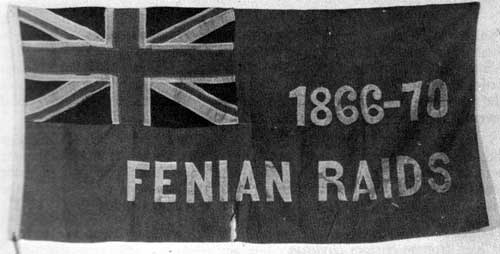
Fenian Raids flag
Many Canadian militia units were called-up to active duty during the Fenian raids and it is possible that the flag shown here belonged to one of them. The Canadian units involved included the Royal Canadian Rifles, Whittey Rifles, Brockville Rifle Company, Hemmingford Company, Toronto Field Battery, Montreal Garrison Artillery, Montreal and Ottawa Garrison Artillery, Ottawa and Carleton Rifles, Quebec Rifles - and several Canadian Indians who acted as boatmen.
Manitoba saw many flags flying over it, and it is possible that this flag could have been brought out with one of the regiments that came here in 1870. It appears to be of the right age and is the sort of thing regiments often carried with them.
Supposed Metis flag

Canadian Military Flags
Canadian regimental flags


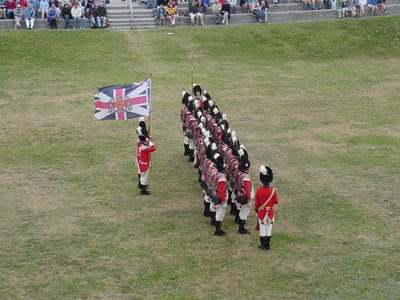
 A Newfoundland regiment was first established to serve in the British Army in 1795. It was disbanded and refounded several times under different names, including His Majesty's Royal Newfoundland Regiment of Foot, The Royal Newfoundland Veterans Companies and The Royal Newfoundland Companies. The regiment dates its origin to 1795, when Major Skinner of the Royal Engineers stationed in St. John's at Fort Townshend, was ordered to raise a regiment.
The regiment was significantly involved in the War of 1812. Soldiers of the regiment fought aboard ships as marines in battles of the Great Lakes, as infantry in Michigan, and in the battle to defend York (Toronto). It was largely distributed throughout the zone as attached sub-units and not as a formed battalion. It was disbanded in 1816. A monument depicting a soldier of the 1813 Royal Newfoundland Regiment standing over a fallen American infantryman was unveiled in Toronto in November 2008.


 http://www.signalhilltattoo.ca/Grenadiers.htm


Calgary Highlanders
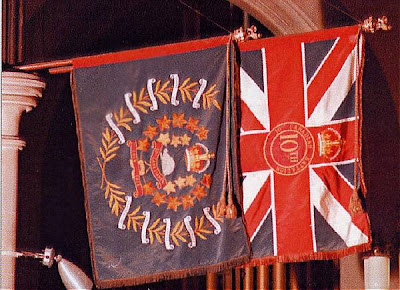 The Colours of the Tenth Battalion at Knox Presbyterian United Church in Calgary, officially deposited 26 April 1953.


 As it now appears at the Cathedral of the Redeemer.
Saskatoon Light Infantry
As it now appears at the Cathedral of the Redeemer.
Saskatoon Light Infantry
 Regimental Colours of New Brunswick
 Death of General Wolfe
The 78th Regiment, (Highland) Regiment of Foot otherwise known as the 78th Fraser Highlanders was a British infantry regiment of the line unit raised in Scotland in 1757, to fight in the French and Indian War.
Death of General Wolfe
The 78th Regiment, (Highland) Regiment of Foot otherwise known as the 78th Fraser Highlanders was a British infantry regiment of the line unit raised in Scotland in 1757, to fight in the French and Indian War.


 His Majesty's Canadian Regiment of Fencible Infantry 1803-1816
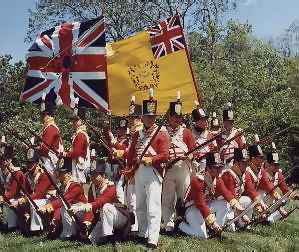 Royal Westminster Regimental Colours
 Colours Of The Thirteenth Regiment
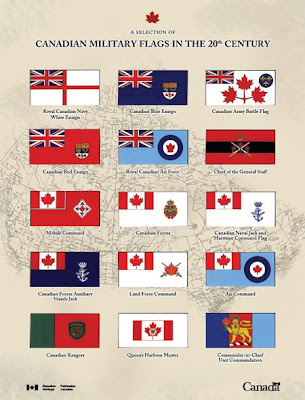
 Canadian Military Flags in the 20th Century
 Canadian red ensign

Canadian blue ensign
 Royal Canadian Navy
 Royal Canadian Air Force
 Canadian Army Battle Flag (Canadian Active Service Force Flag 1939-1944)
Royal Canadian Ordnance Corps

The Royal Canadian Ordnance Corps does not have colours in the military meaning commonly associated with that of the Cavalry and Infantry, but has the unique distinction of flying a flag which embraces the Union flag in its upper canton next to the flag staff.
Royal Canadian Army Services Corps ensign


 WWII Canadian blue naval ensign division flag for the Royal Canadian Army Services Corps. featuring stitched golden crossed swords in the field, the division symbol for the RCASC. Made for use on small ships and landing craft used for carrying the RCASC. Notably, the RCASC served Canada in the Dieppe raid as well as on D-Day in WWII.
Royal Canadian Sea Cadets
 The first Ensign of the Royal Canadian Sea Cadets (RCSC) was a white flag with a Union Jack Canton with the insignia of the RCSC at the fly. Christophe T. Stevenson (Ex-Coxswain of the RCSCC 223 Longueull)

 The Royal Canadian Air Cadets, established as the Air Cadets of Canada by Order in Council PC 2649 on April 9, 1941, utilised the vexillological symbols of the Royal Canadian Air Force to denote their affiliation with the military aviation of the British Empire. Throughout the Second World War and the post-war era, the squadrons of the Air Cadets flew the Royal Canadian Air Force Ensign as their primary colour. This flag, which King George VI approved on July 5, 1940, consisted of a light blue field, legally defined as Air Force Blue, with the Union Flag in the upper canton next to the staff. The fly of the ensign was defaced with the Royal Canadian Air Force roundel, which featured a red maple leaf within a white circle surrounded by a blue ring. Following the granting of the prefix Royal to the organisation by King George VI on September 19, 1946, the Royal Canadian Air Cadets continued to parade under this ensign, which visually linked the youth organisation to the Royal Air Force Ensign used in the United Kingdom.
 pBQ4loMz4hg~~60_57.JPG) The specific badge of the Royal Canadian Air Cadets, which depicts a gold eagle volant superimposed on a red maple leaf, surmounted by the Royal Crown and surrounded by a blue annulus bearing the motto To Learn To Serve, was worn on uniforms but did not appear on a defaced ensign with the Union Flag during this period. The organisation relied exclusively on the standard RCAF Ensign for ceremonial purposes and at Cadet Summer Training Centres such as Greenwood and Trenton. This adherence to the British imperial ensign pattern persisted until September 22, 1971, when Queen Elizabeth II approved a new distinctive ensign for the cadets that replaced the Union Flag in the canton with the Canadian Maple Leaf flag, thereby terminating the use of the Air Force Blue Ensign with the Union Jack by the cadet movement.
The specific badge of the Royal Canadian Air Cadets, which depicts a gold eagle volant superimposed on a red maple leaf, surmounted by the Royal Crown and surrounded by a blue annulus bearing the motto To Learn To Serve, was worn on uniforms but did not appear on a defaced ensign with the Union Flag during this period. The organisation relied exclusively on the standard RCAF Ensign for ceremonial purposes and at Cadet Summer Training Centres such as Greenwood and Trenton. This adherence to the British imperial ensign pattern persisted until September 22, 1971, when Queen Elizabeth II approved a new distinctive ensign for the cadets that replaced the Union Flag in the canton with the Canadian Maple Leaf flag, thereby terminating the use of the Air Force Blue Ensign with the Union Jack by the cadet movement.
The Most Blessed Work in the World

Regiment de Meuron

 The Regiment de Meuron was a regiment of infantry originally raised in Switzerland in 1781 named for its commander, Colonel Charles Daniel de Meuron, born in Neuchatel in 1738. It served the Dutch East India Company in Ceylon and Cape Town. When the Dutch East India Company went bankrupt in 1795, and were unable to pay the regiment, they entered British service, with the understanding that the British would enrol them at the same rate as regular British soldiers and give them the back pay owed by the Dutch East India Co.
His Majesty’s Royal Newfoundland Regiment of Foot
By 1798, this had all been straightened out, and the Regiment de Meuron were fully entered into British service. They served in the Mysore Campaign of 1799, the Mediterranean and Peninsula Campaigns of the Napoleonic Wars 1806 to 1812, and finally went to Canada to serve in the War of 1812 and the Red River Colony. http://en.wikipedia.org/wiki/Regiment_de_Meuron
His Majesty’s Royal Newfoundland Regiment of Foot
The regiment was significantly involved in the War of 1812. Soldiers of the regiment fought aboard ships as marines in battles of the Great Lakes, as infantry in Michigan, and in the battle to defend York (Toronto). It was largely distributed throughout the zone as attached sub-units and not as a formed battalion. It was disbanded in 1816. A monument depicting a soldier of the 1813 Royal Newfoundland Regiment standing over a fallen American infantryman was unveiled in Toronto in November 2008.
Lachlan Macquarie: Regimental Colours
And
I am the extraordinary regimental flag that marked the victory of the
Hemmingford militia who marched against their foes on a cold November
day in 1838. I never saw the battlefield but I saw the pride in the eyes
of the men who defended the Crown in the Battle of Lacolle and
Odelltown when I was presented to their Colonel. - See more at:
http://100objects.qahn.org/content/drum-and-flag-rebellion-1838#sthash.T1JeeaHy.dpuf
The regimental flag that marked the victory of the Hemmingford militia who marched against their foes on a cold November day in 1838 defending the Crown in the Battle of Lacolle and Odelltown when presented to their Colonel.Calgary Highlanders
 The Colours of the Tenth Battalion at Knox Presbyterian United Church in Calgary, officially deposited 26 April 1953.
The first stand of Colours belonging to The Calgary Highlanders, presented 28 December 1927 on the left and the new stand of Colours presented in 1967 with the Tudor crown replaced with the St. Edward's crown, HRH Princess Alexandra of Kent.
 As it now appears at the Cathedral of the Redeemer.
  Regimental Colours of New Brunswick

 Death of General Wolfe
 His Majesty's Canadian Regiment of Fencible Infantry 1803-1816
 Royal Westminster Regimental Colours
 Colours Of The Thirteenth Regiment
 Canadian Military Flags in the 20th Century
 Canadian red ensign
Canadian blue ensign
 Royal Canadian Navy
 Royal Canadian Air Force
 Canadian Army Battle Flag (Canadian Active Service Force Flag 1939-1944)
  |
| Produced by Flying Colours |
In the Second World War, which Canada entered after Britain declared war on Germany, they used the Canadian Red Ensign as their national flag, but also in use was a lesser known battle flag. Canada wanted its army to be distinguishable among the great mass of British troops, and so provided it with, not the Canadian Red Ensign, but this new battle flag. Designed by Colonel Archer Fortescue Duguid, Director of the Historical Section of the National Defence Headquarters in Ottawa, the flag of the Canadian Active Service Force, generally known as the "Battle Flag of Canada," was approved by the War Cabinet December 7 1939.
http://www.loeser.us/flags/canada.html
Upon entering the Second World War, Canada wanted its army to be distinguishable among the great mass of British troops, and so provided it with, not the Canadian Red Ensign, but a new battle flag. Designed by Colonel A. Fortescue Duguid, Director of the Historical Section, National Defence Headquarters, Ottawa, the flag of the Canadian Active Service Force, generally known as the Battle Flag of Canada, was approved by the War Cabinet in December 1939.
The Battle Flag not only appeared on the Canadian headquarters overseas, it appeared on all manner of promotional material on the home front: pins, postcards, posters, magazine covers, and advertisements. Sometimes it appeared alone, sometimes with the Union Flag to emphasize our solidarity with Britain, and sometimes with the flags of the other services, the RCAF ensign and the White Ensign of the RCN, to tell of our many-sided support for the war.
"The flag," comments historian George F.G. Stanley, "was new. It was distinctive. It contained something to please everybody and represented all aspects of Canada's history. But it was cluttered and never won the affection of the officers and men of Canada's army. Eventually it ceased to be seen."From the chapter entitled Flags of National Defence from the book The Flags of Canada, by Alistair B. Fraser
Remarkable example from the George Curtis collection
The Royal Canadian Ordnance Corps does not have colours in the military meaning commonly associated with that of the Cavalry and Infantry, but has the unique distinction of flying a flag which embraces the Union flag in its upper canton next to the flag staff.
The Royal Canadian Ordnance Corps is the only Corps in the Canadian Army that has had this singular privilege bestowed upon it and which traditionally commenced through its parent corps, the royal Army Ordnance Corps, as far back as 1694 when the seal of the board of Ordnance was added to and flown with the red ensign of its day to mark the authority in matters pertaining to it.
The design was submitted by the Director of Ordnance Services on 23 April 1947 for approval and was promulgated in CAO 54-3 on 1 December 1952. A later amendment made to Canadian Army Orders in 1964 defines the flag as follows:
On a blue field, the Union Flag in the upper left hand corner; on the fly end a green maple leaf 12 inches high; superimposed on the maple leaf, in full colour, the royal Canadian Ordnance Corps badge in the design approved by the Sovereign in December 1963, height of badge 6 ½ inches.
The proper size of this flag is 6 ft by 3 ft.
http://www.rcocassn.com/history.htm
Royal Canadian Army Services Corps ensign

Royal Canadian Sea Cadets
 The first Ensign of the Royal Canadian Sea Cadets (RCSC) was a white flag with a Union Jack Canton with the insignia of the RCSC at the fly. Christophe T. Stevenson (Ex-Coxswain of the RCSCC 223 Longueull)
Royal Canadian Air Cadets

 The Royal Canadian Air Cadets, established as the Air Cadets of Canada by Order in Council PC 2649 on April 9, 1941, utilised the vexillological symbols of the Royal Canadian Air Force to denote their affiliation with the military aviation of the British Empire. Throughout the Second World War and the post-war era, the squadrons of the Air Cadets flew the Royal Canadian Air Force Ensign as their primary colour. This flag, which King George VI approved on July 5, 1940, consisted of a light blue field, legally defined as Air Force Blue, with the Union Flag in the upper canton next to the staff. The fly of the ensign was defaced with the Royal Canadian Air Force roundel, which featured a red maple leaf within a white circle surrounded by a blue ring. Following the granting of the prefix Royal to the organisation by King George VI on September 19, 1946, the Royal Canadian Air Cadets continued to parade under this ensign, which visually linked the youth organisation to the Royal Air Force Ensign used in the United Kingdom.
  The specific badge of the Royal Canadian Air Cadets, which depicts a gold eagle volant superimposed on a red maple leaf, surmounted by the Royal Crown and surrounded by a blue annulus bearing the motto To Learn To Serve, was worn on uniforms but did not appear on a defaced ensign with the Union Flag during this period. The organisation relied exclusively on the standard RCAF Ensign for ceremonial purposes and at Cadet Summer Training Centres such as Greenwood and Trenton. This adherence to the British imperial ensign pattern persisted until September 22, 1971, when Queen Elizabeth II approved a new distinctive ensign for the cadets that replaced the Union Flag in the canton with the Canadian Maple Leaf flag, thereby terminating the use of the Air Force Blue Ensign with the Union Jack by the cadet movement.
Queen's York Rangers Cadet Corps Flag


British Empire Service League (Canadian Legion)


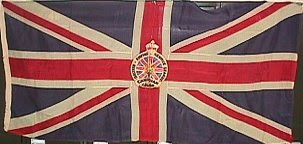
 Displayed at the Flag Day and Open House at the XII Manitoba Dragoons / 26th Field Regiment Museum in the Brandon Armoury.
Royal Canadian Legion branch flag


 Group of Canadians in Belgium with Royal Canadian Legion branch flag.
The Canadian government issued flags for two of the campaigns during World War I. The fifth campaign was the first to issue a flag bearing the 9-province arms. The five blue diagonal stripes represent the campaign - in this case the 5th. The sixth campaign used in lieu of the stripes the British Union flag and coincided with a visit by HM the Prince of Wales to Canada.


Raising the flag in 1919


 It began 23 October 1944 using the slogan "Invest in Victory - Buy One More Than Before". The flag measures approx. 8' long by 4 1/2' wide. It contains a Union Jack in the upper left-hand corner with a flaming sword over a 7 on a shield centring a white field.
0E9s37HliKBRBc(wmUW!~~60_57.JPG)


 This video clip contains footage of Ontario Premier Hepburn purchasing the first three Victory Bonds for his children. It also contains shots of a victory drive parade with floats carrying slogans such as “Let Us to the Task, Tools for Churchill” and “Help Finish the Job”, 1941. On the right, U.S. Radio stars Fibber McGee and Molly (James "Jim" and Marian Driscoll Jordan) at Victory Loan rally, Maple Leaf Gardens. Toronto, Canada with the badges of the nine Victory Loan campaigns in the background.
Pamphlets published in the Dominion of Canada during the Second World War
(click images to enlarge)
Flags of Empire


British Empire Service League (Canadian Legion)
Royal Canadian Legion branch flag
This artefact was originally used by the Canadian Legion in Pouch Cove. The flag is made from a very heavy wool material and has been constructed by the cutting, application, and sewing together of individual pieces of fabric. The main field of the flag is blue with a yellow horizontal strip running through it. Stamped in black ink on the yellow stripe is the text "Canadian Legion B.E.S.L Pouch Cove (NFLD No.4) Branch." In the upper right hand corner is the red, white, and blue British Union Flag. The flag is bordered on three sides by a heavy yellow wool fringe. The fourth side is made by folding over of material to form a loop through which to slide the flag pole. A hole has been worn in the upper centre of the flag.
 Group of Canadians in Belgium with Royal Canadian Legion branch flag.
The Canadian Legion was formed in my hometown of Winnipeg, Manitoba in November of 1925. The official name of the organization was the Canadian Legion of the British Empire Services League. The main goal of the Legion was to act as an advocate for the veterans of the Great War and to advise Government on issued relating to veterans. The Legion expanded to encompass the Canadian veterans of successive 20th century wars. On October 14 1949 the Canadian Legion amalgamated with the Newfoundland Great War Veterans association, itself a member of the British Empire Services League. The aim of the Great War Veterans Association was very similar to that of the Canadian Legion. In 1960 Queen Elizabeth II granted the Canadian Legion the prefix of Royal and their name changed to The Royal Canadian Legion.
Canadian Victory Loan Flags
From the Great War
Victory Loan Flag - Fifth CampaignThe Canadian government issued flags for two of the campaigns during World War I. The fifth campaign was the first to issue a flag bearing the 9-province arms. The five blue diagonal stripes represent the campaign - in this case the 5th. The sixth campaign used in lieu of the stripes the British Union flag and coincided with a visit by HM the Prince of Wales to Canada.


The 6th Victory Loan Campaign of the Great War
Victory Loan Flags were designed to reward those communities that made significant contributions to the Victory Bond campaigns. The population of a city, town or district must have purchased a certain value in Victory Bonds and upon reaching that target the citizens were rewarded with the presentation of a Victory Loan Honour Flag.In 1919 a new flag was commissioned for that year's campaign and it was decided to incorporate the heraldic arms of Prince of Wales, the future Edward the VIII, into the flag's design. The Prince visited Canada in September 1919 and raised the flag at Parliament on Labour Day weekend. The Prince’s remark "I hope every City and District will win my flag” became part of the poster campaign as seen in the image to the right.
http://www.archives.gov.on.ca/English/exhibits/posters/bonds.htm
I have sent regulation size drawings in to FOTW some time ago of all of the WWI and WWII Canadian Service and Honor flags as well as the US ones, but so far none have appeared on the web site. Here is attached also a new full-size drawing I did based on the photo on your web site of the Prince of Wales Honour Flag with two crests. As far as I can gather from the newspaper articles of the day, the additional badge for exceeding your quota could be any one of the Prince's three crests. However all I ever see mentioned are the "plumes" as they are referred to, which is exactly what appears in your photo. Dave Martucci, http://www.vexman.net/ and http://www.midcoast.com/~martucci/neva/

Raising the flag in 1919
World War II Victory Loan Flags
 During the Second World War, the nine Victory Loan campaigns used pledge flags, honour pennants, victory flags, investor pins, honour certificates, slogans, and considerable hoopla, all to great effect. The major change was the transformation of the honour flags of the First World War, awarded only upon attainment of the financial goal, into the pledge flags of the Second World War, awarded at the beginning of each campaign as a token of the community's commitment to fulfil its pledge. Of the same design as the 1919 honour flag, the pledge flags had a white field, a broad red border, the Union Flag in the canton, and a badge, which changed with each campaign, on the fly. The badge was also placed upon the honour pennants. These were awarded when the community or canvassing unit reached its quota. An additional honour pennant was given each time the quota was over subscribed by 25 percent. The first pennant showed the badge on a plain blue field; thereafter, the badge appeared on a white field with a red border. Each campaign lasted for twenty days [sic]. The beginning date, badge description, and slogan for each is as follows:

| Loan | Date | Badge | Slogan |
| 1 | 1941 Jun 2 | blue torch | Help Finish the Job |
| 2 | 1942 Feb 16 | blue maple leaf | Nothing Matters Now but Victory |
| 3 | 1942 Oct 19 | blue dagger on a shield | Come on Canada |
| 4 | 1943 Apr 26 | IV above four maple leaves on a shield | Back the Attack |
| 5 | 1943 Oct 18 | winged V on a shield | Speed the Victory |
| 6 | 1944 Apr 24 | winged VI on a shield | Put Victory First |
| 7 | 1944 Oct 23 | flaming sword over a 7 on a shield | Invest in Victory -Buy One More Than Before |
| 8 | 1945 Apr 23 | laurel around an 8 on a shield | Invest in the Best |
| 9 | 1945 Oct 22 | 9 over a pen on a shield | Sign Your Name for Victory |
1st Campaign
This was a Canadian flag of the early from June 2, 1941 connected with raising money for the war effort. It was the first in a series of nine Pledge Flags, each with a different badge, that were used in promoting the Victory Loan campaign. David Prothero, 27 September 2001

This WW II Canadian Victory Loan pledge flag with the Union Jack, blue shield and dagger on the white field, is from the 3rd campaign of WW II in Oct 1942 to raise funds for the war effort. The slogan for this campaign was "Come on Canada." It was the 3rd in a series of nine Pledge Flags, each with a different badge, that were used in promoting the Victory Loan campaign.
4th campaign
4th campaign

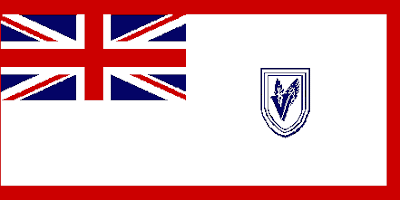
“Something new has been added for the Fifth Victory Loan campaign - a “V” Flag, to be awarded to Canadian plants whose employees do exceptionally well during the campaign. This flag will be awarded to those establishments where 90 per cent, or more of the employees invest 15 per cent or more of the monthly payroll in Victory Bonds or War Savings Certificates. Three stars will be affixed to the lower right hand corner of the flag. The flags were provided in two sizes 4ft.6in. by 9 ft. and 2ft.1in. by 4ft.2in. The larger size is No. 1 Admiralty bunting which will withstand outdoor conditions.”
Sixth Campaign

An
actual unaffixed flag shield, measuring 12 1/2-inches by 18 1/2-inches,
of fine quality woven cotton fabric holding a printed pattern variation
of the loan’s “Winged Six” in Roman Numerals, nicely displayed within a
blue bordered shield outline.
Pennant measuring 22 inches by 55 inches in length.
Seventh Campaign

The pledge flag on the right was flown in St. George during the Seventh Victory Loan. It began 23 October 1944 using the slogan "Invest in Victory - Buy One More Than Before". The flag measures approx. 8' long by 4 1/2' wide and contains a Union Flag in the canton with a flaming sword over a 7 on a shield centring a white field and a red border on three sides.


Approximately 4.5 x 9 feet, this flag was purchased from Vancouver, BC about a year and a half ago. The flag is soiled and stained and unfortunately lacks the badge which would have indicated which Victory Loan Drive it was originally from. Complete with faded "SS Holden Ottawa" manufacturer's tag. Originally sold on eBay by flagsofempire David Zaborowsk
In total, Canada had used 25 different flags and pennants to promote the sale of Victory Bonds during the two wars, all but two of them in the Second World War. They were very successful in accomplishing that goal, but they quickly fell into oblivion. After the wars they had outlived their original purpose and some of those which survived were turned to more prosaic uses. In the 1950s the Prince of Wales flag of 1919 was seen in Toronto being used as a counter cover, and in the town of Maple Creek, Saskatchewan, the Second World War pledge flags were tied together and strung across streets to block traffic during road construction. Sic transit gloria Canadæ
From the chapter entitled National Flags of Occasion from the book, The Flags of Canada by Alistair B. Fraser
Pamphlets published in the Dominion of Canada during the Second World War
(click images to enlarge)
Flags of Empire

Eight-page booklet of WW2 Flags published by Maple Leaf Milling advertising Red River Cereal.
Canada and the United Nations

20
pages, by Gutta, Percha & Rubber Co., lithographed in
Toronto, 19 countries listed with leader portraits and scenic
illustrations.
The Most Blessed Work in the World

12 page pamphlet extolling Canadians to subscribe to the Second Victory Loan/Victory Bonds.

Treaty #7 flag
Treaty #7 flag


