
1901
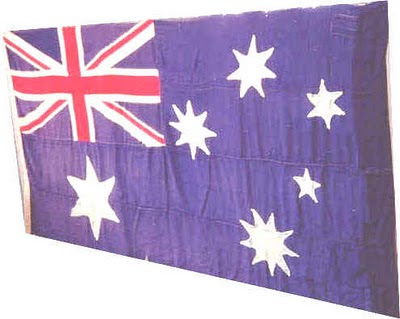
 This 1901 version flag (ensign) was later approved (with minor changes) in red and blue versions. The original concept was to represent the relative brightness of each star in the constellation with the stars of the Southern Cross having 9, 8, 7, 6 and 5 points. The Commonwealth Star, symbol of Australian Federation, had six points, representing the six States. The photo on the right shows the flag covering the grave of 'Breaker Morant' in South Africa during the Boer War taken in February 1902. That's probably before the King even approved the designs.
Merchant Ensign 1901
Current


From the State Library of New South Wales

Glorious WWII-era flag on sale from German Militaria. 87cm x 176cm multi-piece, double sided, cotton flag.


3 feet by 6 feet
Australian Centenary Flag (2001)

It is intended that the flag be a replacement for the 1901 flag which has been lost to the nation and commence a new tradition carrying with it the symbolism of the first flag. The flag would be known as the Centenary Flag. The flag would be maintained for all time as the Commonwealth's flag of state. The flag would be accompanied by a ledger to record each occasion on which it is flown. It is proposed that the flag have dimensions of approximately 3 metres by 1.5 metres and made of silk. It would have a special headband with a cardinal red stripe representing the thread of kinship that stands at the heart of the federation and an embroidered inscription formally recording the details of the re-enactment.
Department of Prime Minster and Cabinet
2 August 2001


 Australian red ensign from the "Lismore" (WWII Minesweeper).

1900 ensign with six-point star 33" x 68"


43 x 65 inches

Personal flag I picked up in Rome with bizarrely-arranged flags in the southern cross

On board the replica of the HMAS Endeavour and the spirit 2 Tasmanian ferry.


Flag measures approx 71" inches x 35" inches (6ft x 3ft).


Royal Australian Navy

 At first, Royal Australian Navy ships flew the British White Ensign from the stern, under the direction of the British Admiralty. Australian government ministers, along with their counterparts from other dominions such as Canada, had proposed in 1909 that a White Ensign defaced with a local symbol would be more appropriate, however the Admiralty insisted that the national flag flown from the jackstaff at the bow was sufficient to display the nationality of the ship.
By 1965, Australian forces were fighting in the Vietnam War, a war which did not involve the British, and a member of parliament questioned the appropriateness of using the ensign of another country. At the same time, it was reported in parliament that the Navy were looking for a distinctly Australian ensign. On considering the matter on 21 January 1966, the Naval Board recommended to the Government "that the Royal Australian Navy should have its own unique white ensign", a "white flag with the Union Flag in the upper canton at the hoist with six blue stars positioned as in the Australian flag". The new ensign was granted Royal Assent on 7 November 1966 and announced by the Prime Minister on 23 December 1966. The introduction of the ensign was brought forward from the originally planned date, 1 May 1967, to 1 March, when HMAS Boonaroo became the first ship to be commissioned under the Australian white ensign.


Royal Australian Air Force


RAAF Car Pennant
 Australian Civil Air Ensign

Inexplicable WWII RAN Ensign


By 1965, Australian forces were fighting in the Vietnam War, a war which did not involve the British, and a member of parliament questioned the appropriateness of using the ensign of another country. At the same time, it was reported in parliament that the Navy were looking for a distinctly Australian ensign. On considering the matter on 21 January 1966, the Naval Board recommended to the Government "that the Royal Australian Navy should have its own unique white ensign", a "white flag with the Union Flag in the upper canton at the hoist with six blue stars positioned as in the Australian flag". The new ensign was granted Royal Assent on 7 November 1966 and announced by the Prime Minister on 23 December 1966. The introduction of the ensign was brought forward from the originally planned date, 1 May 1967, to 1 March, when HMAS Boonaroo became the first ship to be commissioned under the Australian white ensign.


Australian White Ensign, 2 yards, made of a wool/nylon worsted mix. The Jack is sewn and the stars are appliquéd to the field. The flag was presumably a prototype (made in 1966 -a year before the adoption of the Australian White Ensign) and this flag has all of the original government contract stamps which are clearly legible. The lanyards were removed however this flag remains suitable for use as a sleeved flag on a pole 1 inch in diameter.


Battle Ensign size approx 6 x 3 feet...Cotton with laid on construction and clean.Genuine Government Issue with markings

Royal Australian Air Force
1948-1982
The RAAF was established in 1921. On 24 July 1922, the British Royal Air Force Ensign was approved as the ensign of the RAAF which was used until 1948 when the RAAF asked to change the flag to avoid confusion. A warrant for the new flag, which had the roundel in the lower fly of sky-blue ensign with Commonwealth Star and tilted southern cross to match the Australian national flag, was given in 1949. The RAAF adopted a distinctive roundel on 2 July 1956; a red kangaroo replacing the red circle of the British version. The old roundel remained on the ensign, however, until 1981, when Her Majesty The Queen approved the change to the current flag.
The Royal Australian Air Force Ensign is used by the Royal Australian Air Force in Australia and overseas. It is based on the Australian national flag, with the field changed to Air Force blue, and the southern cross tilted clockwise to make room for the RAAF roundel inserted in the lower fly quarter. The roundel is a red leaping kangaroo on white within a dark blue ring. The ensign was proclaimed as a Flag of Australia under section 5 of the Flags Act on 6 May 1982.
The southern cross is tilted so that Gamma Crucis stays in the same position as for the Australian National Flag and that Alpha Crucis is moved along the x-axis towards the hoist by one-sixth of the width of the flag. This results in the axis being rotated 14.036° clockwise around Gamma Crucis and each star is rotated in this way, although the constellation as an whole is not simply rotated.
The RAAF Ensign below was marched in and laid up in a solemn ceremony at the National Service Heritage Chapel to mark National Service Day in 2007. The hand-made silk flag, with gold fringes, was the gift of the National Servicemen’s Branch of the Royal Australia Air Force Association and honours the 23,500 men called up for service in the RAAF between 1951 and 1957. The President of the National Servicemen’s Branch of the RAAF Association, Bob Cotter, carried the Ensign in escorted by four Cadets. After kneeling at the altar, Cotter presented the Ensign to the Association’s State Padre, Dr.Noel Wallis, who draped it on the new altar table, blessed just before the Service. The RAAF Association’s Chaplain, Father Paul Goodland, then blessed the Ensign. http://www.nashoqld.org.au/Wacol_Church_Service_2006.html

Left: Hanging in the "Australian Corner" of St Mary-le-Bow, Cheapside, London.Centre: Royal Australian Air Force (RAAF) Amberley Catafalque Party present arms as the Air Force Ensign is lowered during the Air Force 88th anniversary celebrations held at Queen's Gardens, Brisbane city. Right: At a 2007 Anzac Day parade in Brisbane
 To celebrate the Royal Australian Air Force's (RAAF) 88th anniversary the RAAF Ensign was raised on the Canadian flag pole at Regatta point, Canberra. The Canadian Flagpole is located on the northern shore of Lake Burley Griffin at Regatta Point. It was given to Australia in 1955 by the Honourable C. D. Howe, Minister of Trade and Commerce, on behalf of the Government of Canada...The flagpole is from a single spar of Douglas Fir logged from a forest in the Canadian province of British Columbia...The flagpole is buried more than three metres underground and including this below-ground length, is a total of more than 39 metres in height. Each year on July 1, Canada’s national day, the Canadian flag can be seen flying from the flagpole. www.defence.gov.au

Satin Ceremonial (Factory Second)
RAAF Car Pennant


Australian Customs Service


The Australian Customs Flag is the flag flown by Australian Customs Service vessels and sometimes on ACS buildings. Any vessel acting in a customs capacity must fly this flag. The current version is an Australian National Flag with the word "CUSTOMS" added in bold between the Commonwealth Star and the lower part of the Southern Cross. This flag has been used since 1988.


1904-1988
The Customs Act 1901 was passed soon after federation, and like previous British and colonial legislation, required the use of a customs flag. The first flag appointed under this act was specified in Section 14 of the Customs Regulations, which were gazetted on 1901-10-01 in the Commonwealth of Australia Gazette No. 53, page 172:
"The Customs flag shall be the Blue Ensign, with the addition in the fly of the letters "HMC" in bold character, and the word 'Australia'".
An order in Council altered the regulations to remove the word "AUSTRALIA" from the flag.

Personal collection: Two flags (18ins x 30ins and 44ins x 24ins) made from a coarse lightweight cotton/hessian material with the Union flag and stars having been applied by machine in a white zigzag stitch and Union flag stitched on the back.
Australian Quarantine Flag

Commonwealth Lighthouse Service
Australian Quarantine Flag

Commonwealth Lighthouse Service


Red and blue ensigns

Australian War Service

Australian Honour Flag

http://www.australianaflags.com.au/default.php?content=flags/honourflag.html
This flag was created at the time of the First World War as a reward to recognise Australian towns and districts which subscribed twice their quota of funds for the Commonwealth Government's seventh war loan in 1918. The funds were used to help cover the costs of Australia's World War I expenditure.


The flag had numerous holes throughout due to insect damage and also several tears. It is also faded and stained. The flag was initially cleaned with a slight improvement. As the flag is so damaged it was decided that it required a full lining. A matching wool fabric was selected and pieces were dyed to match the red, blue and cream sections of the flag. Each section was lined and careful hand stitching carried out. The blue silk stripes were lined individually with matching blue silk again using a hand stitching-technique. On completion a photo of the flag was taken and the photo framed and returned to Mintaro District. Much of the stitching work undertaken on the flag was carried out by a volunteer Margaret Cusack shown here.
Prime Minister

Chief of Army
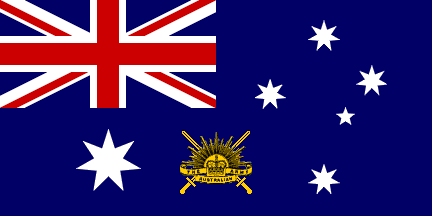
Australian Brigadier

Chief of Army

Australian Brigadier


http://www.diggerhistory.info/pages-flags/brigadier.htm
The Norforce Queen's colour


http://www.spearoffame.com/productrange.html
Governor General's Flag

Historic and State flags of Australia

Historic and State flags of Australia


 | Anti-transportation League - Formed in Launceston to oppose the transportation of convicts to Australia, the Australasian League for the Abolition of Transportation had established branches in several colonies by 1851. At a meeting held in Melbourne a large flag was unfurled - it was a British blue ensign upon which were four golden stars forming the Southern Cross. This is the first known flag using the Southern Cross in a natural arrangement and it is considered to be a significant antecedent to the current Australian National Flag. The original flag is in the collection of the Queen Victoria Museum and Art Gallery, Launceston. The League was dissolved when transportation to Tasmania ended in 1853. |

The flag was designed in 1849 by Reverend John West of Launceton, Tasmania, and from 1851 was used by the Australian Anti-Transportation League in the Australian colonies and in New Zealand. The League was formed in 1851 to campaign against the continuance of convict transportation to Australia and New Zealand. The flag of the League featured a gold Southern Cross on a Blue Ensign. A white border usually featured the League's name, year of institution and identified the colony in which it was flown. The five stars of the Southern Cross were said to represent the colonial settlements in Tasmania, Victoria, New South Wales, South Australia and New Zealand. The League's flag strongly resembles the Australian National Flag and its influence can be seen in the design of the flag of Victoria. (contributed by Blas Delgado Ortiz). This is the Tasmanian Local Version, cloth flag now in Queen Victoria Museum, Launceston
Murray River Flags
The Murray River is represented by two flags, each flag similar but based on different interpretations of the original description. The Upper Murray Flag has darker blue bands on its flag, representing the darker waters of the river's upper reaches. This design was also the house flag of the Murray River Steam Navigation Co. which suggests that it is a lineal descendant of the original flag design. The Lower Murray Flag, used predominantly in South Australia, is distinguished by the use of pale blue bands representing the lighter coloured water of the lower reaches of the Murray.
The flag was described by a reporter of the Australian Register:

Unidentified flag
Lower Murray River Flag


The Murray River is represented by two flags, each flag similar but based on different interpretations of the original description. The Upper Murray Flag has darker blue bands on its flag, representing the darker waters of the river's upper reaches. This design was also the house flag of the Murray River Steam Navigation Co. which suggests that it is a lineal descendant of the original flag design. The Lower Murray Flag, used predominantly in South Australia, is distinguished by the use of pale blue bands representing the lighter coloured water of the lower reaches of the Murray.
Upper Murray River Flag
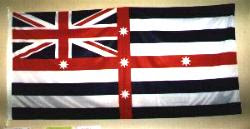

The Murray River Flag is flown from paddle steamers and other vessels in the Australian States of Victoria and South Australia that ply the waters of the Murray-Darling river system. Little is known about the flag's early history but it may have originated as far back as 1850 when the formation of the Murray River League was announced. RW Beddome, founder of the League, enthused "Up with the Murray flag." One of the earliest recorded references to the Murray River Flag was at Goolwa to honour the first paddlesteamer to go into service on the Murray River. The Mary Ann, built by three brothers William, Thomas and Elliot Randell, began her voyage from Mannum downstream to Goolwa on March 4, 1853. The Murray River Flag was hoisted upon their arrival.The flag was described by a reporter of the Australian Register:
The flag bears a red cross with four horizontal blue bars. The cross being charged with five stars as emblems of the Colonies while the upper corner, is taken up with British connections which is depicted by the Union Jack. It has been named, we understand, the Murray River Flag.It is believed that the blue bars represent the four major rivers that run into the Murray River, the Murrumbidgee, Lachlan and the Darling. The design bears a strong resemblance to other Australian flags of the 19th Century, such as the Australian Federation Flag and the National Colonial Flag for Australia.

Unidentified flag
View of the Murray River flag, suspended from the ceiling of the Signal Point cafe at Goolwa. The appearance of the River Murray flag is a matter of speculation, but it is generally accepted to comprise the Union Jack in the top left and the cross of St George in the top right with five white stars, representing the five Australian colonies, on the red of the cross. Below are four blue and four white horizontal stripes. It has been speculated that the four blue stripes represent the four rivers that make up the Murray-Darling system, the Murray, Darling, Lachlan and Murrumbidgee. Today, two flags are common – the Upper Murray flag and the Lower Murray flag. The blue bars of the Upper Murray flag are dark blue, representing the dark waters of that part of the river and those of the Lower Murray flag are pale blue, representing the blue, grey water of the lower reaches.
http://www.slsa.sa.gov.au/murray/content/didYouKnow/flag.htm
New South Wales
New South Wales Ensign/Federation Flag
 b
b
Wool bunting flag with a cotton hoist and cord halyard. The design is printed with the ends of the flag machine sewn. The top and bottom sides are selvedge edges. There are hand sewn repairs. The field is white with a blue cross overall bearing five white five-pointed stars. A Union flag is placed in the canton. The flag was originally designed by Captain John Nicholson in 1831 as a proposed New South Wales ensign. It was used as an unofficial merchant ensign until the Admiralty banned its use at sea in 1883. The flag was subsequently adopted by the Federation movement during campaigns to merge the six Australian colonies into a nation state. Although not adopted as the national flag in 1901, it continued in use until the 1920's.

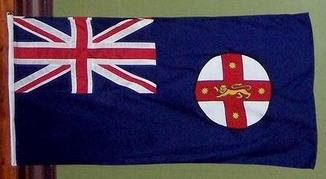
The flag of New South Wales was officially adopted by the government of New South Wales in 1876 and is a defaced British Blue Ensign with the state badge located in the fly. The badge is a white disc with the cross of St George by the Colonial Architect James Barnet and Captain Francis Hixson, a retired Royal Navy officer. Even though no meaning for the design was given, it is perhaps a simplified version of what was the semi-official arms of New South Wales at the time.. In the centre of the cross is a golden lion passant guardant and on each arm of the cross is an eight-pointed gold star. This flag was adopted due to criticisms from the British Admiralty that the previous design was too similar to the design of the Victorian flag.


 http://www.nla.gov.au/pub/nlanews/2002/feb02/article4.html
New South Wales was the only colony from Australia to take part at the World Columbian Exposition, in Chicago, 1893. Besides its flag can be seen the flags of the New South Wales ensign (also known as the 'Federation flag'), a white ensign with a blue St George's cross with five stars, what appears to be an early version of the Australian flag, and one at the immediate right which at the moment I can't properly identify (possibly Tasmania?).
Governor of New South Wales
Governor of New South Wales

 The New South Wales State Governor used the defaced Union Flag which changed to a defaced Blue Ensign in 1981.
 Above is Australian Vexillographer John Vaughan's artwork, which shows the St. Edward's crown sitting on the disk. The significance of this is that according to the Governor's office and John, this is the "official" drawing for the flag as John is the manufacturer for the NSW Governor's office where the Governor's flag is concerned.You may also recall the debate about whether of not a black ring should exist around any disk on an Australian state flag. Well, according to John, the ring should be there on the Governor's flag, and so it is on the actual flag. Clay Moss
New South Wales merchant shipping flag

New South Wales Police Service
In the early years of the 19th Century the name New South Wales was frequently interpreted as including most of the Australian Continent. In the 1830s Captain John Nicholson added two blue stripes to his New South Wales Ensign (later known as the Australian Ensign and then as the Federation Flag) and designated it a proposed merchant shipping flag for Australia. The Red Ensign remained the official merchant flag.
http://www.australianaflags.com.au/default.php?content=flags/nswmerchantshippingflag.php
New South Wales Police Service


Flag produced by Artelina
Flag provided by Clay Moss on the left, with the one on the right sold on eBay by flagsofempire:


I am an Ambulance Paramedic based in Newcastle NSW, and have been in the service since 1977. I am the manager of the Ambulance Service's Ceremonial Guard, which we established in 1988. We are a volunteer unit staffed by serving officers, and are based in Newcastle. In regards to information on the usage of our flag, it is indeed in use constantly with the Ceremonial Guard. We carry it with the state and national flags as well as city flags on Anzac Day, Vietnam Veterans Day and other civic functions. It was used and still is at serving and retired officers funerals although recently the national flag is allowed us at funerals. John Playford
Maritime Services Board of New South Wales

The Maritime Services Board was established on 1 February 1936 (1) under the Maritime Services Board Act, 1935 which received assent on 10 December 1935. (2) The creation of the Board followed the recommendations of the Maritime Services Co-ordination Board. The functions of the Board were the administration of ports and port facilities such as wharves, pilotage services, the conservation of navigable waters, ensuring the safety of passengers and seaworthiness of vessels registered in New South Wales or operating solely in New South Wales and with ensuring that vessels operating in New South Wales are manned by duly qualified persons. The flag is a British blue ensign defaced with the badge of the Maritime Services Board of NSW. The badge features a gold ship in the middle of a southern cross made up of four gold five-pointed stars, all on a red disc with a blue and gold border. Below the disc is a ribbon with the words "THE MARITIME SERVICES BOARD OF N.S.W".

The flag of Queensland is a British Blue Ensign defaced with the state badge on a white disc in the fly featuring a light blue Maltese Cross with an imperial crown in the centre of the cross. The flag dates from 1870, with minor variations, and the badge was designed by William Hemmant, the Colonial Secretary and Treasurer of Queensland in 1876. This particular example uses the wrong shade of blue for the cross.


 Governor's flag

In Queensland, the Governor still flies the Union Jack with its badge in a laurel wreath in the centre of the Saint-George's cross. Queensland is the only state to still do this. The right shows the standard flying from his Rolls Royce.

Queensland branch of the Royal Flying Doctor Service of Australia
Royal Queensland Regiment
 The Queen's and Regimental colours of the Royal Queensland Regiment surmounted by the Regimental hat badge below which are shown the 9th Battalion, 25/49th Battalion, 31st Battalion and the 42 Battalion flags.
poster sold at http://www.heritagemedals.com.au
South Australia The first flag of South Australia was adopted in 1870. It too was a defaced British Blue Ensign, but with a black disc in the fly containing the Southern Cross and the two pointers (Alpha and Beta Centauri).
1876-1904
 Colonial ensign of South Australia used from 1878 to 1904. It is made of wool bunting, machine stitched at the ends with the upper and lower sides selvedged. The whole design is printed. The linen hoist is marked 'M.P.' in ink and a cord is attached for hoisting. The flag is a blue ensign defaced with the circular badge of the colony in the fly. This depicts a standing Britannia holding a shield with the British Royal arms and extending a hand to a seated Australian Aboriginal with a spear. A kangaroo is carved on the rock behind. In 1904, Britannia was replaced by a badge showing a local bird - the piping shrike, in heraldic form.

 The first flag of South Australia was adopted in 1870. It too was a defaced British Blue Ensign, but with a black disc in the fly containing the Southern Cross and the two pointers (Alpha and Beta Centauri).
1876-1904

South Australia then adopted a second flag in 1876, also a Blue Ensign, with a new badge. The badge design was an artistic rendition of the arrival of Britannia (a woman in flowing garb and holding a shield, representing the new settlers) meeting an Aboriginal sitting with a spear on a rocky shoreline. A kangaroo appears to be carved into the rocks behind the Aboriginal. This flag was adopted after a request from the Colonial Office for a new design over the old one due to its similarity to the flags of New Zealand and Victoria.


.jpeg)


Governor's Flag


Tasmania
Van Diemen's Land Ensign

Current Flag


Tasmania Stitched Flag, 6x3ft, MoD fabric.
Former Tasmanian Red Ensign


Apparently the red ensign of 1875

Governor's Flag

The Tasmanian State Governor's flag was changed to a slight variation of the State Flag, with the addition of the St. Edward's Crown above the fly badge in February 1977, after the South Australian governor made a similar change. Ralph Bartlett
Victoria


The flag of Victoria is a British Blue Ensign defaced by the state badge of Victoria in the fly consisting of the Southern Cross topped by an imperial crown, which is currently the St Edward's Crown. The stars of the Southern Cross are white and range from five to eight points with each star having one point pointing to the top of the flag. The flag dates from 1877, with minor variations, the last of which was in 1953.
Standard of the Governor of Victoria

 Victoria Police Ensign
 Victoria Police ensign, made from Bemberg silk and edged with silver twist fringe, held in the main Chapel of the Victoria Police Academy in the eastern suburbs of Melbourne, Victoria, Australia. The badge itself is hand embroidered with gold and silver bullion silk thread.


Western Australia
1870-1953


The first flag of Western Australia was adopted in 1860 and is almost identical to the current flag of Western Australia. The only difference is that the swan was facing the opposite direction towards the fly rather than towards the hoist. The direction of the swan was changed to conform to the vexillological guideline that animals on flags must face the hoist, so when carried on a pole, the animal faces the same direction of the bearer.
Current flag

 The Western Australian State flag is a blue ensign with the addition of the State badge of a black swan on a gold circle symmetrically placed between the second and fourth quarters with the swan swimming towards the hoist. It is clearly based on the British Fire Service Flag used in World War Two:
 http://www.webace.com.au/~lowpress/brigadeflag.htm
Supposed Australian Antarctic Territory flag
cE9s4PsNiSBRQe2Q!c-!~~60_57.JPG)
Unrecognised Australian Secessionist States and Micronations
Dominion of Westralia

 Matthew Lewis Moss, H.K. Watson, James MacCallum Smith and Sir Hal Colebatch at London's Savoy Hotel in 1934 displaying the flag for a proposed Dominion of Westralia. The delegation was attempting to convince the British Government for the right for Western Australia to secede from the Australian federation.
Province of Bumbunga

 The Province of Bumbunga was an Australian secessionist micronation located on a farm near Snowtown and Lochiel, (northeast of Adelaide), South Australia during the 1970s and 1980s. The Province was founded by Alex Brackstone, a former circus monkey-trainer, uranium prospector and postmaster who, was determined to do his part to ensure that at least part of the Australian landmass would remain eternally loyal to the Crown.The Commonwealth of Caledonia Australis
 The Commonwealth of Caledonia Australis is a secessionist movement denying the authority of the Government of Australia on grounds of extremely questionable legal reasoning.
Norfolk Islanders of Pitcairn Descent Flag

Dominion of New Zealand


Surviving example of the 1899 version of the flag, 170cm x 90cm; personal collection
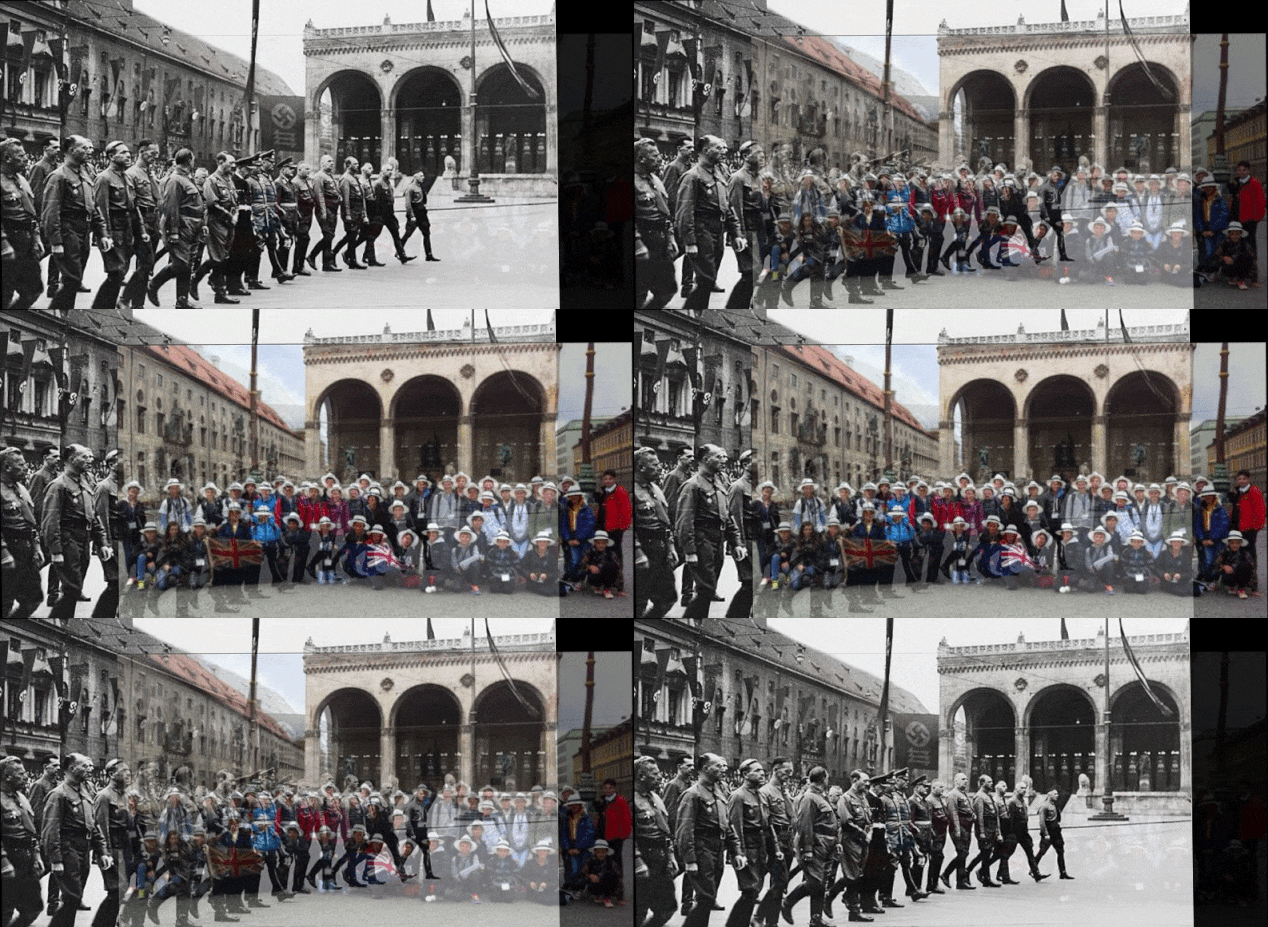 Paying honour to it during a Third Reich tour I gave for the Tauranga International School (with American-made military honour flag on right)

Victoria


The flag of Victoria is a British Blue Ensign defaced by the state badge of Victoria in the fly consisting of the Southern Cross topped by an imperial crown, which is currently the St Edward's Crown. The stars of the Southern Cross are white and range from five to eight points with each star having one point pointing to the top of the flag. The flag dates from 1877, with minor variations, the last of which was in 1953.
Standard of the Governor of Victoria
Governor's Flag
GOVERNMENT HOUSE PRESS RELEASE
18 APRIL 1984
His Excellency the Governor, Rear Admiral Sir Brian Murray, today announced that Her Majesty The Queen had graciously approved of a change in the Personal Standard of the Governor of Victoria. From this day, the Governor's Personal Standard will be the State Flag of Victoria with the blue of the flag being replaced by gold. The new Standard will be flown at Government House and on vehicles conveying the Governor. The old Standard used by all Victorian Governors has been, since 1870, the Union Jack with the Badge of the State emblazoned in the centre thereof.GOVERNMENT HOUSE PRESS RELEASE
18 APRIL 1984
 Victoria Police Ensign
 Victoria Police ensign, made from Bemberg silk and edged with silver twist fringe, held in the main Chapel of the Victoria Police Academy in the eastern suburbs of Melbourne, Victoria, Australia. The badge itself is hand embroidered with gold and silver bullion silk thread.
Western Australia
1870-1953

The first flag of Western Australia was adopted in 1860 and is almost identical to the current flag of Western Australia. The only difference is that the swan was facing the opposite direction towards the fly rather than towards the hoist. The direction of the swan was changed to conform to the vexillological guideline that animals on flags must face the hoist, so when carried on a pole, the animal faces the same direction of the bearer.
Current flag

The state flag of Western Australia made of synthetic and wool bunting
with a cotton hoist. It is entirely machine-sewn with a cord for
hoisting attached. The flag is blue with a Union Flag in the canton.
There is a circular cotton badge in the fly with a black swan on a
yellow background. A maker's label is attached inscribed: 'TUDALUX.
Another flag from TUDOR HOUSE, 286 Albany Highway, Victoria Park.
Telephone 361 1620 [pencil] 6 x 3 WA'. The flag was acquired with items
for an America's Cup display in 1986.
When the colony of Western Australia first adopted the flag in 1870, the
swan faced away from the hoist. As this was felt to be heraldically
incorrect, its direction was changed in 1953 when the present design was
adopted.
Governor's Flag 1953-1988 and Current


Western Australia Fire Service Ensign
Western Australia Fire Service Ensign
 The Western Australian State flag is a blue ensign with the addition of the State badge of a black swan on a gold circle symmetrically placed between the second and fourth quarters with the swan swimming towards the hoist. It is clearly based on the British Fire Service Flag used in World War Two:
 http://www.webace.com.au/~lowpress/brigadeflag.htm
 Supposed Australian Antarctic Territory flag
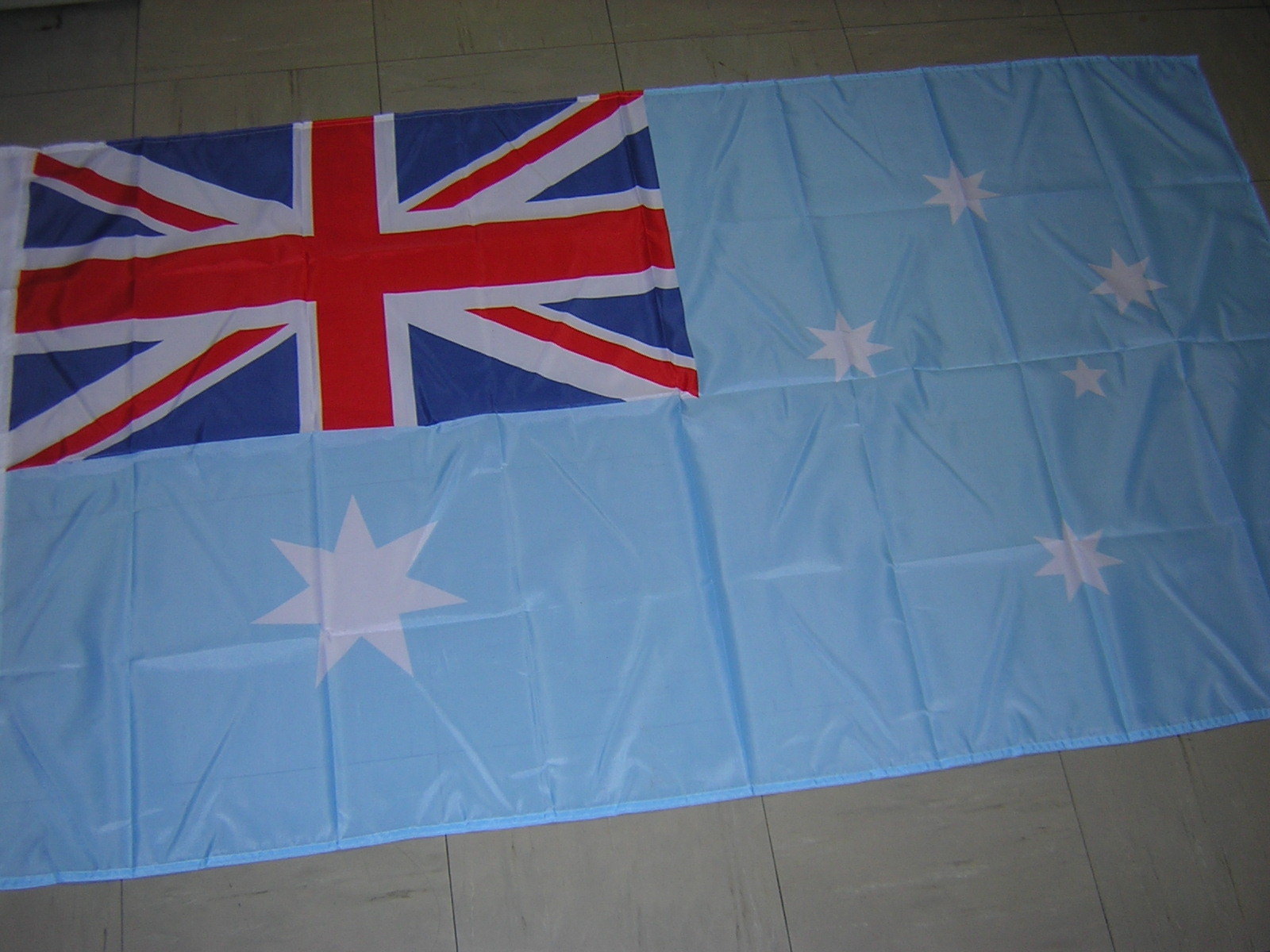
Unrecognised Australian Secessionist States and Micronations
Province of Bumbunga
 The Commonwealth of Caledonia Australis is a secessionist movement denying the authority of the Government of Australia on grounds of extremely questionable legal reasoning.
http://en.wikipedia.org/wiki/Commonwealth_of_Caledonia_Australis
Norfolk Islanders of Pitcairn Descent Flag

In 1985 the Society of Descendants of Pitcairn Settlers of Norfolk Island adopted the pre 1801 Queen Anne Red Ensign, featuring a Norfolk Island pine tree in a white circular badge. In 1987 the descendants' flag was raised aboard HMAV Bounty Replica. The original ship Bounty sailed under the old British Red Ensign. In an act of reconciliation the flag of the Norfolk Islanders of Pitcairn Descent was hoisted, not only by the descendants of the mutineers, but also by the descendants of Captain William Bligh.
http://www.australianaflags.com.au/default.php?content=flags/norfolkislandflag.html


Surviving example of the 1899 version of the flag, 170cm x 90cm; personal collection
In 1887 the British Board of Trade set up a committee to revise the International Code of Signals. Details of the revised code, due to come into use on 1st January 1901, were published in 1898. It continued the existing practice that, "A ship wishing to make a signal hoists her ensign with the code flag under." A new ensign was introduced to identify British colonial merchant ships, a white circle in the fly of the Red Ensign, with the badge of the colony inside the circle.
The Nautical Adviser to the New Zealand Marine Department recommended that four red stars should be set in the circle on the Red Ensign, and a similar badge used on the Blue Ensign. The New Zealand Government agreed to this, and a request for approval of the ensigns was forwarded to London on 5th July 1898 by the Governor, the Earl of Ranfurly. The ensigns were authorised by an Admiralty Warrant dated 7th February 1899, announced in the New Zealand Gazette on 23rd November 1899, and came into use on 1st January 1900. The white circle on the image of the blue ensign by Sam Lockton is possibly a little over-size. The Red Ensign version is similar.
Although intended only for use at sea, the ensigns were also flown on land. William Hall-Jones, Minister of Public Works, and also Minister of Marine, wrote to the Secretary of Public Buildings, and to the Secretary of the Marine Department, "I think it should be clearly understood that the New Zealand flag is that which has been used for so many years (without the disc) and that the Blue and Red Ensigns with the white disc are simply signal flags used to indicate that the vessel is a Colonial one."
On 6th July 1900, questions were asked in Parliament; why had these flags been introduced, and by whose authority? Sir Richard Seddon, the Premier, explained that the government had been persuaded to fall in line with the practice in other colonies. However the flags were being harmed, by their use in commercial advertising, and he proposed to introduce a Bill, re-instating the previous flag, and regulating its use.

 The flag of New Zealand is a defaced Blue Ensign with the Union Jack in the canton, and four red stars with white borders to the right. The stars represent the constellation of Crux, the Southern Cross, as seen from New Zealand. Personal Collection- American military flag.
4 feet by 6 feet sewn cotton flag by Dettra


Civil Ensign

Glorious WWII-era flag on sale from German Militaria. A 66cm x 138 cm, multi-piece constructed, double sided flag. The white cotton bunting is marked "1 ½ yd NZ Red Ensign" with a white manufacture tag for "Hutcheson Wilson".


 Personal collection: Made of a woven material and has 2 inglefield clips for hoisting, the flag measures 103"x 49"
135" (343cm) x 70" (180.5cm), weight approx 1.3 kilos
Royal New Zealand Navy
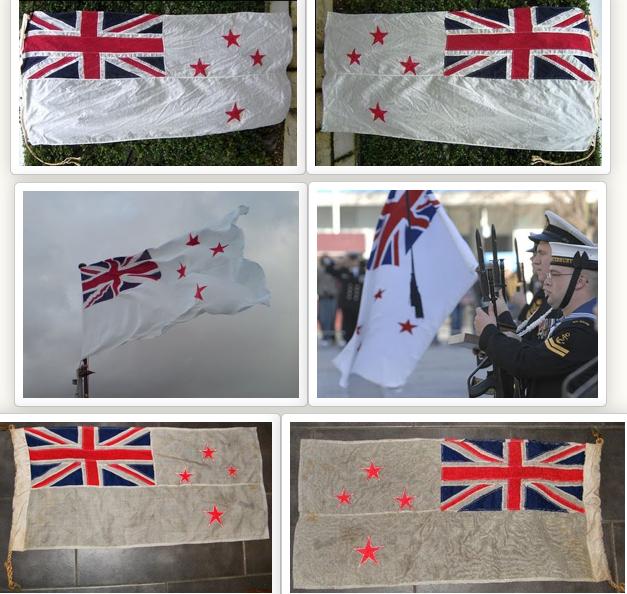
The seller of this 2 1/2 feet by 18 inch ensign claims that this flag is of "(a)lmost certain to be of WW2 vintage" when the flag design itself only dates from 1968.
All ships and establishments of the Royal New Zealand Navy wear the New Zealand White Ensign, which is derived from the White Ensign of the Royal Navy. With one exception the White Ensign is not permitted to be used or worn by other organisations and can only be paraded with the approval of the Chief of Naval Staff. white ensign All ships and establishments of the Royal New Zealand Navy wear the New Zealand White Ensign, which is derived from the White Ensign of the Royal Navy. With one exception the White Ensign is not permitted to used or worn by other organizations and can only be paraded with the approval of the Chief of Naval Staff. From the 17th Century until 1864 the Royal Navy was divided into three squadrons, the Red, White and Blue, and each wore an ensign of the appropriate colour. This system was discontinued in 1864 when the White Ensign was adopted for use by the Royal Navy, the Red Ensign allocated to the Merchant Service and the Blue Ensign assigned for government use. The use of the Blue Ensign includes Fleet auxiliaries and ‘defaced’ was used widely by colonies and dominions as a national flag. His Majesty the King granted the Royal Navy a special Colour, similar in concept to the Regimental Colours of the Army in 1924, a privilege that was extended to the New Zealand Division of the Royal Navy, as the New Zealand Naval Forces were then known, in 1926. Subsequently Sovereign’s Colours were presented by King George VI in 1936, Queen Elizabeth in 1953, 1970 and 1991.
 The first New Zealand naval units were vessels which saw service in the New Zealand Wars. These all wore the Union Flag as an ensign. When the New Zealand Naval Forces were established under the Defence Act of 1913, an Agreement[2] was reached with the Admiralty that New Zealand ships would wear the same ensign and jack[3] as ships of the Royal Navy. This Agreement was the authorisation for His Majesty’s New Zealand ships to wear the White Ensign, as was the case with HMS Philomel, commissioned into the New Zealand Naval Forces in July 1914. It is unclear, however, whether or not Philomel wore a New Zealand national flag in addition to these. Certainly from 1921, units of the New Zealand Division wore the New Zealand national flag as a jack. During the 1920s New Zealand ships began wearing the New Zealand national flag as a jack, although there seems to be no consistency either between ships, or even within the same ship during different commissions. Certainly, by the 1930s the New Zealand flag was customarily worn as a jack. At sea, however, a jack is not usually worn and the White Ensign did not provide a sufficient display of the national identity, particularly in baffle. Even during the First World War HMS New Zealand wore the New Zealand national flag when in action (there is no information on whether or not Philomel did, although I suspect that she did not). During the Second World War New Zealand ships wore the National Flag in addition to Baffle Ensigns. The granting of the title Royal New Zealand Navy to the New Zealand Naval Forces in 1941, was essentially an incidental matter at the time, albeit one of some significance from an historical perspective. With this view, it is understandable that there was no discussion of changing ensigns at the time. Throughout the remainder of the Second World War RNZN ships fought under the White Ensign as they did in Korea and during Confrontation in Malaya. Early documentation on discussions in respect of the development of a distinctive white ensign for the RNZN is particularly sparse. It would seem that the spark for the change was the introduction of the Australian White Ensign by the Royal Australian Navy in 1967. The White Ensign continued to be worn by New Zealand naval vessels until 1968. The question of a distinctive New Zealand White Ensign was addressed. Mr E.W.Jones of the Hydrographic Branch was invited to propose a suitable design and drawing of a New Zealand White Ensign. Following consultation with the Admiralty, the proposed New Zealand White Ensign was submitted to Her Majesty the Queen for approval, which was given on June 20, 1968. This is seen as an important milestone in the development of Royal New Zealand Navy. In 1971, on the centenary of the foundation of the Royal New Zealand Yacht Squadron, its Flag Officers were graciously granted permission to wear the New Zealand White Ensign, the only non naval organisation to be granted this honour.
All ships and establishments of the Royal New Zealand Navy wear the New Zealand White Ensign, which is derived from the White Ensign of the Royal Navy. With one exception the White Ensign is not permitted to be used or worn by other organisations and can only be paraded with the approval of the Chief of Naval Staff. white ensign All ships and establishments of the Royal New Zealand Navy wear the New Zealand White Ensign, which is derived from the White Ensign of the Royal Navy. With one exception the White Ensign is not permitted to used or worn by other organizations and can only be paraded with the approval of the Chief of Naval Staff. From the 17th Century until 1864 the Royal Navy was divided into three squadrons, the Red, White and Blue, and each wore an ensign of the appropriate colour. This system was discontinued in 1864 when the White Ensign was adopted for use by the Royal Navy, the Red Ensign allocated to the Merchant Service and the Blue Ensign assigned for government use. The use of the Blue Ensign includes Fleet auxiliaries and ‘defaced’ was used widely by colonies and dominions as a national flag. His Majesty the King granted the Royal Navy a special Colour, similar in concept to the Regimental Colours of the Army in 1924, a privilege that was extended to the New Zealand Division of the Royal Navy, as the New Zealand Naval Forces were then known, in 1926. Subsequently Sovereign’s Colours were presented by King George VI in 1936, Queen Elizabeth in 1953, 1970 and 1991.

Royal New Zealand Air Force

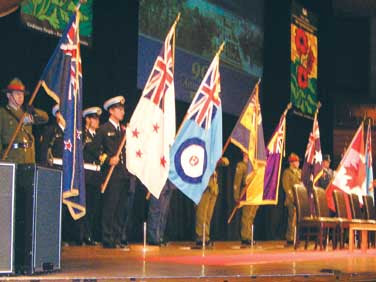

Right: Corporal Chris Watty raises the Royal New Zealand Air Force ensign to commemorate its 71st anniversary.

Civil Air Ensign

Bruce Berry Collection
New Zealand has used an analogue to the British Civil Air Flag, to be used by «British aircraft registered in New Zealand». This flag was adopted for use on 16 November 1938. It is identical to the British Civil Air Flag, a light blue air force ensign with a dark blue cross, fimbriated white, except that it adds four red five-pointed stars in the shape of the Southern Cross in the lower fly quarter. It has generally fallen into disuse in favour of the national flag. Stuart ParkGovernor (1908-1936)


New Zealand Ensign Presented to the Terra Nova by the Pupils of Lyttelton District High School During Scott's second expedition (1910—12), his ship Terra Nova put into Lyttelton, New Zealand, to repair a leak. A local school made a collection for the expedition and presented the ship with a New Zealand ensign with the additional inscription 'L.D.H.S. (Lyttelton District High School) TO TERRA NOVA'.
New Zealand police ensign


New Zealand Fire Service ensign
 The Fire Service Ensign is used at major Fire Service stations. Sam Lockton
New Zealand Ministry of Transport

Queen's New Zealand Colour of the Officer Cadet School


 During Scott's second expedition (1910—12), his ship Terra Nova put into Lyttelton, New Zealand, to repair a leak. A local school made a collection for the expedition and presented the ship with a New Zealand ensign with the additional inscription 'L.D.H.S. (Lyttelton District High School) TO TERRA NOVA'.
New Zealand police ensign


This ensign consists of a Royal Blue flag proportioned 1:2. The New Zealand National Ensign appears in the canton. In the fly of the flag is the New Zealand Police Seal coloured silver-grey. The seal consists of the Queen’s Crown surmounting three inter linked letters ("NZP" for New Zealand Police). The letters are surrounded by two silver ferns. This flag is flown outside all police stations in New Zealand. It flies beneath the New Zealand Blue Ensign on National Holidays, and is draped upon the caskets of Police Officers killed in the line of duty.
Dean Thomas

New Zealand Fire Service ensign
 The Fire Service Ensign is used at major Fire Service stations. Sam Lockton
New Zealand Ministry of Transport
Queen's New Zealand Colour of the Officer Cadet School

Queen's Colour for Royal New Zealand Navy

Proposed Flags of North Island and South Island

 Maori flags


The Red Ensign was (and is) widely used by Maori on land. The specific provision in New Zealand’s current flag legislation permits its use on land and the defacing of the flag, in a Maori context only. This sanctions the long-standing custom of applying white capital letters identifying the particular family or tribal group whose flag it is. There are many examples, old and current — one example in a photo to hand reads «TAKITIMU» — which is the name of one of the ancestral canoes, and thus of a grouping of tribes who are descended from its crew.
Flag of Australasian Team, 1908 and 1912 Olympic Games

During the early days of the Olympic Movement, Australia and New Zealand were represented jointly by one IOC member for "Australasia". They even competed as a joint Australasian team, during the Olympic Games of 1908 and 1912, using a special Australasian flag. Unfortunately, it's not clear whether this was a team flag only, or whether it was also used by the organisations of the Games to represent Australasia. A photograph taken at London 1908 shows that, at least during the Parade of Flags, Australia was represented by its own flag.
http://www.crwflags.com/fotw/flags/oly@stor.html


